وَلَا تَحْسَبَنَّ الَّذِينَ قُتِلُوا فِي سَبِيلِ اللَّهِ أَمْوَاتًا ۚ بَلْ أَحْيَاءٌ عِندَ رَبِّهِمْ يُرْزَقُونَ
Translation: “And do not think of those who are killed in the path of Allah as dead. Rather, they are alive, receiving sustenance from their Lord.”
— Surah Aal-Imran (3:169)
Biography
| Name: |
Hussain ibn Ali ibn Abi Talib (AS) |
| Kunyat: |
Aba Abdillah |
| Alqabat: |
Sayyid al-Shuhada (Leader of the Martyrs), Imam Mazloom (The Oppressed Imam) |
| Father: |
Imam Ali ibn Abi Talib (AS) |
| Mother: |
Sayyida Fatima Zahra (SA) |
| Grandfather: |
Prophet Muhammad (SAW) |
| Birth: |
3rd Sha’ban, 4 AH — Madinah |
| Martyrdom: |
10th Muharram, 61 AH — Karbala |
| Shrine: |
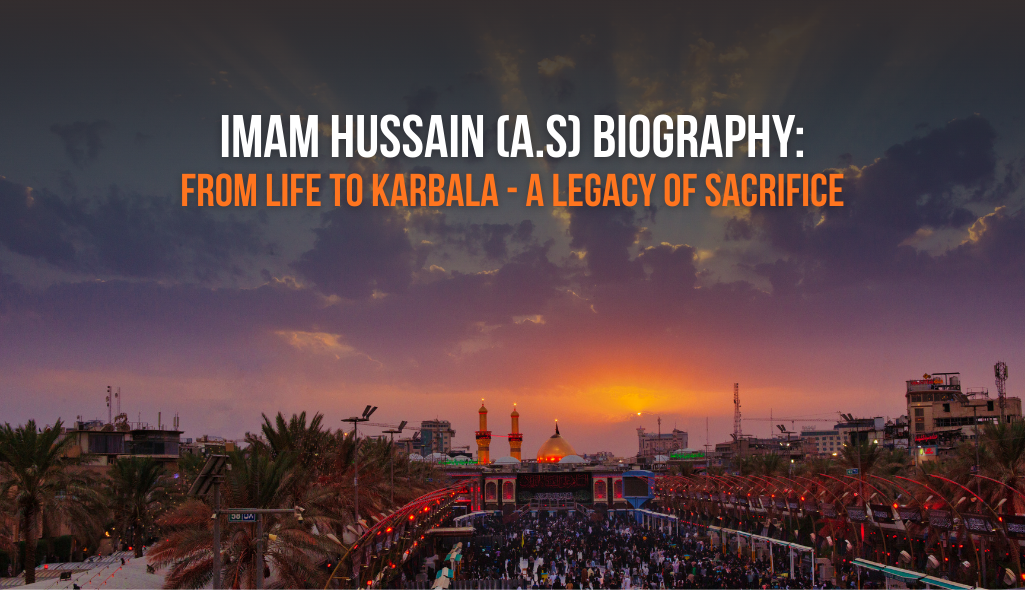
Karbala, Iraq |
| Wives: |
Umm e Rubab (SA), Bibi Shahrbanu (SA) mother of Imam Zain ul Abideen (AS), Umm e Laila |
| Children – Sons: |
Imam Zain ul Abideen (Ali ibn Hussain) (AS), Ali Akbar (AS), Ali Asghar (AS) |
| Children – Daughters: |
Sayyida Sakina/Ruqayyah (SA), Fatima Kubra (SA), (Some sources mention Fatima Sughra) |
| Full Siblings: |
Imam Hasan (AS), Zainab al-Kubra (SA), Umm Kulthum (SA) (from Fatima Zahra SA) |
| Half Siblings: |
Hazrat Abbas (AS), Muhammad ibn al-Hanafiyyah (AS), and others (from other wives of Imam Ali AS) |
Background and History Before His Birth
Before Imam Hussain (AS) entered this world, the heavens and earth were already prepared for his arrival. His birth was not an ordinary moment but a divinely orchestrated chapter in the story of guidance.
Heavenly Signs Before His Birth
When Sayyida Fatimah (SA) conceived Imam Hussain (AS), the Prophet Muhammad (SAW) was informed through divine revelation that a grandson would be born whose blood would awaken a sleeping ummah.
Angel Jibrael Brings the Soil of Karbala
According to Kamal al-Ziyarat, Khasais al-Hussain, and Bihar al-Anwar, the following event occurred:
Angel Jibrael descended with a handful of reddish soil and said:
“O Messenger of Allah, this is the earth where your grandson will be slain. Its name is Karbala.”
The Prophet (SAW) smelled the soil, pressed it to his blessed chest, and his tears began to fall. This soil was kept safely by Umm Salamah, and she later said: “Whenever the soil turned into blood, I knew Hussain (AS) had been martyred.” This was a sign given decades before Karbala happened.
Khak-e-Shifa (Earth of Healing)
The term Khak-e-Shifa (or Turbah al-Hussain) literally means “Earth of Healing” and refers to the sacred soil from the area surrounding the grave of Imam Hussain (AS) in Karbala, Iraq. It holds immense spiritual and ritualistic significance in Shia Islam.
Key Points on Khak-e-Shifa:
1. Source of Healing (Shifa): The dust of Imam Hussain’s shrine is a cure for every ailment except death. This healing power is believed to be both for physical diseases and for spiritual ailments of the soul. Imam Ja’far al-Sadiq (AS) narrated that three things were granted to Imam Hussain (AS):
- Prayers (Dua) under his dome are answered
- The Earth (Turbah) of his shrine has healing power (Shifa)
- The Imamate continues in his progeny
2. Ritualistic Use:
- Prostration (Sajdah): Performing prostration during prayers on Khak-e-Shifa symbolizes humility and connects the worshipper to the sacred soil where the Prophet’s grandson was martyred
- Tasbih (Rosary): Rosary beads made from Khak-e-Shifa carry great reward
- Consumption: For seeking cure, consumed in very small quantity with specific supplications
3. Divine Origins and Foreknowledge: The Angel Jibrael presented the soil of Karbala to the Prophet (SAW) years before the event. The Prophet gave some to Umm Salamah, who was told it would turn to blood when Imam Hussain (AS) was martyred.
Prophet (SAW) Weeps at the Birth of Hussain (AS)
When Imam Hussain (AS) was born, the Prophet (SAW) held the newborn in his arms. At that moment, Jibrael descended again and reminded him of the tragedy awaiting this child. The Prophet (SAW) looked at the innocent face of his grandson and began to cry.
Sayyida Fatimah (SA) asked, “Father, why do you cry? This is a moment of joy.”
The Prophet replied: “Fatimah, this child of mine will be slain in a land called Karbala. A group from my nation will not respect him, will not support him, and will shed his pure blood.”
Hearing this, Fatimah (SA) began to cry as well. Imam Ali (AS), witnessing this moment, cried silently because Allah had already informed him of the same tragedy. Thus, the story of Karbala began before Hussain (AS) even opened his eyes.
Formative Years of Imam Hussain (AS)
Imam Hussain (AS) grew up in the pure household of the Prophet Muhammad (SAW), shaped by love, knowledge, and divine guidance. His early years were spent constantly in the presence of:
1. The Prophet Muhammad (SAW)
He carried Hussain (AS) on his shoulders. He taught him mercy, justice, and courage. He repeatedly declared Hussain (AS) as “Sayyid of the youth of Paradise.” These moments deeply formed his spiritual character.
2. Imam Ali (AS)
Hussain (AS) learned bravery, wisdom, leadership, and truthfulness from his father. Watching Imam Ali (AS) govern with justice shaped Hussain’s understanding of what real Islamic leadership means.
3. Bibi Fatima (SA)
He absorbed her purity, patience, modesty, and unmatched devotion to Allah. Her teachings molded his compassion and his emotional strength.
Imam Hussain’s formative years were built on: Prophetic training, Ahlulbayt values, early lessons in justice and patience, and a commitment to protect Islam at any cost. These early foundations shaped him into the symbol of sacrifice, courage, and truth that the world remembers today.
Why Did Imam Hussain (AS) Leave Madinah?
Imam Husayn (AS) left Madina on 8 Rajab because Marwan’s threat proved that Yazid’s regime wanted either forced allegiance or his death—and Imam chose neither silence nor submission. Imam Hussain (AS) refused to give bay’ah (allegiance) to Yazid because:
- Yazid was an unjust, immoral, and oppressive ruler
- Giving him bay’ah would mean supporting tyranny and the destruction of Islam
So Imam Hussain (AS) left to protect the true message of Islam, not for power or war.
The Journey to Karbala
He first traveled from Madinah → Makkah. From Makkah, he intended to go towards Kufa because thousands of letters came from the people of Kufa inviting him to lead them. However, on the way, Yazid’s army blocked and surrounded him. They forced him to stop in the desert land of Karbala on 2nd Muharram, 61 AH.
Was it Imam Hussain’s Wish to Come to Karbala?
(a) Outwardly (Zahiri): He did not choose Karbala as his travel destination. He was heading toward Kufa, but Yazid’s army forced him to stop in Karbala.
(b) Inwardly (Batini / Divine Knowledge): Imam Hussain (AS) knew through the Prophet (SAW) and divine inspiration that Karbala would be the place of his martyrdom, and his sacrifice would save Islam. So he accepted the path with full willingness because it was Allah’s decree and part of the divine mission.
Was Imam Hussain Forced?
Yes – in terms of physical circumstances, he was forced: His caravan was stopped, access to water was cut, and he was surrounded by thousands of soldiers.
But in terms of intention, he was not forced: He chose to stand for truth, refused humiliation, and willingly embraced martyrdom for the sake of Islam.
Night of 27/28 Rajab: The Incident with Marwan
Yazid’s Order
Upon the death of Mu’awiya in Rajab, the new ruler Yazid sent an urgent, harsh letter to the governor of Madina, Al-Walid, demanding that Imam Hussain (AS) immediately pledge allegiance. Some sources indicate the letter ordered the Imam’s execution if he refused.
Imam’s Caution
Walid summoned the Imam at night to keep the demand secret and pressure him. Imam Hussain (AS), aware of the danger, called upon the young men of Banu Hashim (including Hazrat Abbas) and gave them clear instructions. He told them: “Take up your weapons and sit at the door. If you hear my voice raised, rush in to protect me.”
The Confrontation in the Governor’s Court
Imam Hussain (AS) entered to find Walid and the hostile Marwan ibn al-Hakam present. Walid informed the Imam of Mu’awiya’s death and read Yazid’s demand for Bay’ah. The Imam gave his famous, definitive rejection:
“A person like me does not pledge allegiance to a person like him. We are the House of Prophethood and the Source of Messengership… and Yazid is a corrupt man (fasiq), a killer of innocent souls…”
Marwan immediately advised Walid: “Do not let him leave your presence without pledging allegiance. If he refuses, cut off his head!”
The Imam confronted Marwan, stating, “You lie, O son of Zarqa’! You are not the one to kill me, nor is he!” His voice rose, signaling his men. The Banu Hashim youth rushed in, fully armed, forcing Walid and Marwan to step back, allowing the Imam to leave safely.
The Departure (Night of 28th Rajab)
The Imam understood that his life was in immediate danger. He refused to allow his blood to be shed in Madina, the city of his grandfather. He spent the night visiting the graves of the Holy Prophet (SAW) and his mother, Sayyidah Fatimah (SA), to bid them a heart-wrenching goodbye.
He wrote his famous will for his brother, Muhammad ibn al-Hanafiyyah, clearly stating his intention:
“I have not risen up for the cause of wickedness, or pleasure, or to bring corruption or oppression. I have risen up to reform the Ummah of my grandfather, and to enjoin the good and forbid the evil.”
He then departed Madina with his family and companions on the night of 28th Rajab, heading for Mecca.
Entering the Land of Sacrifice: Karbala
When Imam Hussain (AS) arrived in Karbala (2nd Muharram, 61 AH), he asked the local tribe, the Banu Asad, about the ownership of the land. He told them: “Let me purchase this land so that I, my companions, and my family may be buried here with honor.”
The tribespeople said: “O grandson of the Prophet, the land is yours without payment.”
But Imam Husayn refused to accept it for free. He said “this land will become fertile with my blood and the blood of my kin and companions” and that people will later inhabit it, and his Shia will visit it as a place of pilgrimage.
He wanted to make the land legally and rightfully his own, by purchase, so that the sanctity of that land and the gravesite would be tied to his rightful ownership. This prevented any future dispute over ownership. By formally purchasing it, the land’s status as sacred ground could not be challenged.
— Bihar al-Anwar, Volume 44, page 392
Why Did Imam Hussain (AS) Come to Karbala?
Imam Husayn (AS) came to Karbala because he refused to give allegiance to Yazid, a corrupt ruler, and to protect Islam from being distorted. He said:
“I rose to reform the Ummah of my grandfather.”
Karbala became the place where his stand against tyranny was made clear to the whole world.
Karbala Was Chosen by Allah
Imam Ja’far al-Sadiq (AS) said:
“Allah chose Karbala as a sanctuary of His mercy and the resting place of martyrdom.”
— Bihar al-Anwar, vol. 98, p. 258; vol. 45, p. 9
This establishes Karbala as a divinely chosen land of sacrifice.
“The earth of Karbala is sacred and blessed since the day it embraced the blood of Hussain.”
— Bihar al-Anwar, vol. 98, p. 109
Why Did the Enemy Oppose Imam Hussain (AS)?
The enemies opposed Imam Hussain (AS) because his existence was a threat to their power, corruption, and false version of Islam.
1. Because He Refused to Support Yazid’s Corrupt Rule
Imam Hussain (AS) refused to give bay’ah to Yazid. This made the government fear that people would follow Hussain instead of Yazid. Yazid wanted religious approval, political control, and silence from the Prophet’s family. Imam Hussain (AS) gave him none of these.
2. Because He Exposed Their Hypocrisy
Imam Hussain (AS) was the grandson of the Prophet, pure in character, loved and respected by Muslims. His moral power exposed the injustice and corruption of the Umayyad regime. They opposed him because he showed the world what true Islam looks like, and that threatened their false system.
3. Because Banu Umayyah Had Deep Hatred for Ahlulbayt
Their enmity started long before Islam. Banu Umayyah fought the Prophet (SAW) in major battles and lost many leaders by the sword of Imam Ali (AS). This historical hatred was passed to Muawiya, Yazid, and their governors and soldiers. When Hussain (AS) stood against them, they saw an opportunity for revenge.
4. Because They Wanted Total Political Control
Imam Hussain (AS) was the last independent, influential figure who could stop Yazid’s dictatorship. To secure their kingdom, they felt they must silence him, kill him, and remove his influence. They feared his leadership more than his army.
5. Because They Loved the World More Than Truth
Many who fought him were motivated by wealth, fear of punishment from Ibn Ziyad, desire for government jobs, and tribal pressure. Their hearts were tied to dunya, not justice.
6. Because Propaganda Turned People Against Him
For years, Umayyad rulers spread lies against Imam Ali (AS), Imam Hasan (AS), and Imam Hussain (AS). In places like Syria, people were raised to hate the Ahlulbayt without even knowing who they were. This blind ignorance led them to oppose Hussain (AS).
Last Advice of Imam Hussain (AS) in Karbala
1. Wasiyat to Imam Zain-ul-Abideen (AS)
Source: Bihar al-Anwar (Volume 45), al-Irshad, Luhuf, Maqtal al-Muqarram
Imam Hussain (AS) gave his final instructions to his son, Imam Zain-ul-Abideen (AS). He said:
“O my son, have Taqwa of Allah. Know that Allah is your protector. Speak the truth. Stay patient for the sake of Allah. Spread the message of Karbala and remember me in prayers.”
He also gave him the books and scrolls of the Imams, the Imamate ring, and the weapons of the Prophet (SAW). These were symbols of the next Imam.
2. Wasiyat to the Ahlul Bayt (AS)
Imam Hussain (AS) instructed his family: “Be patient. Allah is your guardian. He will protect you and deliver you from hardship.” He emphasized patience, maintaining dignity, preserving the message of truth, and avoiding confrontation on the journey to Damascus.
— Bihar al-Anwar, Volume 45, Chapter: The events of the day of Ashura
3. His Message for the Ummah
According to Bihar al-Anwar and Maqtal Abi Mikhnaf, he declared:
“I did not rise for corruption or power. I rose to reform the Ummah of my grandfather — to enjoin good and forbid evil.”
— Bihar al-Anwar, Volume 44
This is considered part of his enduring wasiyat to the entire Muslim nation.
4. His Wasiyat About Burial (to Banu Asad)
He requested that: “I should be buried in this land (Karbala) after the battle.” This is connected to his earlier words to Banu Asad regarding the land of Karbala.
— Bihar al-Anwar, Volume 45
5. His Last Supplications
Before his martyrdom, he made dua:
“O Allah, I am content with Your decree. I submit to Your command. There is no one worthy of worship but You.”
— Bihar al-Anwar, Volume 45
These are devotional words, expressing faith and surrender to Allah.
Fazail of Visiting Imam Hussain (AS) Shrine
1. A Source of Forgiveness
Imam Muhammad al-Baqir (AS) said:
“Whoever visits the grave of Hussain (AS) with sincere faith and devotion, Allah forgives their sins.”
— Bihar al-Anwar, vol. 98, p. 158
2. A Sign of Love and Loyalty to the Ahlul Bayt (AS)
Visiting the shrine expresses loyalty and love for the family of the Prophet (SAW) and strengthens one’s connection with Allah.
— Mafatih al-Jinan, Ziyarat Ashura section
3. Intercession on the Day of Judgment
“The one who visits Hussain (AS) will receive his intercession (Shafa’at) on the Day of Judgment.”
— Bihar al-Anwar, vol. 98, p. 158–159
The connection between the love of the Ahlul Bayt (AS) and closeness to Allah (SWT) is summarized by the Qur’anic verse:
“Say (O Muhammad, to mankind): No reward do I ask of you for it but love of my near relatives (the Ahlul Bayt).”
— Holy Qur’an, Surah Ash-Shura, 42:23
Package Overview: The Path of Loyalty
We are honored to invite you to join our deeply spiritual and meticulously planned Ziyarat Package to the holy shrines of Iraq. This journey is designed to allow pilgrims to connect with the pure legacy of the Ahlul Bayt (AS) with complete peace of mind.
View 2026 Ramadan Iraq Packages →
Visit: www.ziaratplanner.com | Email: info@ziaratplanner.com | WhatsApp: +964 786 206 0777





 12-فبراير-2026