Introduction
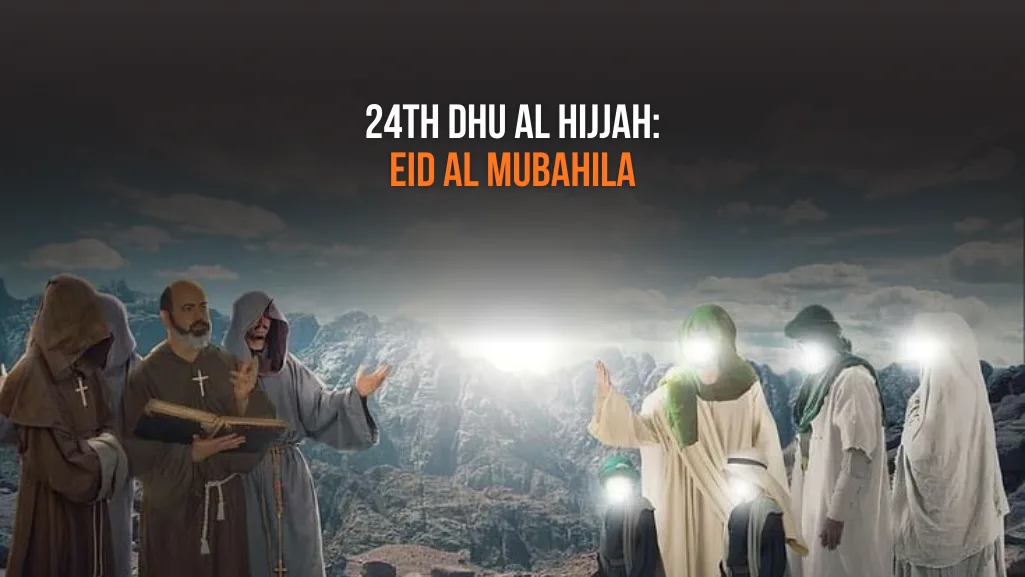
The Event of Mubahala on 24th Dhu'l-Hijjah is a key event in Islamic history in which Prophet Muhammad (SAW) and Christian delegations from Najran met in order to do mubahala (imprecation — a confrontation where God's curse is invoked on whichever side holds false beliefs) to reveal who is truthful and who is lying about their religious differences concerning divinity and monotheism.
The Christians accepted the challenge, however, on the day they had agreed upon earlier, they refused to proceed with imprecation since they saw that the Prophet (PBUH) came with closest and purest members of his family, ONLY 4 of them; who were his daughter, Fatima al-Zahra (SA), his son-in-law, Imam Ali ibn Abi Talib (AS), his grandsons, Hassan (AS) and Hussain (AS), who represented the 'women', 'self', and 'sons' of the Holy Prophet (PBUH). This event marked a great victory for Islam and highlighted the exceptional position of Ahlul-Bayt (AS), as relayed in the Quran verse 3:61.
“"To those that argue with you concerning Jesus after the knowledge you have received say: 'Come, let us gather our sons and your sons, our women and your women, ourselves and yourselves. We will pray together and call down the curse of Allah on every liar'."”
— Quran 3:61
Historical Context
The advent of Islam began with the Prophet Muhammad's revelations around 610 CE in Mecca. Over the next two decades, Muhammad's teachings attracted a substantial following, but also considerable opposition from the Quraysh, the dominant tribe in Mecca. This resistance culminated in the migration (Hijra) of Muhammad and his followers to Medina in 622 CE, an event that marks the beginning of the Islamic calendar.
During the 7th century, Arabia was a mosaic of diverse tribes and religious beliefs, including polytheism, Judaism, Christianity, and Zoroastrianism. The Najran region, located in the southern part of present-day Saudi Arabia, was notable for its significant Christian population. The Christians of Najran were known for their established communities and places of worship, such as churches and monasteries.
The interaction between Muslims and Christians in Arabia was not uncommon, as trade routes and tribal alliances often brought these groups into contact. The political landscape was characterized by a complex web of alliances and rivalries among various tribes, each seeking to maintain autonomy while navigating the growing influence of Islam.
Christian Mission Heads to Madina
After deliberations, it was finally decided to send a mission to Madina and have a dialog with the Muslims. A 14 member delegation headed by Aqib Saidawar and Abu Harisa started off for Makkah. Abu Harisa was considered as the greatest Bishop and scholar of the Christian world at that time and Aqib Sadawar was the biggest strategist and negotiator of the time.
When the delegation reached Madina, the people got impressed by their lavish dressing and pomp and show since it was the first time that a mission had arrived in such a manner.
When they entered the Masjid-e-Nabawi, the Prophet Mohammad (PBUH) looked at the precious stones, gold and silk clothes that they were wearing and turned away his face and did not pay any attention to them. After a while when no one noticed their pomp and show, they got out of the Masjid-e-Nabawi and met Hazrat Usman and Ubaid-ur-Rehman outside and asked them as to why they were invited by the Muslims and then treated in this manner.
Hazrat Usman mentioned that he did not have a clue about that but if they consult Imam Ali (AS), he would be able to tell them what was going on. They took the delegation with them and arrived at the house of Imam Ali (AS) and mentioned the whole incident to him.
Imam Ali (AS) said to the delegation that they were wearing dresses of silk and ornaments of gold which depicted their superior mentality and that they should take them off and dress simply. Only then the Prophet (PBUH) would allow them to visit him and entertain them. When they followed the instructions of Imam Ali (AS), they were allowed to visit the Prophet Mohammad (PBUH) after the Prayers of Asar and have discussions with him.
Detailed Account of the Event
The event of Mubahila is a significant episode in early Islamic history, illustrating a profound moment of interfaith dialogue and the assertion of prophetic authority. The event took place outside Medina, in a designated area where both parties agreed to meet. The specific location is not detailed in all accounts but is generally understood to be near the city.
This event of Mubahila took place on Dhul al-Hijjah 24, involving the Prophet Muhammad (PBUH) and a Christian delegation from Najran. The event of Mubahila is recorded in both Islamic historical texts and religious traditions. The confrontation occurred after a series of discussions between the Prophet Muhammad and a Christian delegation from Najran.
Background and Initiation
When the Prophet (PBUH) wrote letters to rulers of different countries and religious centers, he (PBUH) also wrote a letter to the Bishop of Najran, in which he invited the people of Najran to Islam. The Christians decided to send a delegation to Medina to discuss with the Prophet (PBUH) around 631 CE. The delegation comprised prominent Christian leaders, including bishops and priests, who were well-versed in Christian theology.
Theological Discussions
Upon their arrival in Medina, the Christian delegation engaged in theological discussions with the Prophet Muhammad (PBUH). The central point of contention was the nature of Jesus Christ. The Christians argued for the divinity of Jesus, while the Prophet Muhammad maintained the Islamic view of Jesus as a prophet and a servant of God, not divine.
Proposal of Mubahila
After extensive dialogue, the debate reached an impasse. To resolve the matter, the Prophet Muhammad (PBUH) proposed Mubahila, an invocation of God's curse upon the liars among them if they continued to reject the truth. The Quranic verse (Surah Al-Imran, 3:61) was revealed, outlining the procedure for Mubahila, where each party would bring their closest family members and jointly pray for divine judgment.
For the Mubahila, the Prophet Muhammad (PBUH) represented the Muslim side. According to Islamic tradition, he brought along his closest family members: his daughter Fatimah (as "Our women"), her husband Ali (as "Our souls"), and their two sons, Hasan and Husain (as "Our sons"). The Christian delegation from Najran included their religious leaders and representatives. The names of specific individuals are less frequently mentioned in Islamic sources, but they were high-ranking figures in their community.
At last, the Christian delegates rejected the proposal to invoke the curse on the fixed day and they opted for a peaceful resolution. Thus, they agreed to pay the Jizya (a tax levied on non-Muslims under Muslim rule) and accepted the terms of coexistence proposed by the Prophet Muhammad (PBUH).
Quranic Basis
The event of Mubahila is rooted in the Quran, specifically in Surah Al-Imran (3:61). This verse serves as the theological and scriptural foundation for the event, providing guidance and context for the actions taken by the Prophet Muhammad (PBUH) and the Christian delegation from Najran. Allah says:
“"Should anyone argue with you concerning him, after the knowledge that has come to you, say, 'Come! Let us call our sons and your sons, our women and your women, our souls and your souls, then let us pray earnestly, and call down Allah's curse upon the liars.'"”
— Quran 3:61
This verse was revealed in the context of a theological debate between the Prophet Muhammad (PBUH) and the Christian delegation from Najran concerning the nature of Jesus Christ. The Christians of Najran argued for the divinity of Jesus, while the Prophet Muhammad (PBUH) upheld the Islamic view of Jesus as a prophet and servant of God. When the debate reached an impasse, this verse was revealed, offering Mubahila as a means to invoke divine judgment.
Exegesis and Interpretations
Scholars of Islamic exegesis (Tafsir) have extensively analyzed this verse to understand its meanings and implications. Key points from various Tafsirs include:
Invitation to Mubahila
The verse explicitly outlines the procedure for Mubahila, inviting both parties to bring their closest family members and invoke God's curse upon the liars. This underscores the seriousness of the truth claim and the willingness to submit to divine judgment.
— Shawaid Tanzil, vol. 1, pp. 120-129
Inclusion of Family Members
The inclusion of "sons," "women," and "our souls" in the verse highlights the gravity of the situation. By involving their closest family members, both parties demonstrate their confidence in the truth of their beliefs and their readiness to face divine consequences if proven false.
Theological Significance
The act of Mubahila is seen as a powerful testament to the truth of the Prophet Muhammad's message. It represents a direct appeal to God's judgment, bypassing human arguments and evidence. This elevates the dispute to a divine level, emphasizing the ultimate authority of God in matters of truth.
Significance and Outcomes
The event of Mubahila holds deep significance in Islamic history, theology, and interfaith relations. It not only affirmed the authority of the Prophet Muhammad (PBUH) but also established a precedent for addressing theological disputes and fostering peaceful coexistence between Muslims and Christians. This section explores the immediate outcomes of the event, its long-term impacts, and its broader significance within Islamic tradition and interfaith dynamics.
Immediate Outcomes
The following are some of the immediate outcomes of the event Mubahila:
Affirmation of Prophetic Authority
The event underscored the confidence of the Prophet Muhammad (PBUH) in the truth of his message. The readiness of the Prophet and his family to engage in Mubahila highlighted their unwavering belief in divine support. The hesitation and eventual withdrawal of the Christian delegation from the Mubahila served as an implicit acknowledgment of the Prophet's authority and the seriousness of his claims.
Peaceful Resolution and Agreement
The Christian delegation's decision to avoid the Mubahila and instead agree to the terms proposed by the Prophet Muhammad led to a peaceful resolution. They accepted the imposition of the Jizya (a tax on non-Muslims), which allowed them to maintain their religious practices under the protection of the Muslim state. This agreement set a model for Muslim governance and the treatment of non-Muslim communities.
Long-Term Impacts
The following are some of the long-term impacts of the event Mubahila:
Islamic-Christian Relations
The event established a framework for interfaith dialogue and peaceful coexistence between Muslims and Christians. It demonstrated that theological disputes could be resolved without resorting to violence. The precedent set by Mubahila influenced subsequent interactions between Muslims and Christians, fostering a spirit of dialogue and mutual respect.
Theological and Jurisprudential Significance
The event and the related Quranic verse (Surah Al-Imran, 3:61) became a significant point of reference in Islamic theology and jurisprudence. It was used to illustrate the concept of invoking divine judgment in matters of truth. Both Sunni and Shia traditions hold the event in high regard, though interpretations may vary. For Shia Muslims, the event particularly highlights the special status of the Prophet's family (Ahl al-Bayt).
Strengthening of Muslim Identity
The successful outcome of the event reinforced the nascent Muslim community's sense of identity and mission. It served as a divine endorsement of their beliefs and practices. The event is commemorated in Islamic tradition, reinforcing the values of faith, truth, and the importance of prophetic guidance.
Mubahila in Islamic Tradition
The event of Mubahila is a significant occurrence in Islamic tradition, holding theological, historical, and interfaith importance. Its implications are deeply embedded in both Sunni and Shia traditions, and it is frequently referenced in Islamic scholarship and religious discourse.
Sunni scholars view Mubahila as a powerful demonstration of the Prophet Muhammad's confidence in the truth of his message. It signifies his readiness to invoke divine judgment to settle disputes. It highlights the Prophet's diplomatic approach to dealing with other religious communities.
— Sahih Muslim (Book on Merit, Chapter on Merit of Ali), vol. 2, p. 360; Sahih Tirmidhi, vol. 4, p. 293 (Hadith no. 3085); Mustadrak Sahihayn, vol. 3, p. 150
On the other hand, Shia tradition places significant emphasis on the involvement of the Prophet's family (Ahl al-Bayt) in Mubahila. The presence of Fatimah, Ali, Hassan, and Hussain is seen as an endorsement of their elevated spiritual status and purity.
— Tabatabai, Muhammad Husayn, al-Mizan (under the verse 61 of Quran 3); Tafsir Nemuneh (under the verse 61 of Quran 3)
Conclusion
The event of Mubahila is a cornerstone of Islamic history and theology, occurring in the early 7th century during a pivotal period in Islamic history involving the Prophet Muhammad (PBUH) and a Christian delegation from Najran. Mubahila is seen as a direct challenge to Christian doctrines of the time, specifically the divinity of Jesus. It reaffirms the Islamic belief in the oneness of God and the prophetic role of Jesus.
The event illustrated the power of faith and the importance of peaceful interfaith dialogue. Its immediate and long-term outcomes highlight the Prophet Muhammad's authority, the framework for Muslim-Christian relations, and the theological depth of invoking divine judgment. The broader significance of Mubahila lies in its lessons on conflict resolution, interfaith respect, and moral integrity, making it a profound and enduring event in the annals of religious history. By avoiding the curse and opting for a peaceful agreement, the event set a precedent for how Muslims could coexist with other religious communities while maintaining their own beliefs.
“Iraq Ziarat 2026
Embark on a transformative spiritual odyssey in 2026 that honors the profound legacy of the Event of Mubahila. This exclusive pilgrimage package is meticulously designed to connect the historical "cornerstone" of Islamic theology with the sacred soil of Iraq. As we traverse the holy cities of Najaf, Karbala, and Samarra, we draw inspiration from the Prophet Muhammad's (PBUH) authority and his commitment to peaceful interfaith dialogue.
Just as the Mubahila set a precedent for conflict resolution and moral integrity, our journey focuses on the "theological depth" of the Ahl al-Bayt, offering pilgrims a chance to reflect on the oneness of God and the enduring lessons of interfaith respect. Join us to witness the sites where the power of faith meets history, providing a framework for modern coexistence and spiritual enlightenment.
Ready to walk the path of the Ahl al-Bayt? Book your 2026 spiritual journey at www.ziaratplanner.com”
For more information or any queries, feel free to contact us. We are always ready to help you plan a peaceful and blessed journey.