Introduction: The Day That Perfected the Faith
The caravan returning from the Hajjatul-Widdah (The Final Pilgrimage) of the Prophet Muhammad (peace be upon him and his progeny) was halted unexpectedly. The archangel Jibreel (Gabriel) had come with the message from Allah:
“O Apostle! Deliver what has been revealed to you from your Lord, and if you do not, then you have not delivered His message, and Allah will protect you from the people.” (Qur’an 5:67)
The place where the Muslims had stopped was at Ghadir Khumm. The Prophet then delivered a sermon and appointed Imam Ali (peace be upon him) as his successor.
The Declaration: “Man Kuntu Mawla”
His words were:
“O Muslims! Who is more worthy (in the eyes of) the believers than their own selves?”
The audience replied: “Allah and His Messenger know better.”
Hearing this, the Prophet declared:
“I am the Master (Mawla) of the faithful and I have rights over them even more than what they have over themselves. Therefore of whomsoever I am the Mawla, this Ali is his Mawla.”
The first to congratulate Imam Ali was Umar ibn al-Khattab who said:
“Excellent! How fortunate you are O Abul Hasan! Now you have become my master as well as of all the Muslims.”
This all happened 1,400 years ago.
Addressing Common Misconceptions
But alas! The events following the death of the Prophet took a different turn and Imam Ali was by-passed as the mawla or the leader of the Muslims. Various reasons have been given for this, including:
- By mawla the Prophet meant ‘friend’ – It is difficult to accept this. Would the Prophet have stopped the whole caravan to declare his friendship with Imam Ali and to make friendship to Imam Ali obligatory?
- The Prophet did not appoint anyone and expected the Ummah to make a decision for itself.
The Eternal Pulse of Guidance: From the First Call to Ghadir Khumm
One of the most unique aspects of Islamic theology is that its truth manifests itself in our daily lives. All that is required to see this is a little pondering. Take, for example, the concept expanded in the Qur’an that all things have their own “appointed term.”
The Qur’an tells us:
“What! Reflect they not within themselves; (to see clearly that) Allah created not the heavens and the earth and what is between them except with truth, and for an appointed term?” (30:8)
The Life Cycle of Prophethood
When we apply this principle to the history of divine guidance, we find something fascinating: Prophethood itself had a life cycle. It began with Prophet Adam (AS) and reached its flowering perfection with the Seal of the Prophets, Muhammad (SAWW).
The Sufi poet Mahmud Shabistari beautifully captured this in his Gulshan-i-Raz:
“Nabuat ra zuhur ra az Adam amad, Kamalash dar ujud Khatam amad”
(The first appearance of prophethood was in Adam and its perfection was in the Seal of the Prophets).
The Great Dilemma
This “appointed term” poses a serious question for humanity. If prophethood reached its optimum and concluded with the Prophet Muhammad (SAWW), but human history continues, who guides mankind now?
Allah promises in the Qur’an:
“…And if, as is sure, there comes to you guidance from Me, whosoever follows My guidance on them shall be no fear nor shall they grieve.” (2:38)
How can this promise of continuous guidance be reconciled with the end of revelation? The answer lies in the event of Ghadir Khumm.
Ghadir Khumm: The Bridge to Eternity
Ghadir is not just a historical event; it is a theological solution. It charts a clear path for salvation by establishing the Imamate as the continuation of the Prophet’s spiritual and functional role, minus the reception of new scripture.
At Ghadir, the final revelation was sent down:
“This day have I perfected your religion for you, completed My Favour upon you, and have chosen for you Islam as your faith.” (5:3)
The Two Weighty Things (Al-Thaqalayn)
Because there would be no new prophets, Allah guaranteed the protection of the Qur’an. However, the Book requires an interpreter. The Prophet (SAWW) declared that he was leaving behind two “weighty things” (al-thaqalayn):
- The Qur’an: The protected Word of Allah
- The ‘Itrat (Ahl al-Bayt): The Prophet’s progeny, who serve as the living guides
The Prophet compared his Ahl al-Bayt to Noah’s Ark: those who embark are saved, and those who reject it are destroyed. He also described them as the “Gate of Repentance” for the Ummah.
The Merits of Imam Ali (AS)
Throughout his mission, the Prophet (SAWW) prepared the community for the leadership of Imam Ali. Authentic sources across both Shi’i and Sunni traditions record numerous instances where Ali’s unique status was highlighted:
- The First Believer: He was the first man to accept Islam
- The Sacrifice: He risked his life by sleeping in the Prophet’s bed during the Hijra
- The Purification: He was among the “People of the Cloak” (Ahl al-Kisa) mentioned in Quran 33:33
- The Position of Aaron: The Prophet told Ali: “You are to me what Harun (Aaron) was to Musa (Moses), except there will be no prophet after me.”
A Consistent Message: From the First Khutbah to the Last
The most striking evidence of this planned succession is the symmetry between the Prophet’s very first sermon to his relatives (Da’wat dhu’l-‘Ashira) and his final sermon at Ghadir Khumm. Both mark the beginning and culmination of a single, consistent message about leadership after the Prophet.
The Event of Ghadir Khumm: From Oblivion to Recognition
The event of Ghadir Khumm serves as a profound case study in how historical “truth” is often shaped by the lenses of those who record it. In Western scholarship (Orientalism), the recognition of Ghadir Khumm has followed a path strikingly similar to classical Sunni polemics: moving from total silence to skepticism, and finally to reinterpretations that strip the event of its original weight.
The Three Stages of Denial
Historically, when confronted with evidence supporting the Shi’a perspective on Imam Ali’s succession, polemicists have utilized a three-tiered defense:
- Outright Denial: Claiming the event or hadith simply does not exist
- Discrediting Transmitters: If the event is proven, casting doubt on the reliability of the narrators
- Alternative Interpretation: If the narrators are proven reliable, providing an interpretation that contradicts the Shi’a understanding
Deconstructing Modern Skepticism: The Case of M.A. Shaban
Even contemporary scholars like M.A. Shaban continued to dismiss Ghadir Khumm, calling the tradition something that “should not be taken seriously.” Shaban offers two primary “new” reasons for his skepticism:
The “Youth” Argument
Shaban argues it is “inherently improbable” that the Arabs would entrust a young, “untried” man like Ali with such responsibility. However, history refutes this:
- The Precedent of Qusayy: In pre-Islamic Makkah, youth was not an absolute barrier; the sons of Qusayy were admitted to the ruling council despite their age
- Usama ibn Zayd: Just before his death, the Prophet (SAWW) appointed the 20-year-old Usama to lead an army over senior elders like Abu Bakr and Umar
- Ali’s Proven Record: Far from being “untried,” Ali was entrusted with the Prophet’s safety during the Hijra, the leadership of expeditions to Yemen, and the protection of Medina during the Tabuk expedition
The Behavior of the Medinan Community
Shaban argues that because the community did not immediately act upon this designation after the Prophet’s death, the event must be a later invention. This ignores the “traditional reluctance” and political pressures of the time.
Furthermore, historical records show that the event was not forgotten. Twenty-five years later, in Kufa, Imam Ali publicly implored the surviving companions to testify to what they heard at Ghadir. At least 30 companions stood up to verify the Prophet’s declaration: “Whomsoever I am Mawla, this Ali is his Mawla.”
Conclusion: The Perfection of Faith
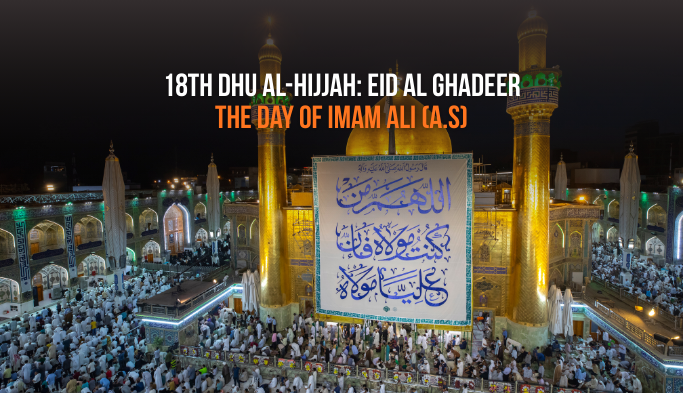
The 18th of Dhu al-Hijjah marks more than just a date on the calendar; it represents the perfection of the faith and the formal conclusion of the Prophet’s mission. As the sun set on this day at Ghadir Khumm, the transition from Nabuwwah (Prophethood) to Imamah (Leadership) was finalized, ensuring that the “appointed term” of human guidance would never truly expire.
Join the Ghadir 2026 Ziarat in Najaf al-Ashraf
This year, Eid al-Ghadir falls on or around June 3–4, 2026. Experience the “Greatest Eid” in Najaf al-Ashraf, standing at the threshold of the Commander of the Faithful, Imam Ali (AS), where the echoes of “Man Kuntu Mawla” still resonate.
Why Plan Your 2026 Ghadir Trip With ZiaratPlanner.com?
- Complete Flexibility: Choose your own dates and stay duration in Najaf and Karbala
- Direct Access: Hotels curated for proximity to the Harams, ensuring you are there for the A’maal of Ghadir
- Personalized Itineraries: Visit the Grand Mosque of Kufa and the House of Imam Ali (AS) without the rush of large groups
- Hassle-Free Logistics: From Iraq Visas to private airport transfers and spiritual guides
Celebrate the Perfection of Faith
Spend the 18th of Dhu al-Hijjah in the city of knowledge. Offer your Salams and renew your allegiance where the “completion of favor” is celebrated with unparalleled joy.
Build your custom Ghadir 2026 package: www.ziaratplanner.com or WhatsApp +964 786 206 0777





 06-Jun-2026