Introduction
In the Islamic calendar, there are certain days that are not just historical commemorations, but milestones of faith, belief, and divine guidance. Among these sacred days, Eid al-Ghadeer stands out as one of the greatest and most significant. It is known as "Eidullah al-Akbar" — the Greatest Eid of Allah — by the believers.
This is the day when the Prophet of Mercy, Hazrat Muhammad Mustafa (PBUH), by the command of Allah, declared the Wilayah (guardianship and leadership) of Imam Ali ibn Abi Talib (AS), thus completing the religion of Islam. The event of Ghadeer is not merely a historical sermon but a divine proclamation that established the criterion of truth and leadership for the Muslim Ummah. It was on this day that the boundary between truth and falsehood was clearly defined, and the eternal message was delivered: leadership belongs to the one chosen by Allah and His Messenger.
The message of Eid al-Ghadeer goes beyond just love for Ali (AS); it is about accepting his divine authority, following in his footsteps, and embracing the true spirit of Islam. That is why every year on the 18th of Dhul Hijjah, believers around the world not only celebrate this occasion but also renew their understanding of its deep spiritual and ideological significance so they may remain steadfast on the path of truth.
The Magnificence of the "Greatest Eid"
There is no overstating the magnificence of this day. Imam al-Rida (AS) is reported to have said:
“"The Day of Ghadir is better known in the heavens than it is on earth… Be generous to your brothers on this day and bring joy to every believing man and woman."”
— Musnad al-Imam al-Rida (AS), v. 2, p. 245
The Imams of Ahl al-Bayt (AS) have encouraged us to seize the blessings of this occasion through worship and acts of devotion. Imam al-Sadiq (AS) is narrated to have said:
“"Indeed, worship on the Day of Ghadir, the 18th of Dhu al-Hijjah, is equal to the worship of eighty months."”
— Al-Iqbal, p. 465
Who Was Imam Ali (AS) and What Was the Context of Ghadeer?
Imam Ali ibn Abi Talib (AS) was the cousin and son-in-law of Prophet Muhammad (PBUH) and the very first person to accept Islam after the Prophet's wife, Bibi Khadijah (SA). He was known for his unmatched bravery in battle, deep knowledge of the Quran, and unwavering commitment to justice and truth.
Imam Ali (AS) stood by the Prophet (PBUH) during every major event in Islamic history, from the early days of persecution in Mecca to the pivotal battles fought in Medina. His character, sacrifices, and piety earned him the title Amirul Muminin (AS), meaning "The Commander of the Faithful."
By the time the Prophet (PBUH) delivered the sermon at Ghadir Khumm, there had already been many occasions where he had publicly praised Imam Ali (AS) and entrusted him with major responsibilities.
One well-known example of this is when Imam Ali (AS) slept in the bed of the Prophet (PBUH) to allow the Prophet (PBUH) to migrate to Medina without his enemies knowing, thus keeping him safe.
Imam Ali (AS) was also known for his immense knowledge. The Prophet (PBUH) is reported to have stated, "I am the city of knowledge, and Ali is its gate, thus, whoever seeks the knowledge should enter the gate."
The event of Ghadeer was the culmination of a lifetime of service in the way of Allah (SWT), and thus, the Prophet (PBUH) announced that Imam Ali (AS) was the one to lead the ummah after him.
What is the Story Behind Eid Al-Ghadeer?
Eid Al-Ghadeer is the commemoration of Prophet Muhammad's (PBUH) final sermon at Ghadir Khumm, which took place on the 18th of Dhu al-Hijjah, 10 AH. This incident was the basis for their acceptance of Imam Ali (AS) succession to the Prophet.
The story behind this Eid begins ten years after the Prophet Muhammad (PBUH) requested his followers to accompany him on his last trip from Mecca to Medina.
The traditions tell us that while traveling from Mecca to Madina after the last hajj, the Prophet (PBUH) and his companions stopped at a lake three miles from Al-Johfa. The Prophet (PBUH) then came to a halt in Ghadeer Khuum, a site between Mecca and Medina. In front of hundreds of people, he proclaimed that Imam Ali (AS) was his chosen successor to rule Islam after him. He held up Imam Ali's (AS) hand during his address and said:
“"Oh Allah, bear witness. My Lord is Allah, and I am the Lord (leader) of the faithful. I am more deserving of believers than they are. Ali is to be the Master of whoever I was Master (Mawla). Oh Allah, be a friend to those who support him (Ali) and an enemy to those who resist him (Ali)."”
It was at that moment, that all the believers hailed Prophet Muhammad's choice and congratulated Imam Ali (AS). The following verse of the Quran was revealed after the Prophet (PBUH) finished his discourse:
“"Today I have perfected your religion and completed my bounty upon you, and I was satisfied that Islam be your religion."”
— Quran 5:3
This Quranic verse is noteworthy because it shows that Imam Ali (AS) was selected by Allah rather than Prophet Muhammad (PBUH), and that there was a rationale for Imam Ali's (AS) selection.
On this day, Imam Ali (AS) was appointed the first of twelve Imams who would continue to give leadership and authority in Islam, marking the conclusion of Prophethood and the commencement of the Institution of Imamate.
Wilaya is a rule of governance, power, and reigning in Islam. It was created when Prophet Muhammad (PBUH) chose Imam Ali (AS) as his successor. The concept of Wilaya reflects Allah's command; only those appointed by Allah (SWT) via the Prophet (PBUH) have governmental authority in Islam.
The holy Imams are regarded as the Prophet's legitimate successors not because they are related to him, but because they possess the attributes essential for religious-political leadership. In the absence of an Imam, a highly educated religious scholar (Marji) can provide direction to believers in all matters of jurisprudence.
What is Eid e Ghadeer?
Eid e Ghadeer commemorates the event of Ghadīr Khumm, which occurred in the year 10 AH, shortly after Prophet Muhammad (PBUH) performed his final Hajj, which is why it is known as "The (year of the) Farewell Hajj" or "Hajjatul Wada." After performing Hajj, the Prophet (PBUH) and those who had accompanied him were returning to their homes on the 18th of Dhul Hijjah.
On this day, the Prophet (PBUH) was commanded by Allah (SWT) to stop the caravan, and so he stopped at a pond called Ghadir Khumm near the miqat of Al-Juhfah by the order of Allah (SWT). At that time, the following verse of the Noble Quran was revealed to him through Angel Jibra'il:
يَٰٓأَيُّهَا ٱلرَّسُولُ بَلِّغْ مَآ أُنزِلَ إِلَيْكَ مِن رَّبِّكَ ۖ وَإِن لَّمْ تَفْعَلْ فَمَا بَلَّغْتَ رِسَالَتَهُۥ ۚ وَٱللَّهُ يَعْصِمُكَ مِنَ ٱلنَّاسِ
— Translation: "O Messenger! Convey everything revealed to you from your Lord. If you do not, then you have not delivered His message. Allah will certainly protect you from the people."
— Surah al-Ma'idah, Verse 67
Prophet Muhammad (PBUH) performed Salatul Zuhr in congregation and then delivered a historic sermon to the tens of thousands of Muslims who were present. The Prophet (PBUH) took the hand of Imam Ali (AS), raised it up high, and announced the wilayah and leadership of Imam Ali (AS) to all.
In his sermon, the Prophet famously declared:
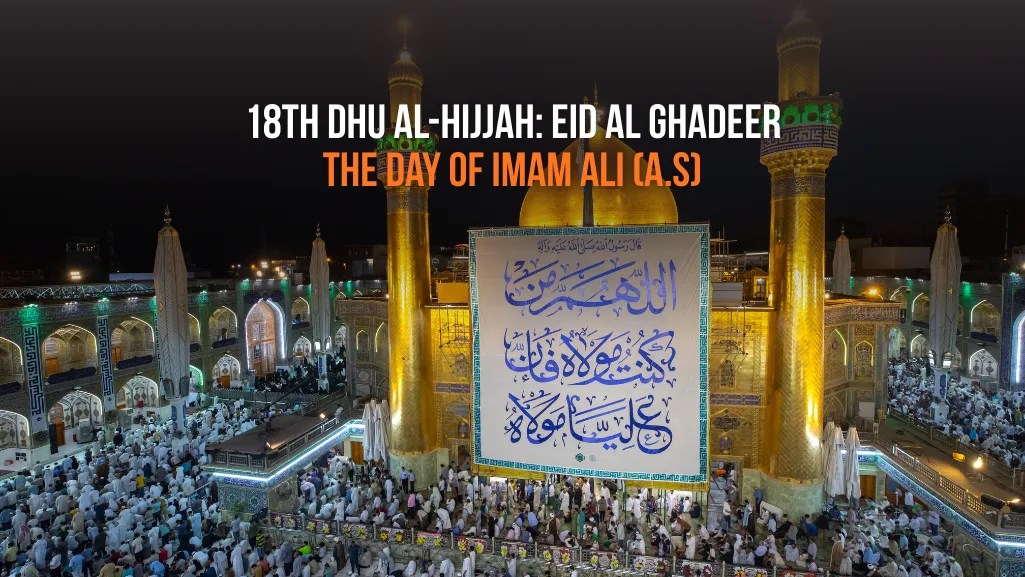
مَنْ كُنْتُ مَوْلَاهُ فَهَذَا عَلِيٌّ مَوْلَاهُ. اللَّهُمَّ وَالِ مَنْ وَالَاهُ وَعَادِ مَنْ عَادَاهُ
— Translation: "O people, for whomsoever I am the master (mawla), Ali is also their master (mawla). O Allah, befriend whoever befriends him, and be an enemy to whoever is an enemy to him…"
Angel Jibra'il then descended once again by the order of Allah (SWT) and revealed the following verse of the Noble Quran:
ٱلْيَوْمَ أَكْمَلْتُ لَكُمْ دِينَكُمْ وَأَتْمَمْتُ عَلَيْكُمْ نِعْمَتِى وَرَضِيتُ لَكُمُ ٱلْإِسْلَٰمَ دِينًۭا
— Translation: "Today, I have perfected your faith for you, completed My favor upon you, and chosen Islam as your religion."
— Surah al-Ma'idah, Verse 3
This statement was not simply a call to love Imam Ali (AS), but a formal declaration of his divine appointment as the Prophet's successor in spiritual and political leadership. This moment is regarded as the beginning of the directive about the future leadership of the ummah and wilayah of the 12 Imams, making Eid e Ghadeer a deeply spiritual and profound occasion.
Ghadir Khum: Messages and Lessons
Some of the most important messages and lessons of this festival include:
Necessity of Loyalty to the Prophet (PBUH)
After introducing Imam Ali (AS) as his successor, the Prophet Muhammad (PBUH) asked Muslims to pledge allegiance to him and accept his leadership. The necessity of loyalty and obedience to the Messenger of God, as demanded by many verses of the Holy Quran, required Muslims to unanimously adhere to this divine command and obey the Prophet's successor.
Importance of Righteous Leadership
The introduction of a person with special and unique qualities as the Prophet's successor highlights the importance and necessity of having righteous and just leadership in the Islamic community. Ali (AS), as a pious, trustworthy, knowledgeable, and courageous individual, was an ideal model for leading the Islamic society, as introduced by the Prophet Muhammad (PBUH).
Unity and Cohesion
The Prophet Muhammad (PBUH) aimed to invite Muslims to unity and cohesion by introducing his successor and, at the same time, reduce potential disagreements and divisions, gathering Muslims around a unified leadership. If Muslims had regarded the Prophet's words as obligatory as divine revelation, this unity would have been achieved better than what we witness today.
Eid al-Ghadir has the potential to act as a factor for unity among Muslims. Despite the religious differences between Shia and Sunni Muslims, all Muslims respect the high status of Amir al-Mu'minin Ali (AS) and regard him as one of the greatest companions of the Prophet Muhammad (PBUH). If Muslims focus on their commonalities rather than differences, they can use Eid al-Ghadir as an opportunity to strengthen solidarity and unity among themselves.
Unfortunately, insufficient attention by Muslims to this very important mission of the Prophet Muhammad (PBUH) has led to many divisions and hostilities, resulting in political and governance weaknesses in the Islamic world and a diminishing of Islamic and moral values in society, causing large sections of the Islamic community to fall into decline and corruption.
Ghadir Khum and the Most Important Duty of Muslims
The first and foremost duty of Muslims regarding the event of Ghadir is to understand it correctly and pass it on to future generations. This responsibility lies today with those who are newly introduced to this historical event of Islam. Awareness of this event helps in a better understanding of Islamic history and the key role of Amir al-Mu'minin Ali (AS) in it.
Organizing the Gathering at Ghadir Khumm
The scorching heat burned the desert ground like fire. Some members of the caravan had moved ahead while others lagged behind. The Prophet (PBUH) sent instructions:
- Call those who went ahead to return
- Urge the slow walkers to speed up
- Prepare a gathering space for the announcement
As night fell, people began to assemble. The Prophet (PBUH) gave directions:
- Everyone should sit in order and respectfully
- No one should occupy the space beneath the five thorny Acacia trees, for that is where the pulpit will be set up
- Spread cloth beneath the trees and place camel saddles to build a raised platform
Once all arrangements were made, and the noon prayer (Zuhr) time arrived, Bilal (RA) called out the Adhan with his melodious voice. The Prophet (PBUH) led the prayer and, after its completion, turned to address the sea of people from the elevated pulpit.
Must-Do Recommended Acts on Eid al-Ghadir
12 deeds of a'mal recommended for Eid ul Ghadeer:
1. Recite Salawat
Recite salawat as much as possible on this day.
2. Greetings When We Meet
At the time of meeting with mumeneen - the brothers-in-faith - congratulate each other in the following words: Alhamdulillaahil ladhi ja'alana minal mutamassikina bi wilaayati amiril m'uminina wal aimmati 'alayhimus salaam. (All praise is due to Allah for having enabled us to be from those who hold to the leadership of Amirul Muminin and all the Imams AS).
3. Perform Sunnah Ghusl
4. Apply Perfume
5. Observe Fast
"Fasting on the day of Ghadeer is equivalent to fasting the time span of the (existence of the) entire world." (Imam Ja'far as Sadiq AS) This hadith conveys the message that the reward for a fast on Eid ul Ghadeer would be equivalent to reward for a person who if they were to live a life of the entire existence of the world and were fasting this period.
6. Arrange for Iftar to Persons Fasting
Amirul Mumineen Imam Ali bin Abi Talib (AS) said that whoever provides iftar to a person who has observed fast on this day, has been treated to Iftar 10 fa'aam. When asked who the fa'aam were, Imam Ali (AS) explained that fa'aam consisted of 100,000 prophets, the truthful and martyrs.
7. Pray 2 Rakaat Salah
First Rakaat: After Sura Al-Fatiha recite Suratul Qadr once. Second Rakaat: After Sura Al-Fatiha recite Suratul Ikhlas once. After salat go into sajdah and recite Shukran Lillah 100 times.
It is reported that one who performs this salat will be rewarded as though he was present near the Noble Prophet (SAW) on the day of Ghadeer and gave allegiance.
8. Just Before Noon Time Pray 2 Rakaat Salah
In every Rakaat, after the recitation of Surah Al Fatiha, recite 10 times each: Sura Al Ikhlas, Ayatul Kursi, and Sura Al Qadr.
The reward for this prayer is equal to that of performing 100,000 obligatory and optional hajj and one's wishes of the world and the hereafter will be fulfilled with ease and will be granted good health.
9. Recite Dua Nudbah
10. Recite Specific Duas
Recite the duas mentioned in Mafatihul Jinan (Pages 276, 279).
11. Recite Tasbih 100 Times
"Alhamdulillahil ladhi ja'ala kamaala deenihi wa tamaama n'imatihi, bi wilayati Amiril mu'mineena Aliyibni Abi Talib 'alayhis salaam" (All Praise be due to Allah who made the perfection of His religion and the completion of His Grace in the leadership of the Commander of the Believers, Ali son of Abu-Talib, peace be upon him.)
12. Recite Ziarah of Imam Ali ibn Abi Talib
Recommended are: (i) Special Ghadir Ziyarat (ii) Ziarat Ameenallah & (iii) Ziarat Mutlaqah. (Reference: Mafatihul Jinan)
The Importance of Eid Ghadeer in Our Lives
Celebrating Eid Ghadeer is not only about honoring the message the Prophet (PBUH) conveyed. Rather, it is about living it today in our actions. The appointment of Imam Ali (AS) teaches us that leadership in Islam is a divine decision and based on piety, knowledge, and service in the way of Allah (SWT).
Families can take this opportunity to:
- Reflect on the qualities of a true leader
- Teach children how to be just, brave, and trustworthy like Imam Ali (AS)
- Commit to personal goals that foster closeness to Allah (SWT) and the Ahlul Bayt (AS), such as memorizing Surahs of the Quran or reading Nahj al-Balaghah, a collection of sermons and sayings by Imam Ali (AS)
Understanding the Concept of Wilayah
At the heart of Eid Ghadeer is the concept of wilayah, the divine authority and guardianship given by Allah (SWT) to special individuals to lead the Muslim community. Wilayah means more than just leadership. It means fostering spiritual guidance, moral responsibility, and a connection with the Ahlul Bayt (AS).
The event of Ghadeer made it clear that the Prophet (PBUH) affirmed Imam Ali (AS) as the divinely appointed successor, not just from a political stance but a spiritual one as well. It is an important reminder that true leadership is rooted in justice, wisdom, and devotion to Allah (SWT).
Teaching children about wilayah helps them understand that following Imam Ali (AS) and the rest of the Ahlul Bayt (AS) means more than just love, it means living by their values and following their guidance for the sake of Allah (SWT).
How to Celebrate Eid Ghadeer with Children
Looking for ways to make Eid Ghadeer fun and meaningful for kids? Here are some ideas that are both spiritual and engaging:
- Host a kid-friendly gathering celebrating Eid Ghadeer
- Read stories about Imam Ali (AS), the Prophet Muhammad (PBUH), and the event of Ghadeer
- Make Eid cards with a verse or hadith about Imam Ali (AS)
Keeping the Essence of Ghadeer Alive
As we reflect on the legacy of Eid Ghadeer, let's remember that this event reminds us to hold firmly to the guidance of Allah (SWT) through the Ahlul Bayt (AS). By teaching children about Eid Ghadeer, we are not just sharing history, but we are cultivating a love for truth, loyalty, and spiritual leadership within our families and communities, insha'Allah.
It is also a time to reflect on the beautiful character of Imam Ali (AS). One such example is found in the story behind verse eight of Surah al-Dahr (also known as Surah al-Insan), revealed in honor of Imam Ali (AS), Sayyidah Fatimah al-Zahra (AS), and their children.
According to many commentators of the Quran, Imam Ali (AS) and Sayyidah Fatimah (AS) made a vow to fast for three days if their sons, Imam Hassan (AS) & Imam Hussain (AS), recovered from an illness. After completing the first fast, just as they were about to begin eating, a miskin (needy person) knocked on their door asking for food. They selflessly gave away their meal and broke their fast with only water.
On the second and third nights, they gave their food again, first to an orphan (yatim) and then to a captive (asir), each time choosing generosity over their own needs. The next day, Allah (SWT) revealed the following verse praising their sincerity and sacrifice, saying:
وَيُطْعِمُونَ ٱلطَّعَامَ عَلَىٰ حُبِّهِۦ مِسْكِينًۭا وَيَتِيمًۭا وَأَسِيرًا
— Translation: "And they give food out of love for Him to the poor and the orphan and the captive."
— Surah ad-Dahr, Verse 8
This story is a powerful example of the compassion, sincerity, and selflessness that Imam Ali (AS) and his family lived by. These noble qualities make the first Imam an ideal leader and a role model for all.
“Journey to the Heart of Wilayah
When we stand before the golden dome of Najaf, we are not just visiting a shrine; we are returning to the source of true leadership and humanity. To walk the path between Najaf and Karbala is to witness the living legacy of the Ahl al-Bayt (AS) — a legacy built on sacrifice and unwavering devotion to God.
Join us in 2026 as we journey to the heart of Iraq to renew our allegiance to the Commander of the Faithful. Let his life inspire yours.
Package Highlights:
Najaf al-Ashraf: Deepen your connection at the doorstep of Imam Ali (AS)
Karbala al-Mu'alla: Experience the unparalleled devotion of Imam al-Hussain (AS)
Samarra & Kadhimiya: Visit the lights of the Imams (AS) in sacred serenity
Spiritual Guidance: On-site lectures focused on the noble qualities and role-modeling of the Ahl al-Bayt
www.ziaratpackage.com”
For more information or any queries, feel free to contact us. We are always ready to help you plan a peaceful and blessed journey.