Bio Data
| Detail | Information |
|---|---|
| Name | Ali |
| Title | Al-Hadi; Al-Naqi (the Guide; the Pure) |
| Kunya | Abu al-Hasan (al-Thalith/the 3rd) |
| Father | Muhammad ibn Ali al-Jawad (AS) |
| Mother | Summana |
| Born | 15th Dhu al-Hijjah (2nd Rajab, different narration), 212 AH / 827 CE in Madinah |
| Died | 3rd Rajab, 254 AH / 868 CE (poisoned by al-Mu'tazz) |
| Age at Martyrdom | 42 years |
| Period of Imamate | 34 years |
| Buried | Samarra, Iraq |
“Imam Ali al-Hadi (AS) is reported to have said: "Miserliness is the most detestable moral trait, and greediness is an ill nature."”
— Al-Majlisi, Bihar al-Anwar, vol. 69, p. 199
The House of Islam
In the history and entirety of Islam, there has not been a lineage more noble than that of Imam al-Hadi, and no family has lit the world with the light of Islam more than that of Prophet Muhammad and his blessed Household. Imam Hadi was born on the 15th of Dhil Hijjah in the year 214 AH (828 AD) in the city of Medina. (Some historians have reported his birth to be on the 27th of Dhil Hijjah and also the 3rd of Rajab, both in the same year.) His father was Imam Muhammad al-Jawad, the ninth Imam whose Imamate (leadership) was a miracle and his generosity a legacy recorded to this day. The mother of the tenth Imam was Lady Samana, an African bondmaid the ninth Imam married. When looking at the status of Lady Samana al-Maghribiyya, it suffices to state she was honored to be the wife of one of Islam's highest men of caliber and to be the mother of the 10th Imam, whose guidance saved the Muslim world from a plunge into darkness.
The Imam was certainly the heir of his father and grandfather's nobility, generosity, and piety, and his superior moral standing has been expressed by all the writers and scholars who have attempted to compose his life in literature. Muhammad ibn Ali ibn Shahrashub, a historian who has produced numerous works on the lives of the Prophet and his blessed Household, provides reflections of the life of the 10th Imam in Al-Manaqib as follows:
“"He (Imam al-Hadi) was the best and most truthful of people. He was the wittiest from near and the most perfect from far. When he kept silent, gravity appeared on him, and when he spoke, splendor appeared on him. He was from the house of prophethood and Imamate, and the abode of guardianship and caliphate. A branch from the lofty tree of prophethood was he, and a fruit from the tree of the mission was he."”
An Age of Struggle
Muslims at the time of Imam al-Hadi were afflicted with countless misfortunes at the hands of the caliphate. Mutawakkil al-Abbasi and the Abbasid rulers lost authority and power to their Turkish advisers who, while maintaining power and decision-making abilities, were horribly ignorant of how to conduct the affairs of a state. The Turks were more inclined towards policies of invasions, wars, and conquests and did not bother themselves with civilized concepts such as religion, medicine, education, or the sciences which the Imams had worked steadfastly to establish. The caliph built the city of Samarra as a garrison to house these Turkish soldiers, and shortly thereafter forced the Imam to migrate there from Medina in an attempt to intimidate the Imam by his military might and curtail his activities by surrounding him with soldiers.
However, as a result of being forced to live in Samarra, Imam al-Hadi had the perfect opportunity to educate the thousands of animistic Turkish soldiers about Islam, God, concepts of Monotheism, and the Guardianship of Imam Ali (AS). Therefore, Islam and Shiism quickly spread to many parts of Central Asia, including Turkey, Uzbekistan, Turkmenistan, and Azerbaijan.
While the caliphs enjoyed a lifestyle of greed, music, illegitimate relationships with women, and alcohol, they also placed an economical blockade on Shias living under their rule. Although the descendants of the Prophet lived in utmost poverty, these conditions did not limit the God-consciousness and generosity of Imam Hadi, who continued to give all material wealth up to the poor and destitute. Mutawakkil al-Abbasi would send the Imam trays of gold and excessive wealth in order to win his allegiance, knowing quite well the basic conditions Imam Hadi lived on, and the items were rejected by the Imam consistently. At night, Imam Hadi would take food and place it at the doors of the orphans and the widows.
One day, the caliph was led to believe that the Imam possessed great riches, and began to send his soldiers to raid the Imam's home in Samarra. However, each time the soldiers returned and told their leader that the home contained no actual furniture, and the Imam was leading a rather modest lifestyle.
The caliphs became increasingly fearful of the inclination of people towards the Imams, who possessed nothing but divine attributes and placed the Imam under house arrest. When he was secretly visited by his followers, they saw that the Imam had dug up a grave by the side of his prayer mat. They inquired and expressed concern as to the cause of this action. Imam Hadi's response demonstrated his piety and worship:
“"In order to remember my end, I keep the grave before my eyes."”
The Tenth Imam
“"The imaginations of those who imagine are lost; the sight of those who see is short; the descriptions of those who describe disintegrate; and the words of the falsifiers vanish before understanding the wonder of His state; or being able to reach the height of His station; For He is in the position which is unlimited; and in the place upon which (the gazes of) eyes have never fallen – neither through a signal, nor an expression; far (be it), far (it is)!"”
— Al-Ihtijaj by Sh. Tabrasi, p. 250
These were the words of Ali, son of Imam Muhammad al-Jawad while answering a question about the Originator of Existence, the Almighty God. The beauty of the awareness of God exudes from the words of such an individual, as if calling out, "This must be an immaculate Imam!"
Imam Muhammad al-Jawad, the ninth Imam, stated:
“"The Imam after me is my son Ali. His command is my command, his words are my words, and obedience to him is obedience to me…"”
— Bihar al-Anwar, Vol. 50, p. 118, Allamah Majlisi
The tenth Imam was known by many titles which designated his virtuous qualities. Two of the most famous of these titles were al-Hadi (the guide) and al-Naqi (the pure).
— Bihar al-Anwar, Vol. 50, p. 113, Allamah Majlisi
Throughout his life, Imam Ali al-Hadi proactively worked to nourish the hearts and minds of the believers with Divine wisdom. The Imam's words and actions called for an elevation of awareness toward realizing the purpose of life. By helping others reflect on the changing, impermanent nature of the world, Imam al-Hadi reminded people of the Hereafter. As the Imam said:
“"The world is a market; some people gained in it, while others lost."”
— Tuhaf al-'Uqul by Sh. Hurani, p. 483
Imam Ali al-Hadi
After Imam Muhammad al-Jawad was poisoned, Imam Ali al-Hadi lived in Madinah, where he remained for several years. Although the Abbasid rule had been cruel under Mu'tasim, the levels of oppression increased drastically under the Abbasid ruler Mutawakkil. A companion of Imam al-Hadi by the name of Ibn Sharaf narrates the following:
“"I was walking with Imam al-Hadi in Madinah and he said to me, 'Aren't you Ibn Sharaf?' So I said, 'Yes.' Then I wanted to ask him about a (religious) question, but before I asked him, he said, 'We are in the middle of the road (in public), and this is not the situation for a (religious) question.'"”
This encounter hints at the terror exercised under Mutawakkil's rule, such that it led Imam al-Hadi to keep Shia religious matters confidential. Indeed, it was Mutawakkil who persecuted and arrested several prominent Shia. Mutawakkil forcibly took Imam al-Hadi to Samarra' (an Abbasid city north of Baghdad) and imprisoned him. Then this wicked caliph demolished the burial site of the Master of Martyrs, Imam Hussain, setting up police stations to prevent devotees from visiting.
The tenth Imam thus maintained secret communications living in various areas. Through an intricate network of representatives, Imam al-Hadi would receive the religious dues from observant believers, as well as answer questions of faith, Islamic law, and politics.
In the face of political and intellectual challenges, Imam al-Hadi stood with wisdom and fortitude. From the foolish ones of Mutawakkil's court to the twisted extremists making false claims, Imam Ali al-Hadi uprooted the trees of distortion with his sound proofs and powerful reminders.
A Reminder through Poetry
On a dark night, Mutawakkil's guards stormed Imam al-Hadi's residence. Word had reached the Abbasid ruler that weapons and letters from loyal supporters were hidden in the Holy Imam's home. The guards barged in and searched the premises for any sign of dissidence. They initially found nothing of the sort…
But then the guards opened the door of a closed off room, only to find the Holy Imam… Their gazes rested upon the devout master – who was dressed in wool, sitting on the sand and gravel, and directing himself toward the Almighty while reciting verses from the Holy Scripture.
Reminded of their orders, the guards carried Imam al-Hadi off to Mutawakkil. "We did not find anything in his house; and we found him facing the qiblah (direction of prayer), reading the Quran," explained the guards. Mutawakkil had been drinking alcohol when the Holy Imam was brought before him.
The corrupt ruler offered the Holy Imam his drink (which is forbidden by Islam). Imam al-Hadi refused, saying, "By God, never has it mixed with my flesh and blood at all, so excuse me."
The corrupt ruler accepted. Then he demanded, "Recite poetry for me." Imam al-Hadi replied, "I narrate little (when it comes to) poetry." But Mutawakkil insisted. Therefore, the Holy Imam recited the following lines of poetry, as a reminder for those who would wish to be reminded:
“"They stayed on the beds of mountains, while guarded –
by the overpowering (ones) among men.
Yet these beds did not save them
And they were brought down – after glory – from their fortresses…
Then they were deposited into holes.
What terrible (places to) stay!
A screaming caller yelled out to them after they were buried:
'Where are the beds, the crowns, and the wardrobes?'
'Where are those faces that used to be pampered –
before them, veils and wreaths were drawn down?'
The grave then spoke out on their behalf as (the screaming caller) asked them:
'Those faces…are what worms fight over (now)'
So long did they eat – for a time – and (for) so (long) they did drink…
But – after having eaten for so long – they are now being eaten
And for so long, they built houses to guard them…
But they departed the houses, the families, and moved on
And for so long, they treasured wealth and saved it…
But they left it behind for their enemies, and traveled on
Their homes have become neglected wastelands…
As the (original) inhabitants have gone to the graves"”
Historians note that Mutawakkil was touched by this poem and started to cry, as did those present. But even so, the corrupt ruler failed to mend his ways.
— Seeratul A'immah by Sh. Ja'far Subhani, pp. 519-520
Martyrdom and Words of Wisdom
Eventually, Mutawakkil was killed by his own son, Muntasir. While Muntasir was not as tyrannical as his father, his rule only lasted for about six months. Muntasir was succeeded by two tyrants, Musta'in and Mu'tazz, who followed suit with the traditional Abbasid oppression. Imam Ali al-Hadi remained under close surveillance and political pressure, but he continued to reject injustice with steadfast resistance and never submitted to corruption. During Mu'tazz's reign, Imam al-Hadi was poisoned… The holy tenth Imam was buried at his residence in Samarra', Iraq.
Imam al-Hadi's following words call for insightful contemplation on the topic of death. They specifically discuss the way to think of this world and the next:
“"Indeed, God has made this world an abode of trials, and the Hereafter an abode of outcome. He made the trials of this world to be a cause for the reward of the Hereafter, and the reward of the Hereafter to be a compensation for the trials in this world…"”
— Tuhaf al-'Uqul by Sh. Hurani, p. 483
“"…Think of your death, in the arms of your family (members), while no doctor can stop you (from dying), and no loved one can do you any good…"”
— Aalamu Deen by Sh. Daylami, p. 311
The Remarkable Merits
Those who met Imam Hadi, including his enemies, were not blind to his remarkable merits. At the time of Imam Hadi, the tyrant and illegitimate ruler at the time Mutawakkil al-Abbasi ordered that he be imprisoned in Medina. Mutawakkil appointed the cruelest warden possible, Zarraqi, to watch over the Imam and make his existence miserable. However, just as the guards of Imam al-Hadi's great-grandfather became his most loyal followers, Zarraqi would witness the Imam's love and submission to God and profess his loyalty towards Imam Hadi. This demonstrates a natural human inclination towards the excellent manners and sincere worship of the Imams. When the caliph was made aware of this, he told Zarraqi:
“"I appointed you so that you behave with your prisoner in the utmost vicious and ill-behaved manner!"”
The guard responded to the caliph by narrating the sublime attributes of his prisoner:
“"O Chief! This person seems to be higher than angels in spiritual accomplishments. Since he is in my charge, I have never seen him eat during the day and sleep the whole night. How do you expect me to deal harshly with one who is mostly busy in the worship of Allah, who fasts everyday, who does not demand anything, who never has a bad word for anyone, whose favorite activity is remembrance of Allah? How can I oppress him and destroy my Hereafter? O Chief! He laments so intensely due to the fear of Allah that his beard gets wet with his tears. He recites the Quran in such a melodious way that if one who hears it had a heart of stone, it would melt like wax. I think that you have put an angel under my charge. I have seen many worshipers but I haven't seen anyone like him."”
— Akhlaq al-Aimma
On Deviant Religious Practices
In addition to the threat posed by the caliphs and their Turk allies, a danger lurked from within the Muslims. The Imam continuously warned his followers from the misguidance being produced by the Sufis in the community. They were a source of deviation and showed asceticism to seduce simple and naïve people. Al-Husayn ibn Abul Khattab said:
"One day, I was with Abul Hasan al-Hadi in the mosque of the Prophet when some of his companions, among whom was Abu Hashim al-Ja'fari, came to him. Abu Hashim was an eloquent man and had a high position near Imam al-Hadi. While we were standing, a group of Sufis came into the mosque. They sat in a corner of the mosque and began saying 'la ilaha illallah'; there is no god but Allah.
"Imam al-Hadi turned towards his companions and said to them, 'Do not pay attention to these deceivers for they are allies of the Devils and destroyers of the bases of religion. They become ascetic to relieve their bodies and watch to hunt cattle…they do not practice rites except to deceive people, and do not decrease food except to…cheat the fool…their worship are but dancing and clapping, and their praises are but singing. No one follows them except the stupid, and no one believes in them except the fool. Whoever went to visit any of them alive or dead as if he went to visit Satan and idolaters, and whoever supported any of them, as if he supported, Mu'awiya, Yazid, and Abu Sufyan.'"
"One of the companions said, 'Even if he acknowledges your rights?'"
"Imam al-Hadi scolded him and shouted, 'Do not say that! He who acknowledges our rights does not disobey us. Do you not know that they are the worst group of Sufis, though all Sufis are dissentient to us and their way is contrary to ours? They are but Christians and magi of this nation. They do their best to put out the light of Allah with their mouths, and Allah will not consent save to perfect His light, though the unbelievers are averse…'"
— The Life of Imam Ali ibn Muhammad al-Hadi
It is important to note that it is not the labels that matter, but rather the characteristics the Imam has highlighted. There may be many "Sufis" today who do not engage in these practices, and similarly, there may be many "Shias" who possess many of the traits the Imam mentioned and the practices he condemned.
Loyal and Reliant on Allah
Imam Hadi had many epithets that reflect his admirable and esteemed qualities. They are a demonstration of his nobility and rank before God, and lessons should only be derived from such individuals. Among the titles of the Imam are: Al-Naqi (the pure); since he was also the highest authority of his time on religious rulings and matters, he earned the title Al-Faqih (The Jurisprudent); Ar-Rasheed (wise, prudent), to reflect his standing as the most knowledgeable scholar of his time; and An-Nasih (loyal), considering he was the most sincere and steadfast guide to the Islamic world at his time.
Imam Hadi was martyred at the age of 40 by the oppressive leadership. He passed away on the 25th of Jamadi al-Thani, 254 AH. However, his knowledge and guidance not only saved the Islamic world from a plunge into darkness at the hands of the Turks and the compliant caliphs, he actually was responsible for the spread of Islam and Shiism among these very Turks!
His pearls continue to reflect light upon the hearts and minds of those who believe. Among his numerous narrations, Imam Hadi advises us on the world and its trials:
“"God made the worldly life a place of trying and the afterlife a place of reward. He made the misfortunes of the worldly life as a means for the reward of the afterlife, and the reward of the afterlife as a compensation for the misfortunes of the worldly life."”
A Miraculous Proof: The Lions Bow Before the Imam
When a woman falsely claimed to be Zainab bint Ali, Imam Ali Naqi (AS) referred to a hadith of the Prophet Muhammad (PBUH) which stated: "The flesh of my progeny is forbidden to wild beasts." Al-Mutawakkil, the Abbasid ruler, demanded practical proof of this hadith. Imam Ali Naqi (AS) fearlessly entered a den of lions. The fierce animals initially approached him aggressively, but as the Imam calmly extended his sleeve over them, they bowed down and sat at his feet testifying to his divine authority.
Martyrdom and the Golden Resting Place in Samarra
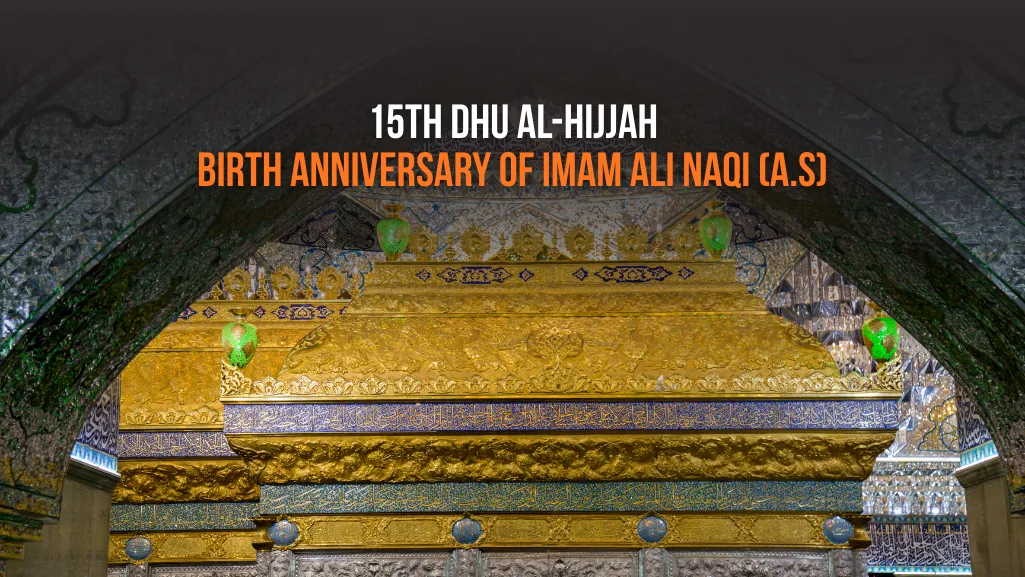
The life of Imam Ali Naqi (AS) reached its earthly conclusion in 254 AH, during the reign of the Abbasid Caliph Al-Mu'tazz. After years of forced residence in the military camp of Samarra where he was kept under constant surveillance, the Imam was martyred through poisoning. His passing was not merely the end of a life, but the culmination of a lifelong struggle to protect the sanctity of the faith from the corruption of the ruling elite.
Conclusion: The Legacy of Imam Ali Naqi (AS)
The legacy of the 10th Imam, Ali al-Hadi (AS), is defined by an unwavering commitment to truth and the intellectual guidance of the Muslim Ummah. Despite a lifetime of surveillance and hardship, his brilliance could not be dimmed, as he continued to nurture the seeds of knowledge and piety among his followers. He proved that the light of the Imamate is a divine gift that no worldly power can extinguish. His profound sayings and moral teachings continue to guide the hearts of the faithful toward humility and righteousness. Though he met a martyr's end, his influence survives in the collective conscience of the believers, reminding us that the path of the Ahlul-Bayt is one of eternal victory over tyranny.
“Visit Samarra
Experience the profound spirituality of visiting the shrine of Imam Ali al-Hadi (AS) in Samarra, Iraq. Walk where the 10th Imam lived and was martyred, and connect with the legacy of the Ahlul Bayt.
Visit Our Page: www.ziaratplanner.com”
For more information or any queries, feel free to contact us. We are always ready to help you plan a peaceful and blessed journey.