Abstract
The nights of 19–21 Ramadan mark the martyrdom of Imam Ali (AS), whose final days in Kufa reflect ultimate faith, justice, and devotion. Visiting Najaf and Kufa during these sacred nights allows believers to connect deeply with his legacy and gain immense spiritual blessings, as emphasized in Islamic sources. These nights offer a powerful reminder of truth, sacrifice, and the path of righteousness taught by Imam Ali (AS).
Introduction
Imam Ali ibn Abi Talib (AS) is one of the most important figures in Islam—the cousin, son-in-law, and closest companion of the Prophet Muhammad (PBUH), the first male to accept Islam, the first Imam, and the fourth khalifa. He was born inside the Holy Kaaba, a unique honor recorded by historians such as al-Mas'udi in Muruj al-Dhahab (Vol. 2) and Ibn Athir in al-Kamil fi al-Tarikh (Vol. 2). Raised in the Prophet's household, he grew under his guidance and became known for unmatched courage and faith.
Scholars explain that Qur'an 5:55, revealed about the one who gave charity while in ruku', refers to Imam Ali, as mentioned in Tafsir al-Tabari, Tafsir al-Qurtubi, and al-Durr al-Manthur. He is also included in the purity verse, Qur'an 33:33, as reported in Sahih Muslim and Tafsir Ibn Kathir. The Prophet (PBUH) praised him, saying, "I am the city of knowledge and Ali is its gate" (Sunan al-Tirmidhi, Hadith 3723), "Ali is from me and I am from him" (Sahih al-Tirmidhi, Hadith 3712), and "For whomever I am his mawla, Ali is his mawla" (Musnad Ahmad, Hadith 18464). His bravery in Badr, Uhud, Khandaq, and Khaybar and his justice and wisdom—preserved in Nahjul Balagha—make him a timeless model of leadership, truth, and piety.
Brief Biography of Imam Ali (AS)
| Name: | Ali ibn Abi Talib |
| Father: | Abu Talib ibn Abdul Muttalib |
| Mother: | Fatimah bint Asad |
| Kunyat (Patronymic Titles): | Abu al-Hassan Abu Turab (given by the Prophet SAW) |
| Alqaab (Titles): | • Ameer al-Mu'mineen • Asadullah (Lion of Allah) • Murtaza • Haider • Wali-Allah • Imam al-Muttaqeen |
| Date of Birth: | 13th Rajab, 30 Aam al-Fil Born inside the Kaaba (recorded by al-Mas'udi, Muruj al-Dhahab, vol. 2) |
| Place of Birth: | Holy Kaaba, Makkah |
| Date of Martyrdom: | 21st Ramadan, 40 AH |
| Day of Attack (Shab-e-Zarbat): | 19th Ramadan, 40 AH |
| Place of Martyrdom: | Masjid al-Kufa, Iraq |
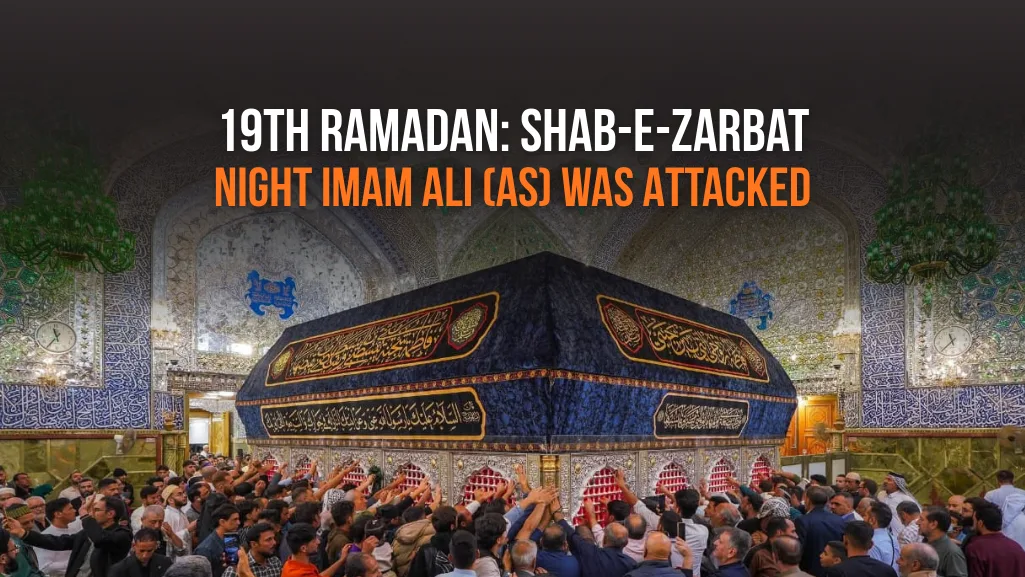
| Shrine: | Najaf al-Ashraf, Iraq |
| Marriage: | Lady Fatimah al-Zahra (SA), daughter of Prophet Muhammad (PBUH) |
| Children: | Hasan (AS), Hussain (AS), Zainab (SA), Umm Kulthum (SA) Several others from later marriages |
Key Fazilat (Virtues):
- First male to accept Islam
- Known for unmatched knowledge, courage, justice, and piety
- Prophet said: "I am the city of knowledge and Ali is its gate." — Sunan al-Tirmidhi, Hadith 3723
- Included in Ayat al-Tatheer (Qur'an 33:33)
- Verse Qur'an 5:55 revealed about him giving charity in ruku' (Tafsir al-Tabari, Tafsir al-Qurtubi)
Major Battles Participated:
- Battle of Badr
- Battle of Uhud
- Battle of Khandaq (Trench) — defeated Amr ibn Abd-Wudd
- Battle of Khaybar — lifted the gate of Khaybar
- Battle of Hunayn
- Battle of Jamal, Siffin, Nahrawan (during his caliphate)
Caliphate:
Fourth apparent Khalifa. Ruled from Kufa with justice and simplicity.
Famous Work:
Nahjul Balagha — collection of sermons, letters, and sayings
Shab-e-Zarbat, the 19th Night of Ramadan
Shab-e-Zarbat, the 19th night of Ramadan, is one of the most painful nights in Islamic history. It is the night when Imam Ali ibn Abi Talib (AS), the first Imam, the fourth caliph, and the "gate of knowledge," was struck with a poisoned sword during Fajr prayer in Masjid Kufa. His injury brought deep sorrow to the entire Muslim Ummah, because he was a man praised by the Prophet (PBUH), who said, "I am the city of knowledge and Ali is its gate" (Sunan al-Tirmidhi, Hadith 3723).
Many scholars also relate Qur'an 5:55, the verse about giving charity during ruku', to Imam Ali, and he is included in the people of purity in Qur'an 33:33. In this blog, you will read about who Imam Ali (AS) was, the events leading to this tragic night, the conspiracy behind the attack, what happened inside Masjid Kufa, Imam Ali's final advice, and the spiritual lessons we learn from this heartbreaking event. This night is not only a reminder of grief but also a source of guidance, patience, and deep reflection for every believer.
Historical Context: Imam Ali's Life Before Shab-e-Zarbat
Imam Ali (AS) grew up in the home of Prophet Muhammad, which shaped his character, faith, and knowledge from an early age. He was the first young male to accept Islam, and historians like Ibn Hisham and al-Tabari (Tarikh al-Tabari, Vol. 2) mention how closely the Prophet raised and trained him. Imam Ali's courage was seen in the battles of Badr, Uhud, Khandaq, and Khaybar. In Khaybar, the Prophet said, "I will give the banner to a man who loves Allah and His Messenger, and Allah and His Messenger love him," then gave it to Ali—a narration recorded in Sahih Muslim.
His appointment at Ghadir Khumm is confirmed through the hadith, "Whoever has me as his mawla, Ali is his mawla," found in Musnad Ahmad (Hadith 18464) and al-Nasa'i's Al-Khasa'is. Qur'anic verses 5:67 and 5:3 highlight the significance of this event.
As the ruler of Kufa, Imam Ali built a just and compassionate government. His letter to Malik al-Ashtar in Nahjul Balagha, Letter 53, remains one of the greatest documents of Islamic justice and leadership.
The Conspiracy Against Imam Ali (AS) — Detailed Explanation
The tragedy of Shab-e-Zarbat was the result of a long conspiracy that began after the Battle of Siffin. When arbitration was forced on Imam Ali (AS), a group from his own army became angry and broke away. This group, later called the Khawarij, developed extreme beliefs and wrongly blamed Imam Ali for accepting arbitration. Historians such as al-Tabari (Tarikh al-Tabari, Vol. 4) and Ibn al-Athir (Al-Kamil fi al-Tarikh, Vol. 3) record that their hatred led them to meet secretly in Makkah, where they planned to assassinate three leaders: Imam Ali (AS), Mu'awiya, and Amr ibn Aas.
For killing Imam Ali, they chose Abdur-Rahman ibn Muljim. According to al-Tabari and Ibn Kathir (al-Bidaya wa'l-Nihaya, Vol. 7), he traveled to Kufa, stayed with Khawarij supporters, and prepared a poisoned sword. Influenced by politics and personal motives, he waited for the early morning prayer in Masjid Kufa—the moment when he would strike Imam Ali (AS).
The Spiritual Atmosphere of the 19th Night of Ramadan
The 19th night of Ramadan, known as Shab-e-Zarbat, is one of the most spiritual nights in Islamic history. Many sources, including Bihar al-Anwar, Vol. 42, mention that Imam Ali (AS) behaved differently that night. He kept looking at the sky and said, "This is the night that I was promised," showing he knew his martyrdom was near. Instead of fear, he showed calmness, humility, and long prostrations. His state reflected the Qur'anic truth: "Every soul shall taste death" (3:185). Historians like al-Mas'udi (Muruj al-Dhahab, Vol. 2) note that he prayed more, ate simple food, and expressed deep gratitude, preparing to meet Allah with peace and certainty.
Imam Ali's (AS) Visit to His Daughter Umm Kulthum (SA) — A Night Wrapped in Sorrow and Divine Awareness
A Different Atmosphere on the Night of the 19th
The night of the 19th of Ramadan was unlike any ordinary night. Narrations in Bihar al-Anwar, vol. 42, mention that Imam Ali was quiet and deeply absorbed in worship, repeatedly looking toward the sky. He softly said, "By Allah, this is the night I was promised," showing he knew his time had come.
Imam Ali's Visit to His Daughter's Home
That evening, he visited his daughter Umm Kulthum for iftar. When she placed bread, salt, and milk before him, he removed the milk and said he wished to meet Allah with a simple meal. He told her gently that this would be his last night in the world, leaving her in tears.
A Heart Heavy With Hidden Pain
Inside the house, his family noticed he was unusually restless—walking in and out, sitting and standing repeatedly. They grew worried as he explained that the Prophet had already informed him long ago about the blow that would end his life. Imam Ali felt that moment approaching and prepared his heart with patience.
Foretelling His Martyrdom — "My Beard Will Be Dyed With Blood"
During their conversation, Imam Ali touched his beard and said, as recorded in Bihar al-Anwar, vol. 42, "Soon, this beard will be dyed with the blood of my head." His words shocked his daughter, but he comforted her and remained steady, fully accepting Allah's decree. He spoke with certainty, as if witnessing his destiny unfold.
His Final Advice to His Daughters
Before leaving, Imam Ali gathered his daughters and offered them sincere advice. He urged them to remain patient, hold fast to piety, and live with dignity despite hardships. These words were his final gift, guiding them for the life that awaited after his departure.
The Imam Leaves the House — The Final Goodbye
When he stepped outside, he paused and looked at the sky once more. Umm Kulthum followed him to the door, and he told her that if Allah willed, this would be his last return from the mosque. Imam Ali then walked toward Masjid Kufa, where Ibn Muljim waited, and where the prophecy of his martyrdom would soon be fulfilled.
The Poison and Its Effect
The strike of Ibn Muljim was meant to be fatal. Al-Irshad by Sheikh al-Mufid (pp. 20–23) states that his sword had been soaked in strong poison for days, designed to spread quickly and cause severe internal damage. The combination of the head wound and poison created intense pain and neurological weakness, making movement and speech difficult. Imam Ali's face became pale as the poison spread, and the physicians of Kufa knew the injury was beyond treatment. Bihar al-Anwar, Vol. 42, reports that he remained patient and in constant remembrance of Allah. His condition worsened from the 19th to the 21st of Ramadan, until the poison finally caused his martyrdom.
The Assassination in Masjid al-Kufa
On the morning of 19th Ramadan, Imam Ali (AS) woke before Fajr with a calm heart. Bihar al-Anwar, Vol. 42, mentions he felt a heaviness in the night and said, "O night, lengthen not, for you will not see Ali after this," showing he knew his martyrdom was near. He walked quietly toward Masjid al-Kufa in the darkness, taking what would be his final steps to prayer.
Inside the mosque, Ibn Muljim hid behind a pillar with a sword soaked in poison, as recorded in Tarikh al-Tabari, Vol. 4. As Imam Ali called the believers to prayer and entered sujood, Ibn Muljim struck him on the head.
In that moment, Imam Ali declared:
“"Fuztu wa Rabbil Ka'bah" — "By the Lord of the Kaaba, I am successful."”
This act fulfilled the meaning of Qur'an 33:23, describing those who complete their covenant with Allah through unwavering faith and sacrifice.
Lessons from Shab-e-Zarbat
Shab-e-Zarbat is a night of deep sorrow and powerful guidance. Imam Ali (AS) showed that real courage lies in humility and obedience to Allah, not in outward strength. He upheld justice even when it cost him power, fulfilling the Qur'anic command in 16:90. His forgiveness toward Ibn Muljim, despite the fatal strike, reflects unmatched mercy. As death approached, he remained peaceful, living the Qur'anic truth of 62:8. His teachings in Nahjul Balagha—about piety, the temporary nature of this world, and preparing for the Hereafter—remind believers to stay truthful, patient, and humble. Shab-e-Zarbat calls us to live with integrity, justice, and unwavering devotion to Allah.
Death, Funeral & Burial
Imam Ali (AS) passed away on the 21st of Ramadan, two days after being struck by the poisoned sword of Ibn Muljim in the Mihrab of Masjid Kufa (Bihar al-Anwar, Vol. 42). His final moments were spent in dhikr and advising his sons to uphold justice, prayer, and compassion as preserved in Nahjul Balagha, Letter 47. His body was washed and shrouded by Imam Hasan and Imam Husain (AS), and he was buried secretly in Najaf at night to protect his grave from the enemies of Ahl al-Bayt (al-Irshad by Shaykh al-Mufid, pp. 23–24). The burial location remained hidden for years until later Imams disclosed it.
Imam Ali's Final Will to Imam Hasan & Imam Hussain (AS)
When Imam Ali (AS) was struck and knew his life was nearing its end, he called his sons Imam Hasan and Imam Hussain (AS) and gave them a final will filled with wisdom. This will is recorded in Nahjul Balagha, Letter 47.
Taqwa and Worship
Imam Ali began by saying:
“"Fear Allah, and do not run after this world even if it comes to you."”
— He advised them to guard their daily prayers, reminding that prayer is the believer's link with Allah. This reflects the Qur'an's teaching: "Righteousness is… to establish prayer." (Qur'an 2:177)
Care for Orphans and the Weak
He said:
“"Fear Allah regarding the orphans; do not let them be hungry or lost."”
The Qur'an repeatedly emphasises caring for orphans and the vulnerable.
Unity and Brotherhood
Imam Ali urged them to keep Muslims united and avoid division, telling them to hold tightly to Allah's guidance—just as the Qur'an says: "Hold fast to the rope of Allah, all of you together." (Qur'an 3:103)
Justice and Supporting the Oppressed
He reminded them to always stand with justice, following the Qur'anic command: "Allah commands justice and doing good…" (Qur'an 16:90)
Truthfulness and Good Character
Finally, he advised:
“"Speak the truth, show mercy to the weak, and prepare for the Hereafter."”
These final words of Imam Ali remain a timeless guide for every believer who seeks a righteous and meaningful life.
Visiting Najaf and Kufa During the Sacred Nights of 19–21 Ramadan
Visiting Najaf and Kufa during the sacred nights of 19–21 Ramadan carries great spiritual reward. These are the nights when Imam Ali (AS) was struck and attained martyrdom—nights described as filled with angels and destiny (Qur'an 97:4). Scholars state that worship and ziyarat near his shrine bring forgiveness and answered prayers (Bihar al-Anwar, Vol. 97). Masjid Kufa is among the four holiest mosques, where one prayer equals a thousand (Man la Yahduruhu al-Faqih, Vol. 1). Being in these sacred sites during these nights connects believers to Imam Ali's courage, sacrifice, and spiritual light.
Join us for a special Ziyarat journey during the holiest nights of Imam Ali's martyrdom—Shab-e-Zarbat, Shab-e-Sakht, and Shab-e-Shahadat. These nights hold deep spiritual significance, when the heavens mourned and Imam Ali (AS) delivered his final words of justice and truth.
Strengthen your connection to Ahl al-Bayt on the most blessed nights of Ramadan.
“Book Your Ramadan Ziyarat Package Now - Experience Shab-e-Zarbat in Najaf & Kufa
Visit: www.ziaratplanner.com | Email: info@ziaratplanner.com | WhatsApp: +964 786 206 0777”
Conclusion
Shab-e-Zarbat remains a night of deep sorrow and powerful guidance. Imam Ali's (AS) martyrdom was not only a loss for the Ummah—it was a reminder that truth, justice, and faith stand firm even in the face of tyranny. His final words, "Fuztu wa Rabbil Ka'bah," teach that true success lies in returning to Allah with purity and sincerity. His courage, humility, and forgiveness illuminate the path for every believer. May Allah grant us the strength to follow Imam Ali's example, live with justice and compassion, support the oppressed, and remain steadfast in faith until our final moment. Ameen.
For more information or any queries, feel free to contact us. We are always ready to help you plan a peaceful and blessed journey.