“"The first to believe in the Messenger of Allah was Khadijah (SA)." — Al-Kafi, Vol. 1, P. 447”
Khadijah bint Khuwaylid, Malikatul Arab, was a pillar of strength for Prophet Muhammad (PBUH) and the early Muslim community. Let's explore her remarkable life and legacy.
Biography
| Name: | Khadijah al-Kubra |
| Father: | Khuwaylid ibn Asad |
| Mother: | Fatimah bint Za'idah |
| Place of Birth: | Makkah (Saudi Arabia) |
| Spouse: | Prophet Muhammad (PBUH) |
| Death: | 10th of Ramadan, Makkah |
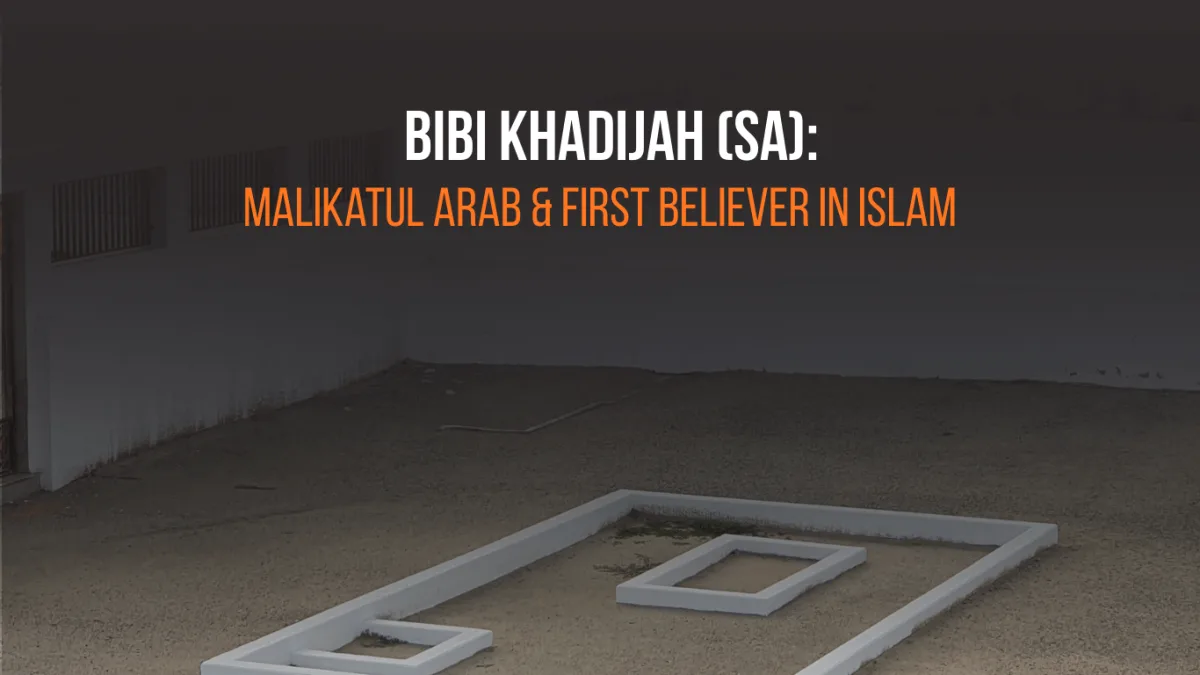
| Shrine (Grave): | Jannat al-Mu'alla (Makkah, Saudi Arabia) |
| Titles (Alqabat): | • Malikatul Arab (Queen of the Arabs) • Tahirah (The Pure One) • Siddiqah (The Truthful One) • Umm al-Mu'minin (Mother of the Believers) |
Her noble ancestry traces back to the tribe of Quraysh, known for leadership and integrity in Makkah. Her family managed the affairs of trade, diplomacy, and tribal responsibilities long before Islam. This heritage shaped her into a wise, strong, and respected woman even before she encountered the message of Islam.
Early Life
Khadijah (SA) was born into a noble family, the Quraish tribe, and was known for her exceptional beauty, intelligence, and strong character. Her father, Khuwaylid, was a successful merchant, and her mother, Fatimah, was a kind and gentle soul. Khadijah (SA) grew up in a society where women were often marginalized, but she defied conventions and became a successful businesswoman. She was known for her honesty, integrity, and kindness, earning her the title Tahira, the pure one.
Khadijah (SA) was a skilled trader and merchant, and her business flourished due to her honesty, integrity, and kindness. She was highly respected in Meccan society and was known as "The Princess of Quraish". Khadijah (SA) had a strong sense of justice and was known for her generosity and compassion towards the poor and needy. She was a kind and gentle soul, and her home was a center of hospitality and charity.
The Nikkah of Malikatul Arab: A Union of Faith and Trust
Khadijah (SA), Malikatul Arab, decided to marry Prophet Muhammad (PBUH) after being impressed by his honesty, trustworthiness, and noble character. She had heard about his reputation as "Al-Amin" (the trustworthy one) and wanted to marry him. She sent a proposal to him through a messenger.
The Prophet (PBUH) accepted the proposal, and they were married when he was 28 years old and she was 40. Abu Talib, the Prophet's (PBUH) uncle, recited the khutbah (sermon) for their nikkah (marriage ceremony). The marriage was a significant event in the Prophet's (PBUH) life, and Khadijah (SA) became his supportive partner and confidante.
After Marriage to Prophet Muhammad (PBUH)
After her marriage to Prophet Muhammad (PBUH), Khadijah (SA) dedicated herself to supporting the Prophet (PBUH) and spreading the message of Islam. She was the Prophet's (PBUH) confidante, advisor, and partner in every sense of the word. She provided emotional, financial, and spiritual support to the Prophet (PBUH), and her home became a center of Islamic activity.
Khadijah (SA) was the first person to believe in the Prophet's (PBUH) message and offered him unwavering support and backing. She stood by him during the difficult times, providing comfort and solace. The Prophet (PBUH) loved Khadijah (SA) dearly and often spoke of her virtues and sacrifices. He (PBUH) said, "I have not found a better wife than Khadijah. She believed in me when no one else did, and she supported me with her wealth and her life."
Khadijah (SA) played a pivotal role in the early days of Islam, and her contributions cannot be overstated. She was a true partner to the Prophet (PBUH) and a devoted mother to their children.
Words of Faithfulness
“"By Allah, Allah shall never subject you to any indignity..., for you always maintain your ties with those of your kin, and you are always generous in giving" [1]
"You are the trustworthy one, and I trust you with my life" [1]
"I will support you with my wealth and my life" [1]
"You are the chosen one, and I will stand by you" [1]”
Her Historic Words
“"I believe in you, O Muhammad, and I know that you are the Messenger of Allah."”
— Khadijah bint Khuwaylid, Al-Sira Al-Nabawiyah, Page 145
“"By Allah, Allah will never disgrace you, for you are kind to your relatives, truthful in speech, and helpful to the poor and the needy."”
— Khadijah bint Khuwaylid, Sahih Bukhari, Volume 1, Book 1, Hadith 3
Contribution to Islam
The contribution of Bibi Khadijah (SA) to Islam is unmatched and foundational. When the Prophet (PBUH & his family) received the first revelation in the Cave of Hira, she was the very first person to believe in him.
Her support was not limited to belief alone. She dedicated her entire wealth to the mission of Islam. Imam Ali (AS) affirmed in Bihar al-Anwar (vol. 19, p. 7) that no wealth ever benefited Islam as much as the wealth of Khadijah. Her financial contributions fed, sheltered, and protected the early Muslim community when persecution was at its peak. Her home became the first center of Islamic da'wah, where early Muslims gathered to learn and strengthen their faith.
Emotionally, she was the greatest comfort to the Prophet (PBUH). Whenever he faced rejection, mockery, or physical harm from Quraysh, she received him with love, reassurance, and unwavering loyalty. The Prophet (PBUH) said, "She believed in me when people denied me" (Bihar al-Anwar, vol. 16, p. 22). Her presence was so vital that he also stated, "Islam did not rise except through the sword of Ali and the wealth of Khadijah," preserved in Dalā'il al-Imāmah (p. 30).
Through her, the lineage of the Prophet continued in the form of Sayyida Fatima Zahra (SA), mother of the Imams, making her contributions spiritually eternal.
Quranic Verse
“"And He found you in need and made you independent."”
— Surah Al-Duha, 93:8
This verse refers to the financial support Khadijah (SA) provided to Prophet Muhammad (PBUH) during the early days of his prophethood, freeing him to devote himself to his mission.
Important Battles
Although Bibi Khadijah (SA) passed away before the major Islamic battles such as Badr, Uhud, and Khandaq took place, her impact on these historical events remained profound. Her wealth had preserved the Muslim community during the most fragile time in its existence — especially during the three-year boycott in Shi'b Abi Talib, a period marked by hunger, suffering, and social isolation.
Almost all resources that sustained Muslims during the siege came from her wealth, as documented in Manaqib Ibn Shahr Ashub (vol. 1, p. 158). The Muslims who survived that boycott — funded by Khadijah (SA) — later became the soldiers of Badr and defenders of Uhud. Her emotional support had strengthened the Prophet (PBUH) during the early years of hostility, building in him the resolve that he would later need in the battlefield.
Thus, although she did not live to witness the battles, their victories were built on the foundation she helped create. The Prophet (PBUH) himself acknowledged her role when he said she supported him "with herself and her wealth," a phrase preserved and reaffirmed in Bihar al-Anwar (vol. 16).
Sha'b Abi Talib and the Beginning of the 'Amul Huzn
Sha'b Abi Talib—the Valley of Abu Talib—stands as one of the darkest and most heart-wrenching chapters in early Islamic history. It was here that Quraysh enforced a ruthless social and economic boycott on the Prophet Muhammad (PBUH & his pure family), Bibi Khadija al-Kubra (SA), Imam Ali (AS), and the entire Banu Hashim.
For three long years, beginning around the seventh year of Prophethood, the Muslims were trapped inside this narrow mountain valley with no access to food, water, trade, supplies, or outside support. The boycott document, hung inside the Kaaba, declared that no tribe would marry them, buy from them, sell to them, or even speak to them.
The suffering inside Sha'b Abi Talib was so severe that many nights passed with nothing to eat except dry leaves and water from the rocky streams, and even that was often unavailable. Children cried from hunger, elders grew weak, and Bibi Khadija (SA)—once the wealthiest woman in Arabia—spent every last coin, jewel, and resource she possessed to secretly purchase whatever small amount of food could be smuggled into the valley.
Imam Ali (AS), still young but courageous, risked his life by venturing out at night to find supplies for the believers. Despite the brutality of Quraysh, the people of the valley held fast to faith, protected by the relentless courage of Abu Talib (AS) and the soothing sacrifice of Bibi Khadija (SA), who comforted the Prophet (PBUH) through every hardship.
When the boycott finally collapsed—after insects (Termite) had eaten the oppressive document inside the Kaaba—its physical and emotional effects were irreversible.
The years of starvation, exposure to harsh weather, constant fear, and exhaustion had deeply damaged the health of both Bibi Khadija (SA) and Abu Talib (AS). Within a short period after emerging from the valley, first Abu Talib (AS) passed away, and then Bibi Khadija (SA) followed, her weakened body unable to recover from the years of suffering she endured for Islam.
Their deaths occurred in the same year, plunging the Prophet (PBUH & his purified family) into profound grief. This year became known in history as the 'Amul Huzn—the Year of Sorrow.
With the passing of Abu Talib (AS), the Prophet (PBUH) lost his greatest political and physical protector in Makkah; with the passing of Bibi Khadija (SA), he lost the companion whose love, wealth, faith, and steadfast support had been the foundation of the early Islamic mission.
The 'Amul Huzn marks not only the death of two of the Prophet's (PBUH) most loyal supporters but also the end of an era of unconditional protection, tenderness, and strength that had sustained him through the harshest years of revelation. Their sacrifices in Sha'b Abi Talib remain among the most powerful symbols of loyalty, faith, and devotion in Islamic history.
Fazail of Visiting Her Shrine
Although the historical structure of her shrine in Jannat al-Mu'alla was demolished, the spiritual value of the site remains immense. Pilgrims visiting her grave feel deep tranquility, remembering her sacrifices for Islam.
Scholars note that Ziyarah at her resting place is a source of barakah, strengthening love for Ahlulbayt (AS) and inspiring patience. Many narrations also mention that duas made near the graves of righteous believers are accepted by Allah.
Conclusion
Khadijah al-Kubra (SA), Malikatul Arab, was the epitome of support and devotion to Prophet Muhammad (PBUH). Her unwavering faith, love, and sacrifices paved the way for Islam's early success. She stood by the Prophet (PBUH) through persecution and hardship, offering comfort and strength.
Her legacy as a symbol of kindness, generosity, and unwavering loyalty continues to inspire Muslims worldwide.
References
[1] Al-Kafi, Volume 1, Page 437, Hadith 1 (Kitab al-Hujjah)
[2] Bihar al-Anwar, Volume 16, Page 191
[3] Nahjul Balagha, Sermon 192
[4] Sahih Al-Bukhari – Book 58 Hadith 164
For more information or any queries, feel free to contact us. We are always ready to help you plan a peaceful and blessed journey.