Introductory words
Throughout human history, the struggle between truth and falsehood has remained a timeless battle. While oppressive regimes have often used power and manipulation to suppress the truth, divine leaders appointed by God have consistently upheld justice, guided the masses, and stood firm against tyranny. Among these luminous personalities is Imam Muhammad al-Taqi (a), also known as al-Jawad, the ninth Imam from the noble lineage of the Ahlul Bayt (a)
Imam al-Taqi (a) assumed the immense responsibility of Imamate at a remarkably young age. Despite his youth, he displayed unmatched wisdom, spiritual excellence, and scholarly brilliance that astonished both followers and opponents alike. His life is a shining example of how the torchbearers of truth can outshine even the most cunning plots of the oppressive powers.
This blog, titled Imam Muhammad al-Taqi (a): Triumph of Truth Over Tyranny," aims to explore the pivotal role of the Imam in an era rife with political deception and religious challenges. Through his intellectual strength, moral integrity, and divine insight, Imam al-Taqi (a) emerged as a beacon of resistance and righteousness, proving that truth, no matter how young or seemingly weak, always prevails over falsehood.
A Introduction to Imam Muhammad al-Taqi (a)
Imam Muhammad al-Taqi (a) the ninth luminous star in the lineage of the Ahlul-Bayt (a) is remembered with the revered title “al-Jawad”, meaning The Most Generous. He was born on the 10th of Rajab, 195 AH in the holy city of Medina. His father was the noble Imam Ali al-Ridha (a), and his mother was the lady Sayyida Sabīkah (also referred to in some sources as Khayzran), a woman of deep faith and spiritual excellence.
The birth of Imam al-Taqi (a) was seen as a divine response to the taunts and doubts surrounding >Imam alRidha (a). For much of Imam Ridha’s life, he had no children, leading some skeptics and enemies of the AhlulBayt (a) to mockingly label him as “abtar”a derogatory term meaning cut off or without progeny. However, Allah silenced their mockery with the blessed arrival of Imam Muhammad al-Taqi (a), who not only continued the sacred line of Imamate but also became a symbol of knowledge, purity, generosity, and strength.
Imam al-Taqi (a) assumed the responsibility of Imamate at the incredibly young age of just eight years old, following the martyrdom of his father. This early succession was both a test and a miracle—astonishing the enemies of Ahlul-Bayt (a) and challenging the belief of many followers. Yet, Imam al-Taqi (a) proved to be divinely appointed and deeply capable, demonstrating wisdom and knowledge that silenced the scholars of the Abbasid court and even the most seasoned theologians.
He was the only son of Imam al-Ridha (a) and the father of the tenth Imam, Imam Ali al-Naqi (a). Through him, the chain of divine guidance continued unbroken. His brief but impactful life was a testimony that divine authority and spiritual leadership are granted by Allah not by age, worldly status, or power. Imam al-Taqi (a)’s legacy continues to inspire millions, and his life story stands as a beacon of hope and strength in the face of falsehood and oppression.
The Childhood of Imam Muhammad al-Taqi (a)
The childhood of Imam Muhammad al-Taqi (a) was unlike that of ordinary children. Born in 195 AH during the politically sensitive period of his father Imam Ali al-Ridha’s (a) vice-regency under the Abbasid Caliphate, Imam al-Taqi’s (a) arrival brought divine reassurance to the Ahlul-bayt (a) and stood as a heavenly response to the conspiracies of their enemies. From an early age, the Imam exhibited extraordinary qualities of piety, wisdom, and spiritual depth. Unlike other children, he was not inclined toward playful distractions. Instead, he showed a deep interest in reflection, remembrance of Allah, and seeking knowledge. His presence radiated tranquility, and his behavior displayed maturity far beyond his years.
Imam al-Ridha (a) would lovingly look upon his young son and say:
"This is the blessed child no child born in Islam has brought more blessings to our followers than he has." Historical accounts tell us that even in the streets of Medina, scholars and elders would be struck by the luminous presence of the young Imam. His radiant face and composed demeanor hinted at the divine mission he was destined for. He had a deep understanding of the Qur'an, and his thoughtfulness and spiritual focus made him stand out even in childhood.
The divine nature of his upbringing became even more evident when, at the tender age of eight, Imam Muhammad al-Taqi (a) was entrusted with the leadership of the Ummah after the martyrdom of his father. This moment shattered the notion that spiritual leadership depends on age or worldly experience. The Imam, though young in years, silenced seasoned scholars and politicians with his unmatched wisdom and authority —proving that Imamate is a divine appointment, not a human choice. The childhood of Imam al-Taqi (a) was a sacred prelude to his divinely guided mission. It was during these early years that God nurtured His representative in the cradle of purity and knowledge so that he could one day stand as a light of guidance against falsehood, even in the most corrupt of courts.
Historical Background
The Imamate of Imam Muhammad al-Taqi (a) unfolded during one of the most politically sensitive and turbulent periods of the Abbasid Caliphate. While the Abbasid rulers outwardly posed as protectors of Islam, in reality, they were deeply threatened by the rising spiritual influence and popularity of the Ahlul-Bayt (a). To suppress their message, many of the Imams were subjected to imprisonment, surveillance, or martyrdom strategies aimed at cutting off their reach from the masses.
When Imam Ali al-Ridha (a) was appointed as the crown prince by ,Caliph al-Ma'mun, it was not a gesture of honor but a calculated political move. Al-Ma'mun sought to neutralize the Imam’s spiritual authority by
bringing him into the Abbasid court. However, Imam al-Ridha (a) countered these political maneuvers with wisdom, integrity, and unwavering commitment to divine principles. After Imam al-Ridha (a) was *martyred in Khorasan, his young son, Imam Muhammad al-Taqi (a), assumed the responsibilities of the Imamate in 203 AH at just eight years of age. The youthfulness of the Imam was both a test for the believers and a miraculous sign of divine guidance.
Al-Ma'mun, continuing his political strategy, summoned the young Imam to his court and arranged his marriage with his daughter, Umm al-Fazl. This marriage was an attempt to integrate the Imam into the royal structure and restrict his independent religious outreach and teachings When al-Ma'mun died, he was succeeded by al-Mu'tasim, a harsh, power-driven, and oppressive ruler who viewed Imam al-Taqi (a) as a threat to his regime. Under Mu’tasim’s rule, the pressure on the Imam intensified. Eventually, the Imam was forced to relocate to Baghdad, where he was kept under close surveillance until he was poisoned and martyred a tragic end engineered by the Abbasid authorities.
This era was one of severe trials for the followers of the Ahlul-Bayt (a). The outward power was in the hands of false caliphs, but the spiritual leadership remained alive through luminous figures like Imam al-Taqi (a). Despite his young age, the Imam confronted political deception, theological challenges, and the treachery of the Abbasid court with unmatched patience, profound knowledge, and divine composure. The life of Imam Muhammad al-Taqi (a) stands as a timeless example of truth confronting tyranny, and divine light shining through the darkest of political storms.
Imam Al Jawad's knowledge and landmark debate in the Abbasid Court
Imam Muhammad Taqi (A.S.) had very little opportunity to receive knowledge and training directly from his father. At the tender age of just six, his father, Imam Ali Raza (A.S.), was forced into exile from Medina by the Abbasid Caliph Mamun Rashid, who also insisted that the Imam’s family remain in Medina. In this state of separation and hardship, the martyrdom of Imam Ali Raza (A.S.), known as Ghareeb-ul-Ghuraba (The Stranger among Strangers), took place. At only eight years old, Imam Muhammad Taqi (A.S.) took on the significant responsibilities of Imamate. Many people, unfamiliar with the greatness of the Prophet’s family (Ahl al-Bayt) and unaware of the spiritual sanctity of the Imamate, wrongly assumed that such a young Imam could not possess the same intellectual and spiritual leadership. However, this misconception was soon dispelled.
During a visit to Medina, Caliph Mamun Rashid encountered Imam Muhammad Taqi (A.S.) in the marketplace and engaged him in a conversation. When Mamun attempted to test the young Imam’s knowledge, the Imam responded with the eloquence and depth characteristic of the Household of the Prophet. He said, “Allah has created small fish in the ocean of His power, and the rulers of the time try to catch these with their falcons to test the knowledge of the Ahl al-Bayt.”
Impressed by the Imam’s unmatched wisdom, Mamun Rashid brought him to the capital. For political reasons, Mamun wished to marry his daughter, Umm al-Fadl, to Imam Muhammad Taqi (A.S.). This decision faced strong opposition from the Abbasid family, who also opposed Imam Ali Raza’s appointment as heir apparent during his time. Despite opposition, Mamun justified his decision by pointing to the Imam's exceptional knowledge. To publicly demonstrate this, he arranged a grand scholarly debate between Imam Muhammad Taqi (A.S.) and the most respected scholar and judge of that era, Qadi Yahya ibn Aktham. In this historic intellectual duel, the young Imam not only answered the judge's complex questions with precision but also posed a question in return that left the Qadi speechless.
This remarkable debate is recorded in many historical sources. It confirmed Imam Muhammad Taqi’s divine wisdom and unmatched intellect, despite his young age. The event silenced all critics and proved that the chosen members of the Prophet's family (Ahl al-Bayt) are gifted not only with purity and righteousness but also with divine knowledge and wisdom. Recognizing his scholarly superiority, Mamun officially married his daughter Umm al-Fadl to Imam Muhammad Taqi (A.S.), affirming his status as a true spiritual and intellectual leader.
The Role of Imam Muhammad al-Taqi (a) Under a Tyrannical Regime
The period of Imam Muhammad al-Taqi’s (a) Imamate coincided with some of the most oppressive and politically manipulative phases of the Abbasid Caliphate. Though the Abbasid rulers outwardly claimed to uphold Islamic values and represent the Prophet’s legacy, inwardly they feared the growing influence and spiritual authority of the Ahlul Bayt (a). This fear often translated into severe restrictions, imprisonment, and even martyrdom of the Imams to suppress their message. After the martyrdom of Imam Ali al-Ridha (a), Imam al-Taqi (a) assumed the divine responsibility of Imamate at the young age of only eight. The Abbasids, particularly Caliph al-Ma’mun, initially underestimated him due to his age. However, Imam al-Taqi (a) soon demonstrated that true leadership and divine knowledge were not bound by age but were rooted in divine guidance.
Ma’mun, though outwardly lenient toward the Ahlul Bayt (a), had deep political motives. He summoned the young Imam to his court, arranged his marriage to his daughter Umm al-Fadl, and attempted to contain the Imam’s influence by keeping him close under watch. After Ma’mun’s death, his successor, al-Mu‘tasim, was far more hostile and oppressive. He perceived Imam al-Taqi (a)’s growing influence and integrity as a threat to his authority. Despite being under constant surveillance, political pressure, and courtly plots, Imam Muhammad al-Taqi (a) remained steadfast in truth, justice, and the principles of Islam. He demonstrated that even within a tyrannical system, one could uphold righteousness through wisdom, knowledge, and unshakable faith.
Imam’s fearless stance, moral dignity, and scholarly brilliance exposed the illegitimacy of the rulers’ authority.
He refused to compromise on divine truth and became a shining example of resistance through spiritual leadership. Even when others chose silence in fear, Imam al-Taqi (a) upheld the banner of truth with courage
and clarity. Eventually, unable to bear the Imam’s influence and popularity, Caliph al Mu‘tasim resorted to poisoning and martyring him. However, this tragic end only illuminated the eternal truth: oppressive regimes perish, but the light of divine guidance carried by the Ahlul Bayt (a) continues to shine and inspire.
The Spiritual Upbringing and Scholarly Legacy of Imam Muhammad al-Taqi (a)
Among the many luminous aspects of Imam Muhammad al-Taqi’s (a) life, one of the most remarkable was his commitment to spiritual development and training of students who became the intellectual pillars of the Shi'a tradition.
Divinely Guided Upbringing: Wisdom Beyond His Years Imam al-Taqi (a) was raised in a home glowing with piety and divine knowledge. His father,Imam Ali al-Ridha (a), personally nurtured his spiritual and intellectual development. Although the Imam lost his father at a young age due to martyrdom in the court of al-Ma’mun, his inner strength, divine knowledge, and moral excellence became evident early on. His upbringing shaped him into a paragon of wisdom, even in his childhood.
Training Future Scholars: Building the Intellectual Backbone of Shi'ism
Despite living under the shadow of oppressive Abbasid rule, Imam al-Taqi (a) focused on mentoring and guiding a select group of devoted students. These individuals later emerged as the torchbearers of Shi'a theology, jurisprudence, and philosophy. Notable among his students were:
Ali ibn Mahziyar Ahwazi Muhammad ibn Isma'il ibn Bazi’ Fadl ibn Shadhan Ahmad ibn Muhammad ibn Abi Nasr al-Bazanti Through his mentorship, Imam al-Taqi (a) laid a strong intellectual foundation that strengthened Shi’a thought in the face of both internal challenges and external threats.
Ethical Teachings and Spiritual Wisdom.
The Imam (a) didn’t just impart legal and theological knowledge he also deeply emphasized ethics, humility, patience, and devotion to God. His sayings reflect profound spiritual insight and timeless moral guidance. One
of his famous quotes: The wisest person is the one who avoids what does not concern him; and the most sorrowful is the one who envies others.
(Bihar al-Anwar, vol. 75,)
Such teachings continue to inspire seekers of knowledge and spirituality to this day.
Safeguarding the Intellectual Identity of Ahlul Bayt (a).
Imam al-Taqi (a) played a crucial role in preserving and advancing the ideological framework of the AhlulBayt (a) despite living under surveillance and suppression. His depth of knowledge, unwavering faith, and strategic mentorship ensured that the divine message remained alive and intellectually sound in an era of widespread distortion.
Date of Martyrdom.
Imam Muhammad al-Taqi (a), the ninth Imam of the Ahlul-Bayt, was martyred on the 29th of Dhul Qa'dah, 220 AH in Baghdad at the young age of 25. His martyrdom was orchestrated by the Abbasid Caliph alMu’tasim, who viewed the Imam’s growing influence as a threat to his authority. The Imam was poisoned in a calculated political assassination another painful chapter in the oppression faced by the family of the Prophet(s).
The Imam’s Final Will and Burial Rites.
Before his passing, Imam al-Taqi (a) appointed his young son, Imam Ali al-Naqi (a), as his successor and the next rightful guide for the Ummah. This spiritual bequest ensured the continuity of divine guidance through the Imamate. Despite being under heavy surveillance, the Imam’s followers and family ensured that his funeral rites were carried out with dignity and respect. His burial was a solemn occasion marked by reverence and deep sorrow from the Shi'a community.
Final Resting Place.
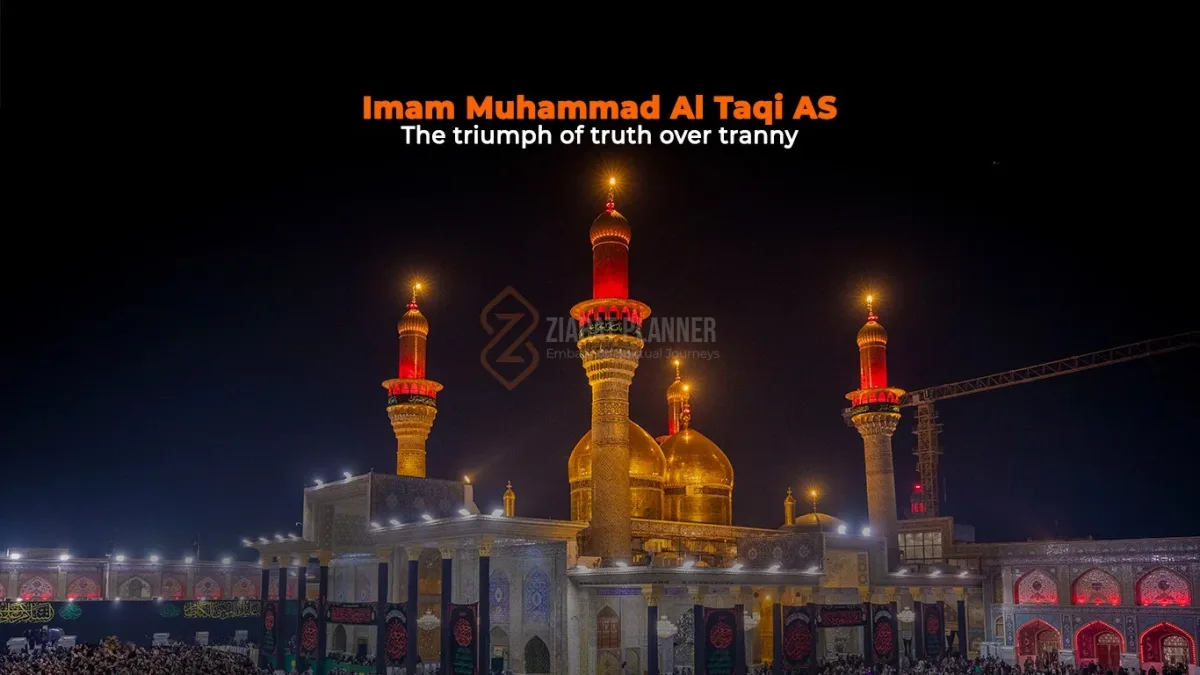
Imam Muhammad al-Taqi (a) is buried in Kazimayn, a revered city in Iraq. He was laid to rest beside his grandfather, Imam Musa al-Kazim (a), the seventh Imam of the Ahlul-Bayt. The shrine is known today as AlKazimayn Holy Shrine and serves as one of the most important pilgrimage sites for Shia Muslims worldwide.
Significance of Kazimayn: The Twin Lights of Baghdad Kazimayn, meaning *"The Two Kazim's" (those who restrain anger), is a district located in the northern part of Baghdad. It is home to the sacred shrines of:
Imam Musa al-Kazim (a)
Imam Muhammad al-Taqi (a)
The Kazmain shrine is a beacon of spirituality, knowledge, and resistance against tyranny. It draws millions
of pilgrims annually, who come to pay their respects, offer prayers, and connect with the legacy of the AhlulBayt. The spiritual ambiance of this shrine is deeply moving—filled with *recitations of Ziyarah, supplications, and
heartfelt tears of love and loyalty.
The Spiritual Merit of Visiting the Shrines of the Imams: A Divine Connection.
Ibrahim narrates that he once wrote to Imam Ali al-Naqi (a), asking about the significance of visiting the holy shrines of Imam Hussain (a), Imam Musa al-Kadhim (a), and Imam Muhammad al-Taqi (a). In his response, the Imam wrote: The Ziyarat (pilgrimage) of Aba Abdillah Imam Hussain (a) is the most superior and holds the highest priority among all. However, the Ziyarat of Kadhimayn (where Imam Musa al-Kadhim and Imam Muhammad al-Taqi are buried) is more comprehensive in its spiritual benefits and holds tremendous divine reward.
In another narration, Imam Ja'far al-Sadiq (a) was asked,
"What is the reward of visiting one of the Imams from among you?”
The Imam replied:
The one who performs Ziyarat of an Imam from among us, it is as if he has visited the Messenger of Allah
(s). Kamil uz ziyarat
Sayings of Imam muhammad Al-Taqi(AS).
Man’s Utter Dependence and Allah’s Infinite Self-Sufficiency Man is the embodiment of need, while Allah (SWT) is the Absolute and Self-Sufficient, possessing all that creation could ever require. If, even for a moment, His divine gaze of mercy is withheld, the world would turn into a living hell for humanity. Allah never abandons His servant, except when the servant chooses to place his hope in something or someone other than Allah.
Imam Muhammad al-Taqi (a) said:
One who attaches his heart to other than Allah, Allah leaves him to his own condition.
Hard Work Is the Key to True Success Allah does not waste the efforts of anyone. Diligent work is the bridge to meaningful achievements. The more noble and lofty the goal, the more effort it demands.
Imam al-Jawad (a) advised:
Strive hard today so that you may reach your goal; otherwise, you will be left in grief and regret. This golden advice reminds us that without hard work, success is only a dream.
Sins Bring Calamities, While Dua and Istighfar Remove Them Sins are a major cause of trials and tribulations, while du'a (supplication) and istighfar (seeking forgiveness) act as shields that repel divine wrath and remove afflictions.
In a short yet powerful statement, Imam al-Jawad (a) said:
Supplication drives away calamities. This highlights the spiritual and practical power of prayer in transforming one's life and removing hardships.
The Four Pillars of Action: No Excuses Left Enjoying blessings obliges gratitude and obedience to the One who bestows them. According to Imam Muhammad al-Taqi (a), there are four divine gifts that, when present, leave no excuse for inaction:
1. Good health
2. Sufficiency and financial independence
3. Knowledge
4. Divine help (tawfiq)
These four pillars empower a person to act. When they are present, not acting becomes a form of ingratitude.
The Greatest Moral Corruption: Greed While every sin causes spiritual harm, there is one trait that destroys a person from within, eroding dignity and poisoning character Greed.
Imam Muhammad al-Taqi (a) warned: Nothing corrupts a person more than greed. Greed blinds the soul, robs contentment, and leads to dishonor. Avoiding greed is key to preserving one’s spiritual and social integrity. Jalwa E Noor
Conclusion:
A Beacon of Light in Times of Darkness The life of Imam Muhammad al-Taqi (a) is a radiant example of piety, knowledge, patience, and steadfastness. Despite his young age, he stood firm against the oppressive Abbasid regime and illuminated the path of truth through his wisdom, ethics, and unwavering stand for justice. His noble character teaches us that no matter how challenging the circumstances, if one remains connected to Allah, acts with sincerity, and speaks with integrity, then even the strongest storms of falsehood cannot shake them. In today’s world, where truth is often sacrificed for worldly gain and standing for justice is seen as a risk, the life of Imam al-Jawad (a) offers a timeless lesson in resilience, self-respect, and spiritual clarity. For the youthespecially, his personality stands as a perfect role model—balancing intellect with faith and courage with humility.May Allah grant us the ability to walk in the footsteps of Imam Muhammad al-Taqi (a), and may we live by histeachings in our daily lives. O Allah, hasten the reappearance of Your Wali (Imam Mahdi a.s), and include us among his helpers,supporters, and defenders.(AMEEN)
For more information or any queries, feel free to contact us. We are always ready to help you plan a peaceful and blessed journey.