Introduction
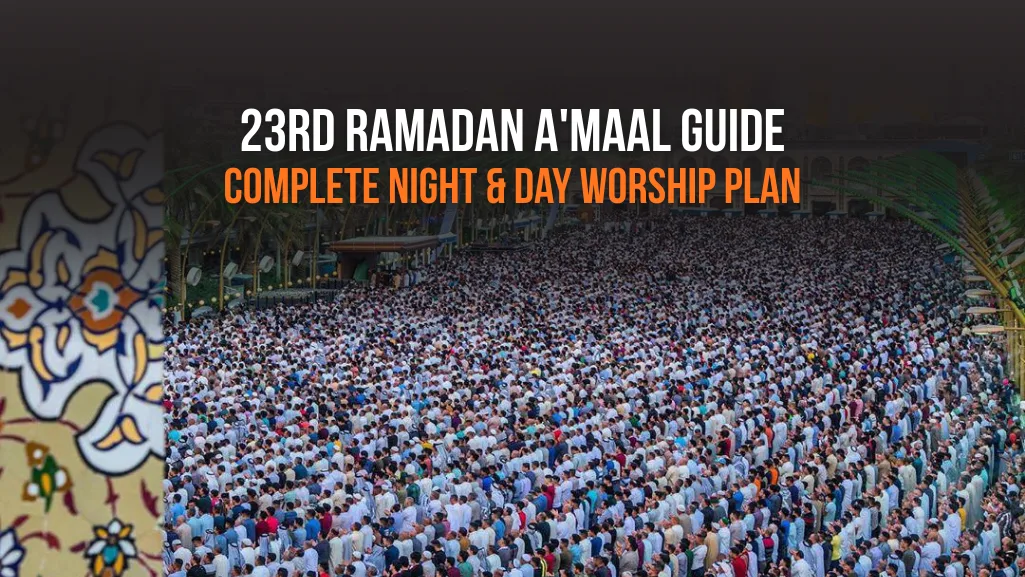
The 23rd night of Ramadan is one of the most sacred nights in Islam and is regarded by the majority of Shia scholars as the most likely night of Laylatul Qadr. Laylatul Qadr, also known as the Night of Destiny, is the night when Allah decrees the affairs of the coming year. It is a night filled with mercy, forgiveness, and spiritual elevation. The Holy Qur'an describes this night beautifully in Surah al-Qadr (97:1), reminding us that it is the night in which the Qur'an was first revealed and that it is "better than a thousand months."
For Shia Muslims, the main source for the recommended acts of worship on this night is Mafatih al-Jinan, compiled by Sheikh Abbas Qummi. This book collects authentic duas, supplications, and a'maal specifically narrated for the blessed nights of Ramadan, with a special focus on the nights of Qadr.
Among these, the 23rd night receives the highest emphasis from the Imams. Imam al-Sadiq (AS) is reported to have said that this is the true Night of Qadr, as narrated in Bihar al-Anwar, Vol. 94. Similarly, Kitab al-Kafi, Vol. 4, includes traditions confirming the importance of this night above the others.
The virtues of this night include forgiveness of past sins, acceptance of prayers, protection from harm, increase in sustenance (rizq), blessings in life, and the rewriting of one's destiny with goodness. This article aims to guide readers through the authentic a'maal of this powerful night with clear references, simple explanations, and practical steps.
Significance of the 23rd Night
The 23rd night of Ramadan is considered by many scholars and believers to be the strongest candidate for Laylatul Qadr, the Night of Destiny. This belief is supported by clear statements from the Imams. Imam al-Baqir (AS) said, "The 23rd night is the night of Qadr," as recorded in al-Kafi, Vol. 4, p. 159. Similarly, Imam al-Sadiq (AS) explained that "The 21st is one of the nights, and the 23rd is the night of Qadr," mentioned in al-Tahdhib, Vol. 3, p. 60. Another narration from al-Kafi, Vol. 1, p. 532 states that on this night, angels and the Rooh descend upon the Imam of the time, bringing the decrees for the entire year.
The Qur'an itself highlights the greatness of this night in Surah al-Qadr (97). It describes Laylatul Qadr as the night when the Qur'an was revealed, a night "better than a thousand months," when countless angels descend with peace and blessings until dawn. These verses show that this night carries unmatched spiritual weight, offering a lifetime of reward in a few hours of sincere worship.
In Mafatih al-Jinan, pp. 240–260, the chapter "A'maal of the Nights of Qadr" gathers many narrations that emphasize special acts for this night. These include performing ghusl as a purification, reciting long duas with sincerity, performing the two-rak'at special prayer, reading Dua al-Jawshan al-Kabir, and reciting the Ziyarah of Imam Husain (AS). Each of these actions has been recommended for attracting mercy, forgiveness, and divine closeness.
Because of these clear hadith, Qur'anic verses, and the practices preserved in Mafatih al-Jinan, the 23rd night stands out as the most significant night of Ramadan, offering believers a precious opportunity to shape their destiny with prayer, repentance, and hope.
General A'maal of All Three Nights (19, 21, 23) - Performed Also on the 23rd Night
The three nights of 19th, 21st, and 23rd Ramadan are known as the Nights of Qadr. Our Imams taught special a'maal for these nights, and all of them apply to the 23rd night as well. Most details come from Mafatih al-Jinan by Sheikh Abbas Qummi.
1. Ghusl (Purification Bath)
It is recommended to perform Ghusl at sunset or before Maghrib. This act prepares the body and heart for worship and symbolizes starting the night with purity. This ruling is mentioned in Mafatih al-Jinan, p. 242. Scholars explain that entering these nights clean helps increase focus, humility, and sincerity in dua.
2. Two Rakat Prayer
A special two-rakat prayer is advised for all three nights. In each rakat, one recites Surah al-Fatiha followed by Surah al-Ikhlas seven times. This prayer brings a life filled with righteousness and protection, as stated in Mafatih, p. 243. The repetition of Surah al-Ikhlas softens the heart and reminds us of Allah's complete oneness.
3. Placing the Quran on the Head
This ritual is a moment of deep submission. One holds the Quran on the head and recites: "Bi haqqi Qur'anika…" mentioning the names: Allah, Muhammad, Ali, Fatimah, Hasan, and Husain. This practice appears in Mafatih, p. 247. It symbolizes seeking protection, mercy, and a good destiny through Allah's Book and the Ahl al-Bayt.
4. Dua al-Jawshan al-Kabir
This is one of the most powerful supplications of Islam, containing 100 sections and 1000 Divine Names. It is highly emphasized in all Nights of Qadr as recorded in Mafatih, pp. 250–260. The dua teaches the believer to call upon Allah through His attributes of mercy, strength, and protection.
5. Ziyarah of Imam Husain (AS)
The Imams strongly encouraged performing the Ziyarah of Imam Husain on these nights. According to narrations, its reward equals one thousand accepted Hajj. This is mentioned in Kamil al-Ziyarat, p. 174 and in the Ziyarah section of Mafatih. Ziyarah strengthens love for the Ahl al-Bayt and opens the doors of forgiveness.
6. Istighfar (Seeking Forgiveness)
One should recite: "Astaghfirullaha Rabbi wa Atubu Ilayh" seventy times. This act is recorded in Mafatih, p. 244. The angels write forgiveness for the believer who repents sincerely. This prepares the heart to fully benefit from the blessings of the 23rd night.
Specific A'maal of the 23rd Night
The 23rd night of Ramadan is considered the strongest night of Laylatul Qadr. Many narrations explain that destinies are written, sins are forgiven, and the gates of mercy are fully open. Allah describes this blessed night in Surah al-Qadr as a night when angels descend and peace continues until Fajr. Because of its greatness, the Imams taught detailed a'maal to perform on this night. These actions come from Mafatih al-Jinan and classical hadith books.
1. Ghusl (The Bath of Purification)
One of the first a'maal is performing Ghusl before Maghrib or any time during the night. This act is symbolic—it prepares the soul and body for a holy night in which angels descend with destiny, as mentioned in Qur'an 97:4. Ghusl expresses spiritual cleanliness and humility before Allah. This recommendation is recorded in Mafatih, p. 242. Performing it with intention and sincerity allows a person to enter Laylatul Qadr with clarity and purity.
2. The Two Rakat Prayer (Very Important)
This prayer is one of the most emphasized acts on this night. Each rakat contains Surah al-Fatiha followed by Surah al-Ikhlas seven times. A narration from Imam al-Baqir (AS) states, "Whoever performs this prayer, Allah will forgive his sins and grant him a good destiny," as written in Bihar al-Anwar, Vol. 94. This prayer invites mercy, opens the doors of forgiveness, and makes the heart peaceful. Many believers feel a deep sense of relief after completing it.
3. The Dua for the Nights of Qadr
After the prayer, one recites the special dua beginning with: "Allahumma inni amsaytu laka abdan daakhiran..."
Its translation is simple: "O Allah, tonight I stand before You as Your humble servant. I admit my weakness and Your greatness. I ask You to accept me, forgive me, and show me mercy."
This dua expresses deep dependence on Allah, which is the true spirit of Laylatul Qadr. It appears in Mafatih, p. 248.
4. Quran on the Head Ritual (Highly Emphasized)
This is one of the most emotional and powerful acts of the night. A person places the Holy Qur'an on their head and recites: "Bi haqqi hazal Qur'an…"
Then the names of the Prophet and the fourteen infallibles are recited: Allah, Muhammad, Ali, Fatimah, Hasan, Husain, Ali Zain al-Abideen, Muhammad al-Baqir, Ja'far, Musa, Ali, Muhammad, Ali, Hasan, and the living Imam al-Hujjat (ATFS).
This act shows complete surrender to the Book of Allah and the Ahl al-Bayt. It brings protection, acceptance of duas, and removal of hardships. This ritual is detailed in Mafatih al-Jinan, pp. 247–249. Many people experience tears and spiritual closeness during this moment.
5. Dua al-Jawshan al-Kabir
This dua is one of the most powerful a'maal of the 23rd night. History narrates that during battle, when the Prophet's armor became unbearably heavy, Jibraeel descended with this dua as a shield of spiritual protection. It contains 100 sections and 1000 Names of Allah, many of which are believed to hold secrets of Ism-e-Azam. Reciting it is said to bring forgiveness, protection, healing, and mercy. The dua is found in Mafatih, pp. 250–260 and Al-Balad al-Amin, p. 84. It is long, but its blessings are countless.
6. Ziyarah of Imam Husain (AS)
The Imams strongly emphasized visiting or remembering Imam Husain on Laylatul Qadr. It is narrated: "Whoever performs Ziyarah of Husain on Laylatul Qadr, Allah forgives all his past sins." This hadith is preserved in Kamil al-Ziyarat, p. 174. If a person cannot visit physically, reciting Ziyarat Waritha at home brings the same reward. Connecting with Imam Husain reminds the believer of sacrifice, love, and sincerity—all qualities needed for this night.
7. The 100 Rak'at Prayer (Optional but Very Rewarded)
This prayer consists of 50 sets of two rak'ats. Imam al-Sadiq (AS) said, "Whoever prays 100 rak'at on this night, Allah fulfills 100 needs for him," as mentioned in Mafatih, p. 244. It can be done slowly throughout the night. Even praying a part of it brings reward.
8. Istighfar 70 Times
Recite: "Astaghfirullaha Rabbi wa Atubu Ilayh."
Translation: "I seek God's forgiveness and turn back to Him."
Even though short, this action washes away sins. It is recommended in Mafatih, p. 244. The angels write forgiveness for the one who repeats it with sincerity.
9. Special Dua from Imam al-Baqir (AS)
Another recommended supplication is: "Allahumma qulbi wa sam'i wa basri..."
This dua asks Allah to purify one's heart, hearing, and sight, and guide the believer toward goodness. It is found in Mafatih, p. 249.
10. Reciting Surah al-Qadr 1000 Times (Optional)
A narration from Imam al-Sadiq (AS) encourages reciting Surah al-Qadr one thousand times on this night. It fills the heart with light and increases understanding of the greatness of Laylatul Qadr. This practice is mentioned in Tafsir al-Burhan, Vol. 5.
Day A'maal of the 23rd of Ramadan
The day of the 23rd of Ramadan also holds strong spiritual importance. While the night is known as the most likely Laylatul Qadr, the blessings of this night continue into the day. Scholars explain that when a person keeps their worship alive during the day, it strengthens the effects of the a'maal performed at night. It also keeps the heart connected to Allah's mercy, forgiveness, and protection.
1. Ghusl (Recommended Bath)
Many scholars recommend doing ghusl on this day. It helps a person stay clean and spiritually prepared for worship. This is mentioned in Mafatih al-Jinan, p. 262.
2. Giving Charity (Sadaqah)
Giving even a small amount of sadaqah brings safety and blessings. The Prophet (SAW) said, "Sadaqah removes seventy calamities," recorded in al-Kafi, Vol. 2, p. 110. On this blessed day, offering charity in the way of Allah increases protection and barakah.
3. Reciting Surah al-Qadr Frequently
The Qur'an states that angels descend "every" Laylatul Qadr, which shows that the day also has a sacred atmosphere. Reciting Surah al-Qadr often keeps one connected to this spiritual blessing and reminds the heart of Allah's mercy.
4. Visiting a Mosque or Shrine
If possible, spending some time in a mosque or the shrine of an Imam brings spiritual benefit. It brings peace, focus, and protection. This practice is mentioned in the general day a'maal of Mafatih al-Jinan.
5. Dua of the 23rd Day
There is a special dua for this day, recorded in Mafatih, p. 135. Reciting it brings mercy, acceptance of prayers, and spiritual comfort.
6. Reciting Dua al-Sahar (Before Fajr)
If one is awake before Fajr, it is recommended to recite Dua al-Sahar, narrated from Imam Baqir (AS). This dua is found in Misbah al-Mutahajjid, p. 598. It brings spiritual light and helps the believer feel closer to Allah.
Practical Advice for the Night of the 23rd of Ramadan
The 23rd night of Ramadan is one of the most powerful nights of the year. To benefit from its blessings, it helps to prepare practically and spiritually. The Qur'an reminds us that this is the night when angels descend with peace and destiny (Qur'an 97:4). The Imams also encouraged believers to spend this night in worship, reflection, and seeking forgiveness (Bihar al-Anwar, Vol. 94).
Managing Your Time Wisely
Divide the night into small parts so you don't feel overwhelmed. For example: first hour for Quran recitation, next hour for dua, then some time for istighfar. The Prophet (SAW) encouraged organized worship, saying that the best deeds are those done with consistency (al-Kafi, Vol. 2).
Creating a Peaceful Environment
Choose a quiet place, turn off distractions, and keep your prayer area clean. Imam Ali (AS) said that hearts open to worship in calm surroundings (Nahj al-Balagha). A peaceful space helps you remain focused.
Preparing a Dua List Before the Night
Write down what you want to ask from Allah—spiritual needs, forgiveness, health, family, and future goals. Imam Sadiq (AS) said that Allah loves when His servants ask Him with clarity and purpose (al-Kafi, Vol. 2).
Encouraging Family to Recite Together
Praying together increases mercy in the home. The Prophet (SAW) said that when a family remembers Allah together, angels surround them with blessings (al-Tirmidhi). Recite Quran, duas, or short prayers as a group.
Reflecting on the Lessons of This Night
This night teaches important values:
- Forgiveness — because Allah's mercy is wide open
- Planning for the future — since destiny is written tonight, it is a time to rethink life goals
- Gratitude — remembering Allah's gifts softens the heart
Imam Zain al-Abideen (AS) taught that the best worship is a heart filled with thankfulness and humility (Sahifa Sajjadiya).
Conclusion
The 23rd night of Ramadan is described by the Imams as the strongest and most blessed night of the entire year. It is the night when destinies are written, prayers are accepted, and the mercy of Allah surrounds every sincere believer. The a'maal recommended by the Prophet and the Ahlulbayt—such as ghusl, Quran recitation, Dua al-Jawshan al-Kabir, Ziyarah of Imam Husain (AS), and heartfelt duas—open the doors of forgiveness and protection for the year ahead, as mentioned in Mafatih al-Jinan and Bihar al-Anwar.
This night is also a chance to start fresh. A single tear of regret, a short moment of reflection, or a quiet whisper asking Allah for help can change a person's future. Imam Sadiq (AS) encouraged believers to approach this night with sincerity, humility, and hope, because Allah never turns away a servant who calls upon Him with a truthful heart (al-Kafi, Vol. 2).
“The Qur'an beautifully summarizes the greatness of this night: "The angels and the Spirit descend by the permission of their Lord with every decree."”
— Qur'an 97:4
May Allah bless this night for all who seek Him.
“Discover the Spiritual Power of Visiting the Holy Shrines on Sacred Days. Experience a journey that elevates your soul, deepens your faith, and connects you to the timeless blessings of the holy sites. Plan your ziyarat with comfort, guidance, and meaningful spiritual experiences.
Visit: www.ziaratplanner.com | Email: info@ziaratplanner.com | WhatsApp: +964 786 206 0777”
For more information or any queries, feel free to contact us. We are always ready to help you plan a peaceful and blessed journey.