The Youngest Voice of Karbala
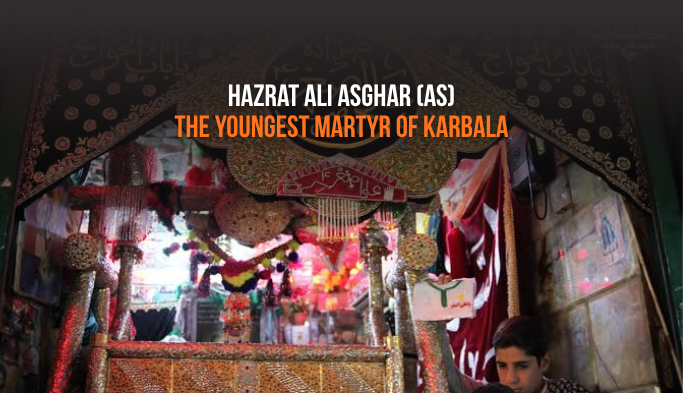
On the 9th of Rajab, 60 AH, a child was born in Madinah who would live for six months. He never spoke a word. He never walked. He was still an infant when the journey began — from Madinah to Makkah, from Makkah to the plains of Karbala. His name was Abdullah ibn al-Hussain, and the world has known him ever since as Ali Asghar (as) — Ali the Younger.
On the Day of Ashura, the 10th of Muharram, 61 AH, his father Imam Hussain (as) carried him in his arms toward the army of Yazid. Not as a weapon. Not as a shield. As a final argument — the most unanswerable one left. The army had deprived the camp of water for three days. The infant was thirsty. Imam Hussain (as) asked only for a drop of water for the child.
A three-headed arrow was the response.
He was struck in the neck while lying in his father’s arms and died instantly. Imam Hussain (as) raised the child’s blood toward the sky, then carried him back to the tents. In that moment, whatever remained of the enemy’s claim to any moral or religious legitimacy was gone. An infant’s blood on a father’s chest said everything that needed to be said about who was standing for truth and who was not.
Today, on the anniversary of his birth, we remember him.
Biography at a Glance
| Full Name: |
Abdullah ibn al-Hussain (as) |
| Title: |
Ali Asghar (Ali the Younger); Abdullah al-Radhi’ (the suckling child) |
| Father: |
Imam Hussain ibn Ali (as), the third Imam |
| Mother: |
Lady Rubab bint Imra’ al-Qays |
| Date of Birth: |
9th Rajab, 60 AH — Madinah |
| Date of Martyrdom: |
10th Muharram, 61 AH — Karbala, Iraq (Day of Ashura) |
| Age at Martyrdom: |
Approximately 6 months |
| Buried: |
Karbala, Iraq — in the vicinity of his father’s shrine |
His Birth, His Family, His Journey
Ali Asghar (as) was born approximately six months before the tragedy of Karbala, in the city of the Prophet (s). His mother, Lady Rubab (sa), was known for her deep devotion — and for the grief she carried after Karbala, which never left her. Through his father, Ali Asghar (as) belonged to the purified household of the Ahlul Bayt (as), whose purity Allah declared in the Quran:
إِنَّمَا يُرِيدُ اللَّهُ لِيُذْهِبَ عَنكُمُ الرِّجْسَ أَهْلَ الْبَيْتِ وَيُطَهِّرَكُمْ تَطْهِيرًا
Translation: “Indeed, Allah only desires to keep away all impurity from you, O People of the House, and to purify you with a thorough purification.” (Surah al-Ahzab, 33:33)
He travelled with the caravan from Madinah to Makkah, and from Makkah to Karbala. His presence among the travellers was not incidental. Imam Hussain (as) brought his entire family — not because he did not know what lay ahead, but because he did. The mission of Karbala was not a private matter. It was a public declaration, made before all of creation, that the truth of Islam would not be surrendered to those who wielded political power. Every member of the household who traveled that road did so as a witness to that declaration. Even the youngest.
The Day of Ashura: A Plea That Exposed Everything
By the morning of the 10th of Muharram, the camp of Imam Hussain (as) had been without water for three days. The Euphrates was close and deliberately blocked. Children cried from thirst. The infant Ali Asghar (as), dependent on water and milk, was suffering in the heat of the Iraqi plain.
Imam Hussain (as) came to the battlefield carrying his son. He was not carrying a weapon. He was carrying the most powerful argument available to him — a thirsty infant — and he presented it directly to the army that had come to kill him. He asked not for his own life, not for the lives of his companions. He asked for water for the child.
This was the moment that stripped away every pretext. The army that called itself Muslim, that invoked the name of Allah and prayed five times a day, that accused the Imam of rebellion and sedition — that army was now being asked to give water to an infant. The world was watching. History was watching.
Harmalah ibn Kahil responded with an arrow. Three-headed, fired at the throat of the child.
Imam Hussain (as) caught his son as the arrow struck. He held the dying infant, cupped the blood in his hands, and raised it toward the sky — addressing Allah directly, committing the matter to divine justice, accepting what had been given to him. Then he carried Ali Asghar (as) back to the tents and buried him near the camp. His composure in that moment — his refusal to break, his surrender to Allah’s will while his own child died in his arms — is among the most profound images in human history.
What His Martyrdom Revealed
Ali Asghar (as) is called sayyid al-shuhada al-asghar — the youngest of the martyrs. He represents what the Arabic tradition calls mazlumiyya: the state of being oppressed without recourse, of suffering an injustice that cannot be undone by any earthly power. An infant has no politics. An infant has no ideology. An infant makes no claims and threatens no one. And yet he was killed.
That is precisely what makes his martyrdom the most unanswerable argument Karbala produced. Imam Hussain (as) had preached, debated, refused, and resisted. His companions had fought and fallen one by one. Every act of the day had been a statement. But when a father carries his thirsty infant son to an army and asks for water — and the army fires an arrow — there is nothing left to say. The argument is over. The side that kills an infant has identified itself beyond any further discussion.
This is why Ali Asghar (as) is remembered not only in Muharram, but in every gathering where Karbala is named. His six months of life carry a weight that most lives of sixty years do not approach — because what those six months exposed has never been forgotten, and must never be.
His Birth Anniversary in Rajab
The 9th of Rajab is the day he came into the world. He came into it as the son of the third Imam, in the city of the Prophet (s), in a household that the Quran had declared purified. He was received with love. He was named. He was carried in the arms that would later carry him to the battlefield. Six months later, those arms would carry him back.
On this day, we remember that love — the love of his parents, the love of his family, the love of Imam Hussain (as) who made him, in those final moments at Karbala, the most eloquent argument for truth that history has recorded.
To stand at the shrine of Imam Hussain (as) in Karbala — the same earth where Ali Asghar (as) was buried, the same plain where his blood was raised toward the sky — is one of the most profound acts of connection available to any believer. Our 2026–2027 Iraq Ziyarat Packages bring you to Karbala, and to Najaf, Kadhimiya, and Samarra — the cities where the family he belonged to rests.
Visit: www.ziaratplanner.com





 04-Jun-2026