“Whenever I Long to See the Prophet, I Look at Akbar”
There is a statement Imam Hussain (as) made about his eldest son that has been transmitted across every generation of the tradition. He said: “Whenever I long to see the Messenger of Allah, I look at the face of Akbar.”
Ali al-Akbar ibn Hussain (as) did not merely resemble the Prophet (s) in appearance — though historians of the early period consistently record that resemblance as striking. He resembled him in his manner of speaking, in the logic of his arguments, in his character, and in the tone of his voice. When the people of Madinah missed the Prophet (s), they would come to the house of Imam Hussain (as) to see Ali al-Akbar. He was the living image of a grandfather he had never met.
His birth anniversary is observed on the 11th of Sha’ban — the month that has already commemorated his father’s birth (3rd) and his uncle Abbas’s birth (4th). Three consecutive anniversaries across the early days of Sha’ban; three members of the household that Karbala would define.
Biography at a Glance
| Full Name: |
Ali al-Akbar ibn Hussain ibn Ali ibn Abi Talib (as) |
| Title: |
Shabih al-Nabi (The Likeness of the Prophet); Shabih al-Mustafa |
| Father: |
Imam Hussain ibn Ali (as), the third Imam |
| Mother: |
Lady Umm al-Layla (Layla bint Abi Murrah al-Thaqafiyya) |
| Wiladat (Birth): |
11th Sha’ban — Madinah (year varies across narrations: 33 AH or ~44 AH) |
| Martyrdom: |
10th Muharram, 61 AH — Karbala, Iraq (Day of Ashura) |
| Age at Karbala: |
~18 years (based on birth ~44 AH) |
| Buried: |
At the feet of Imam Hussain (as), Karbala, Iraq — within the inner zarih |
Shabih al-Nabi: The Living Image
The title Shabih al-Nabi — the Likeness of the Prophet — was not a poetic description. It was a statement about something people experienced in his presence. When Ali al-Akbar (as) spoke, those who had heard the Prophet (s) speak said the logic and the character were the same. When he argued, his arguments carried the authority of divine teaching — not because he claimed any prophetic rank, but because he had been raised by the son of the Prophet’s daughter and had absorbed, through years of proximity to that household, the same manner of engaging truth that the Prophet had embodied.
Imam Hussain (as) witnessed this likeness most directly. He had never known his grandfather as an adult who could look at him the way a son looks at a father — the Prophet (s) died when Hussain was seven. But he had Ali al-Akbar, and in his son’s face he saw what he had spent his life carrying forward: the living inheritance of Muhammad ibn Abdillah (s). (Bihar al-Anwar, Allama Majlisi, vol. 45; maqtal literature)
Allah says in the Quran about the Prophet (s):
وَإِنَّكَ لَعَلَىٰ خُلُقٍ عَظِيمٍ
Translation: “And indeed, you are of a great moral character.” (Surah al-Qalam, 68:4)
What the companions of the Prophet (s) witnessed in him, the companions of Imam Hussain (as) witnessed in his son. The great character transmitted.
The Morning of Ashura: The Adhan That Made the Women Weep
On the morning of the 10th of Muharram, as the camps were prepared and the battle’s opening was imminent, Imam Hussain (as) turned to his son and asked him to call the Adhan. It was both a practical act — the call to the Fajr prayer — and something more. The sound of Ali al-Akbar’s voice, which was so close to the sound of the Prophet’s (s) voice, echoed across the plain of Karbala.
In the tents, the women wept. Not from fear of what the day held — they already knew what the day held — but from the sound itself. Lady Zainab (sa) and Umm al-Layla and the others who heard that Adhan understood that it was likely the last time that voice would call them to prayer. They were right.
Permission, Farewell, and the Father in the Dust
After the noon prayer, when the companions had fallen one by one and Imam Hussain (as) stood with his family and a shrinking number of supporters, Ali al-Akbar (as) came to his father and asked permission to fight. The Imam gave it — in his son’s case there was no hesitation, no twice-refused request as there had been with Qasim ibn Hassan (as). This was different. This was his own blood, his eldest son, the one who carried his grandfather’s face.
He asked Ali al-Akbar to go first and say farewell to the women of the household. What happened in those tents — his mother, his sisters, Lady Zainab — is not recorded in words but in the Karbala tradition’s memory of grief so complete it could not be contained.
When Ali al-Akbar (as) mounted his horse and rode toward the battlefield, Imam Hussain (as) walked behind him in the dust. Ali al-Akbar turned and asked why his father was following him on foot. The Imam said: “My son, if you had a son like yourself, you would surely understand.”
He then raised his hands toward the sky and testified before Allah: “O Lord! Bear witness — he who has gone out to face them bears a strong likeness to Your Prophet in appearance, disposition, and speech. Whenever we longed to see the Messenger, we looked at him.” (Bihar al-Anwar, vol. 45)
The Battlefield, the Thirst, and the End
Ali al-Akbar (as) fought with a force that scattered the enemy’s front ranks and forced the commanders to recognize that single combat would not be enough to stop him. When the enemy tried to tempt him — offering amnesty because of a distant maternal connection to the Umayyad line — his response was immediate: “The kinship of the Apostle of God should be second to none.”
He returned to his father once, parched from three days without water and weakened by the battle’s intensity. He said: “O father, thirst is killing me.” Imam Hussain (as) had no water. He placed his own tongue against his son’s to show him that the father was even thirstier. Then he gave him his ring to hold in his mouth — a gesture of accompanying him in the final trial, of not letting him suffer the last moments alone.
When Ali al-Akbar (as) fell, struck in the back and the head by the enemy, he was carrying a vision. His final words reached his father: “O father, here is my grandfather the Messenger of Allah. He has given me a drink from his cup, and he says: ‘Hurry, my Hussain, for we are waiting for you.'”
Imam Hussain (as) reached his son, who was lying with his hand pressed to his chest. The Imam pulled the hand away and saw the blade of a spear lodged there. He pulled it from his son’s chest, and in the grief of that moment, he called out to his father Imam Ali (as), buried in Najaf:
“O father! You lifted the gates of Khaybar. But you never had to lift a spear from the chest of your own son.”
Then, facing the army that surrounded him, he said the words that have been repeated at every majlis for Karbala since that day:
عَلَى الدُّنْيَا بَعْدَكَ الْعَفَاءُ
Transliteration: “‘Alā al-dunyā ba’daka al-‘afā'” — “After you, my son, the world is worthless.” (Bihar al-Anwar, vol. 45; Maqtal al-Hussain literature)
The Hexagonal Shrine: Buried at His Father’s Feet
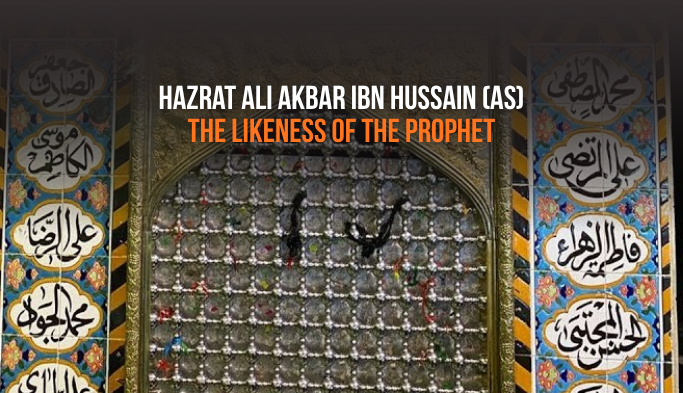
There is a detail of the inner shrine of Imam Hussain (as) in Karbala that most pilgrims do not know before their first visit: the zarih — the inner sanctum — is hexagonal rather than rectangular. The four-sided structure that houses most shrines has two additional corners. Those two corners exist because Ali al-Akbar (as) is buried at the feet of his father.
He is not in the collective grave of the other Karbala martyrs. He is there, at the feet of the Imam, in an arrangement that the architecture of the shrine makes visible to every person who enters. The pilgrims who come to visit Imam Hussain (as) cannot reach his threshold without their path passing through the space where his son rests. This is not a coincidence of construction — it is a permanent statement about a relationship that Karbala expressed in the most absolute terms available.
To stand in that hexagonal zarih — at the father’s feet, where the son who bore the Prophet’s face and voice and character is buried — is to stand at one of the most concentrated points of meaning in the entire Islamic world.
On this 11th of Sha’ban, the birthday of the one whose face made Imam Hussain remember his grandfather, our 2026–2027 Iraq Ziyarat Packages bring you to that zarih. To the hexagonal shrine. To the father’s feet, where the likeness of the Prophet rests.
Visit: www.ziaratplanner.com





 06-Jun-2026