The Day Basra Witnessed a War Among Companions
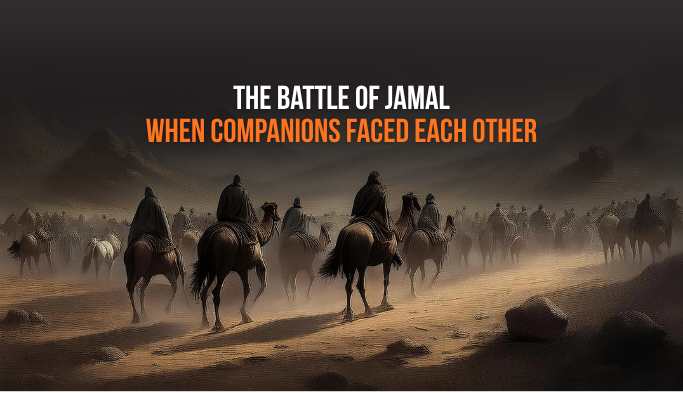
On the 10th of Jamadi al-Awwal, 36 AH (656 CE), the plains outside Basra in Iraq became the site of the most devastating internal conflict the early Muslim community had yet faced. The Battle of Jamal — the Battle of the Camel — was not a war against an external enemy. It was a confrontation between the fourth Caliph, Imam Ali ibn Abi Talib (as), and a coalition led by Lady Aisha, Talha, and Zubair, who claimed to be seeking justice for the murdered third Caliph Uthman.
The Prophet (s) had said: “I am leaving among you two weighty things: the Book of Allah and my Ahlul Bayt. Hold fast to them, and you shall not go astray.” The battle that occurred in Basra was, in many ways, the first public test of whether that instruction would hold.
It did not hold — not because the instruction was wrong, but because the forces pulling the community apart were stronger in that moment than the forces keeping it together. The Battle of Jamal is a lesson in what happens when political pressure, grief, and tribal loyalty combine to produce violence among people who share a faith.
The death of Uthman ibn Affan in 35 AH created a crisis the early Muslim community was not prepared to resolve. He had been killed by rebels — a complex episode involving legitimate grievances about governance, tribal dynamics, and unresolved tensions that the assassination both expressed and intensified. When Imam Ali (as) assumed the Caliphate, he faced an immediate demand from several prominent companions: punish Uthman’s killers first, before anything else.
Imam Ali (as) took a different position. He was aware that many of those who had participated in the rebellion against Uthman were now in his own army — without their support, he could not govern at all. He chose a path of investigation and due process rather than immediate punishment, believing that justice required evidence and proper procedure, not emotional reaction. This measured approach was misread by some as tolerance of the killers, and the misreading became the stated justification for the coalition that gathered in Basra.
Lady Aisha, Talha, and Zubair had pledged allegiance to Imam Ali (as) and then withdrawn it — an act with serious theological weight in Islamic jurisprudence. They traveled to Basra, where tribal politics and existing resentments created fertile ground for their movement. Their stated purpose was to demand justice for Uthman and to pressure Imam Ali (as) to act.
Negotiations, Then War
Before the battle began, Imam Ali (as) made genuine and sustained efforts to avoid bloodshed. He sent emissaries to the opposing camp with a clear message: no one would be punished without investigation and proper evidence, and the unity of the Muslim community was more important than the speed of any single judicial outcome. He met personally with Talha and Zubair, reminding them of the Prophet’s (s) guidance and the consequences of Muslims fighting Muslims.
His efforts came close to succeeding. There are accounts suggesting that Talha and Zubair were on the verge of standing down when elements within the opposing camp — who preferred war to a negotiated outcome — deliberately provoked fighting before an agreement could be reached. Once the first arrows were fired, the possibility of peaceful resolution collapsed.
Both sides mobilized roughly: Lady Aisha’s coalition brought approximately ten thousand fighters; Imam Ali (as) led approximately fifteen thousand. Lady Aisha remained mounted on her camel throughout the battle — both as a symbol of her authority and as a strategic center around which her forces organized. The battle’s name derives from this: whoever controlled the camel controlled the morale of her army.
The Battle and Imam Ali’s Conduct
Imam Ali (as) gave his commanders a clear ethical instruction: do not pursue those who flee, do not kill the wounded, do not harm Lady Aisha directly, and do not treat the defeated as enemies to be destroyed. Malik al-Ashtar was among his key commanders, executing a disciplined campaign that gradually broke the opposition’s formation while minimizing unnecessary casualties.
Talha was killed in the fighting. Zubair withdrew from the battlefield — accounts differ on whether he left out of regret or tactical judgment — and was killed shortly afterward under disputed circumstances. The loss of both men removed the political and military leadership from Lady Aisha’s coalition. The camel that had been her symbol became the final objective: Imam Ali (as) had it hamstrung, removing the rallying point around which her forces had organized, and the battle effectively ended.
Lady Aisha was taken under protection. Imam Ali (as) ensured she was treated with complete respect and arranged for her return to Madinah under the escort of trusted companions. This act — extending full protection and dignity to the person who had led an army against him — is among the most frequently cited examples of his conduct in governance. He wept when Talha’s body was brought to him. He prayed over the fallen on both sides.
The Outcome and Its Consequences
Imam Ali (as) was victorious. Politically, the battle strengthened his authority as Caliph and demonstrated that the state’s military capability was intact. But the victory carried a cost that no military success could offset: thousands of Muslims had died at the hands of other Muslims, families were divided, and the political fracture within the community had deepened.
The damage to Muslim unity was not immediately visible but proved enduring. The same pattern of competing loyalties, tribal politics, and accusations of insufficient justice that produced Jamal would produce Siffin the following year — a far larger and more complex confrontation with Muawiyah ibn Abi Sufyan in Syria. And the scars that Jamal opened never fully closed in the early Muslim world.
Imam Ali (as) returned to Kufa, which became his capital for the remaining years of his Caliphate. He is buried in Najaf — the city that became the heart of Shia scholarship and devotion, and that today receives millions of pilgrims who come to the man who wept for his enemies and arranged the safe return of the woman who had led an army against him.
Lessons from the Battle of Jamal
The Battle of Jamal offers lessons that have not aged in fourteen centuries. The most important is about haste: Lady Aisha’s coalition demanded immediate action against Uthman’s killers and rejected the investigative approach Imam Ali (as) was pursuing. The haste produced a war that killed more Muslims than it could possibly have punished. Patience in the face of justified anger is not weakness — it is the discipline that prevents justice from becoming vengeance.
The second lesson is about the influence of political advisors and tribal loyalties on people who are genuinely pious. Talha and Zubair were companions of the Prophet (s). Lady Aisha was the Prophet’s wife. None of them were people of bad faith in any simple sense. And yet the combination of grief over Uthman, political calculation, and tribal dynamics produced a catastrophe that none of them had sought. Good intentions, without the wisdom and patience to pursue them correctly, can cause the very harm they were meant to prevent.
The third lesson is Imam Ali’s (as) own conduct: extending mercy to the defeated, arranging dignity for Lady Aisha, weeping for Talha — these were not political calculations. They were the expression of a standard of Islamic ethics in governance that the Prophet (s) had embodied and that Imam Ali (as) had spent his life absorbing.
For those who wish to stand where Imam Ali (as) rests — in Najaf, the city he made his capital and where his shrine now draws millions — and to visit Basra, the Iraqi city where the Battle of Jamal was fought, our 2026–2027 Iraq Ziyarat Packages cover the holy cities of Iraq from Karbala to Najaf to Kadhimiya and Samarra.
Visit: www.ziaratplanner.com






 06-Jun-2026