The Night the Ka’bah Opened
There is one birth in all of Islamic history that stands entirely alone. Not because of the lineage of the child — though that lineage is the most honoured in creation. Not because of what the child would become — though what he became has no parallel. But because of where it happened.
On the 13th of Rajab, 30 years after the Year of the Elephant, Lady Fatima bint Asad (sa) came to the Ka’bah in the final hours before delivery, overwhelmed with the pain of labour. She raised her hands and prayed — sincerely, directly, completely. And the wall of the Ka’bah opened.
She entered. The wall closed behind her. For three days she remained inside the House of Allah, and when the wall opened again she emerged holding her son. The people standing outside, who had watched the wall seal itself shut and found no key or force capable of opening it, now witnessed her emerge. In her arms was the child who would become the first Imam of the Ahlul Bayt (as), the Commander of the Faithful, the gate of the city of the Prophet’s knowledge — Ali ibn Abi Talib (as).
No one else has ever been born inside the Ka’bah. That distinction belongs to him alone. (Bihar al-Anwar, Allama Majlisi, vol. 35; Manaqib Al Abi Talib, Ibn Shahr Ashub)
Biography at a Glance
| Full Name: |
Ali ibn Abi Talib ibn Abd al-Muttalib (as) |
| Kunyat: |
Abu al-Hasan, Abu Turab |
| Titles: |
Amir al-Mu’minin (Commander of the Faithful), Haider, Murtaza, Wali Allah |
| Father: |
Abu Talib ibn Abd al-Muttalib |
| Mother: |
Lady Fatima bint Asad (sa) |
| Wife: |
Lady Fatima al-Zahra (sa), daughter of the Prophet (s) |
| Children: |
Imam Hasan (as), Imam Hussain (as), Lady Zainab (sa), Lady Umm Kulthum (sa), and others |
| Wiladat (Birth): |
13th Rajab, ~30 years after the Year of the Elephant — inside the Ka’bah, Makkah |
| Shahadat (Martyrdom): |
21st Ramadan, 40 AH — Kufa, Iraq |
| Shrine: |
Najaf al-Ashraf, Iraq |
Lady Fatima bint Asad and Three Days Inside the House of Allah
The circumstances of Imam Ali’s (as) birth are not a legend embellished over time — they are narrated by classical scholars of both Shia and Sunni tradition, documented in the hadith literature, and transmitted through chains that span the first centuries of Islam. The event is reported in Bihar al-Anwar (Allama Majlisi), Manaqib Al Abi Talib (Ibn Shahr Ashub), and referenced by a number of early biographical sources.
Lady Fatima bint Asad (sa) — the mother of Imam Ali (as), the woman whose household had sheltered and supported the Prophet (s) since his childhood — was not an ordinary woman making an ordinary prayer. When she spoke at the Ka’bah, she addressed Allah directly: “O Allah, I believe in You, in Your Prophets, and in the words of your Books. I believe in all that has been said by my forefather Ibrahim (as) who built this ancient house. So I ask You, by the right of this House, and by the right of the child in my womb, to make my delivery easy.” (Bihar al-Anwar, vol. 35)
The wall opened. She entered. Three days later, she emerged holding her son. When people asked her what she had witnessed inside, she is reported to have said that she had been given sustenance she had not seen on earth, and that she was in a state of light she could not fully describe.
The symbolic weight of this birth has been understood by every generation since. He was born inside the house that Ibrahim (as) built — a direct link to the prophetic line that predates the Prophet (s) himself. He was born not in a palace, not in comfortable circumstances, but in a sacred enclosure, received not by the wealthy and powerful of Makkah but by the walls of the House of Allah. The circumstances of his birth were a statement about who he was: chosen before the world had any say in the matter.
His Knowledge, His Governance, His Legacy
The Prophet (s) said: “I am the city of knowledge and Ali is its gate.” (Mustadrak al-Hakim; referenced in Bihar al-Anwar) In the history of Islamic thought, that statement has never been a mere metaphor — it has been a fact. The jurisprudence, theology, spiritual wisdom, and ethical teaching that the Ahlul Bayt (as) transmitted to every subsequent generation passed through Imam Ali (as) first. He was the first male to accept Islam. He slept in the Prophet’s (s) bed on the night of the Hijrah, offering his life to ensure the Prophet’s escape. He carried the Prophet’s (s) knowledge as directly as any human being in history.
His caliphate, though brief and contested, produced the most demanding standard of governance in Islamic history. He treated the treasury of the Muslims as a trust, not a resource. He wrote letters and orders of governance that are still studied as models of ethical leadership. His correspondence with his governor Malik al-Ashtar — a document instructing him on the rights of the governed, the obligations of a ruler, and the sources of justice — is among the most extraordinary political texts ever produced. It is preserved in Nahj al-Balagha: the collection of his sermons, letters, and short sayings compiled by Sharif al-Radi, one of the great treasures of Arabic literature.
Among his words recorded there: “Be an enemy of the oppressor and a helper of the oppressed.” And: “Your worth is what you know.” (Nahj al-Balagha, compiled by Sharif al-Radi) These are not inspirational phrases — they are the condensed output of a life that tested every word it ever spoke.
The Battles That Defined an Era
Imam Ali’s (as) role in the early battles of Islam was not incidental — it was central. At Badr, the first major confrontation between the Muslim community and the Quraysh, he was among the most effective fighters on the field and his actions helped secure a victory that consolidated the young community’s ability to survive. At Uhud, when the tide turned against the Muslims and many companions retreated, he remained beside the Prophet (s). At the Battle of Khandaq, he faced and defeated Amr ibn Abd Wudd — a warrior who had crossed the trench alone when no one else dared — in single combat that broke the enemy’s momentum. At Khaybar, when the fortresses had resisted every previous attempt, the Prophet (s) gave the standard to the one he said would be loved by Allah and His Messenger — and he conquered it. (Sahih al-Bukhari; Sahih Muslim; Bihar al-Anwar)
In every battle he fought alongside the Prophet (s), his presence served the same purpose his birth had symbolised: that truth, when it takes a form, is not easily moved.
His Shrine in Najaf — and What It Means
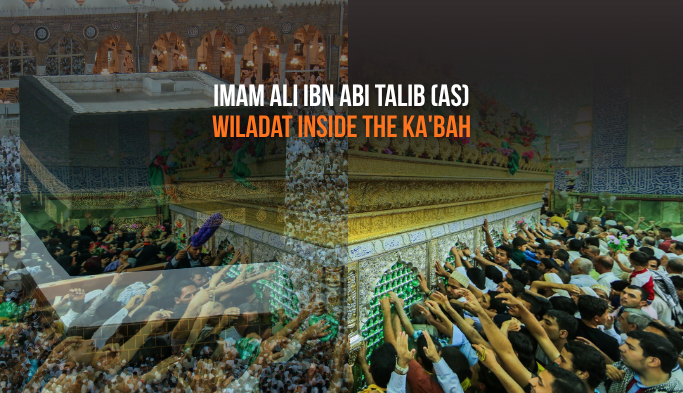
Imam Ali (as) was martyred in Kufa on the 21st of Ramadan, 40 AH, struck by the poisoned sword of Ibn Muljam during the Fajr prayer — a prayer he had not abandoned in his life, and did not abandon in his death. His shrine in Najaf al-Ashraf, Iraq, is among the most visited sacred sites on earth. Millions come each year — and the narrations about the reward of Ziyarat at his threshold are among the most widely transmitted in the Shia devotional tradition.
On the 13th of Rajab, the day he was born inside the Ka’bah, the love the world carries for him is made explicit. It is a day of joy proportionate to what he gave: a life entirely in service of truth, from the wall that opened to receive his mother to the prayer mat where he fell.
For those who wish to stand at his shrine in Najaf — to walk through the gate of the city of knowledge and face the dome that stands over the first Imam — our 2026–2027 Iraq Ziyarat Packages bring you to Najaf alongside Karbala, Kadhimiya, and Samarra. The house that Ibrahim (as) built sent him into the world. Najaf is where the world comes to find him.
Visit: www.ziaratplanner.com





 04-Jun-2026