The Night That Changed Everything
In the year 610 CE, in a cave on the mountain of Hira outside Makkah, a man who had been sitting alone in contemplation received a visitor he had not seen before. The visitor was Jibrail (as), the archangel of revelation, and his message was four words that would become the opening of the final scripture revealed to humanity:
Iqra’ bismi rabbika alladhi khalaq — “Read in the name of your Lord who created.” (Surah al-Alaq, 96:1)
Muhammad ibn Abdillah (s) was forty years old. He descended from the mountain that night as the Messenger of Allah — the final Prophet, the seal of the line that began with Adam (as) and ran through Ibrahim, Musa, Isa, and every prophet sent before him. The mission he received that night in Hira was the mission he would carry for the remaining twenty-three years of his life, through persecution, exile, war, and the eventual transformation of the Arabian Peninsula and then much of the known world.
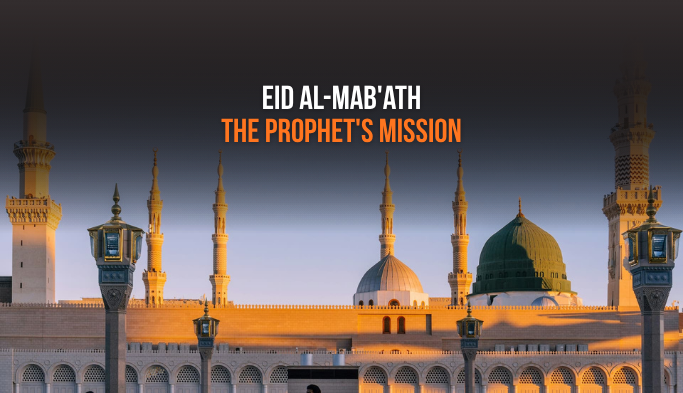
The 27th of Rajab is the day Muslims commemorate this event — Eid al-Mab’ath: the Eid of the Mission, the Eid of the Sending Forth. In Shia tradition, it is counted among the greatest days of the entire Islamic calendar. It is celebrated as a day of profound joy — not the joy of personal good fortune, but the joy of knowing that humanity was not left without guidance, that the darkness which had accumulated was met with a light that has not gone out.
What Mab’ath Means
The Arabic word mab’ath comes from the root ba’atha — to send, to raise, to dispatch. It is the same root from which yawm al-ba’th — the Day of Resurrection, the day of being raised — derives. In the context of prophethood, mab’ath refers to the divine appointment: the moment Allah raised the Prophet (s) to his mission and sent him to humanity as His Messenger.
This word carries theological weight that the English word “mission” does not fully convey. The Prophet (s) was not simply given a task to accomplish. He was sent — designated, commissioned, and supported — by the same Creator who made the heavens and the earth and the human beings he was dispatched to guide. His authority was not self-declared or community-granted. It descended from above, confirmed by revelation, and witnessed first by the angel who carried the words.
Imam Ja’far al-Sadiq (as) is reported to have said that Eid al-Mab’ath is the greatest of the four Eids that the believers observe, the others being the two Eids of Fitr and Adha, and Eid al-Ghadir. (Mafatih al-Jinan, Shaykh Abbas Qumi; Iqbal al-A’mal, Sayyid Ibn Tawus) The ranking is significant. It places the day of the Prophet’s appointment — the day when divine guidance became available again to a people lost — above the days of personal worship completion and communal celebration. Before the community can be guided, the guide must be sent.
Imam Ali (as) Was There
There is a detail of the night of Mab’ath that the Shia tradition preserves with particular care: when the revelation descended on the Prophet (s) in the Cave of Hira, Imam Ali ibn Abi Talib (as) was nearby. He was the first male to witness the beginning of the mission. He was the first male to affirm it — the first male believer in Islam. (Bihar al-Anwar, Allama Majlisi, vol. 18)
This is not a biographical footnote. It is a theological statement about the relationship between prophethood and the Imamate. The mission that began on the night of Mab’ath was not a mission for a single generation. It was a message entrusted to humanity until the Day of Judgment. The Prophet (s) carried it for twenty-three years. After him, the Ahlul Bayt (as) carried it — not by claiming prophethood, which ended with him, but by preserving, transmitting, and living the message he had received. The night of Hira was the beginning of a chain. Imam Ali (as) being present at its opening is a sign of what he would carry when the Prophet’s own carrying was done.
Celebrating Eid al-Mab’ath, for the lover of the Ahlul Bayt (as), is therefore not only a celebration of the Prophet (s) — it is a celebration of the entire chain of guidance that his night in Hira set in motion.
How to Observe Eid al-Mab’ath
Ghusl
Performing Ghusl on the 27th of Rajab is among the most strongly recommended acts of this Eid in classical Shia devotional literature. Shaykh Abbas Qumi in Mafatih al-Jinan describes it as one of the days for which a specific Ghusl has been transmitted. Begin the day with purification of body and intention, with the awareness that you are preparing for an act of worship on one of the greatest days of the year.
Fasting
Fasting on Eid al-Mab’ath is highly recommended. Classical sources report that its reward is equivalent to sixty months of voluntary fasting — a reward proportionate to the magnitude of what the day itself commemorates. The Prophet (s) arrived in this world to remove the burden of ignorance and oppression from humanity. Observing a fast in gratitude for that arrival is among the most direct ways to mark the day. (Iqbal al-A’mal, Sayyid Ibn Tawus; Mafatih al-Jinan)
The Twelve-Rakaat Prayer
A prayer of twelve rak’aat is specifically recommended for this day in the devotional tradition, performed in sets of two. In each unit, recite Surah al-Fatihah, Surah al-Ikhlas ten times, Surah al-Falaq three times, and Surah al-Nas three times. After completing the prayer, recite the Tasbih of Lady Fatima al-Zahra (sa) — Allahu Akbar (34 times), Alhamdulillah (33 times), SubhanAllah (33 times) — and then prostrate and recite salawat upon the Prophet (s) and his household one hundred times. Following the prostration, raise your hands and make dua for your needs. (Mafatih al-Jinan, Shaykh Abbas Qumi)
The full Arabic text of the supplication recommended after this prayer is available in Mafatih al-Jinan in the section on the Amaal of Rajab.
Dua al-Mab’ath
A specific supplication has been transmitted for this day, attributed to the tradition of the Ahlul Bayt (as) and preserved in Iqbal al-A’mal and Mafatih al-Jinan. It acknowledges the gift of prophethood, sends salutations upon the Prophet (s) and his household, and asks Allah to keep the believer firm on the path the Prophet (s) was sent to illuminate. The full text is in Mafatih al-Jinan under the Amaal of Rajab, specifically the 27th.
Abundant Salawat
There is no act more fitting for the day of the Prophet’s mission than sending blessings upon him and his household. The day he was sent to us is the day we were given everything we have in terms of guidance. Responding to that gift with salawat — offered abundantly, sincerely, throughout the day — is both gratitude and proximity.
اَللّٰهُمَّ صَلِّ عَلَى مُحَمَّدٍ وَآلِ مُحَمَّدٍ
“O Allah, send blessings upon Muhammad and the family of Muhammad.”
Charity
Giving in charity on Eid al-Mab’ath is a participation in the spirit of what the day commemorates. The Prophet (s) was sent as a mercy to all the worlds — not only to those who could recite his name, but to all of creation. Sharing from what you have been given, on the day you celebrate the mercy that made it possible to know how to share, is an act that closes a circle.
The Night Before: From Maghrib to Fajr
The night of the 27th of Rajab — from the Maghrib of the 26th to the Fajr of the 27th — is itself a night of great significance. Classical scholars describe it as one of the four most blessed nights of the year, alongside the Night of Power in Ramadan, the night of the 15th of Sha’ban, and the eve of the 1st of Rajab. Staying awake in worship on this night — prayer, Quran, dua, salawat — is among the acts that carry exceptional reward. (Iqbal al-A’mal, Sayyid Ibn Tawus)
If you cannot spend the entire night, even an hour of deliberate worship after Isha, offered with awareness of what night it is, is not wasted. The night that the Prophet (s) first received revelation in Hira was not a night like any other. Its anniversary asks the believer to offer something of themselves in return.
Rajab Ends, but the Mission Continues
Eid al-Mab’ath falls near the end of Rajab, the first of the three sacred months before Ramadan. The month that opened with remembrance of the Imam who split open knowledge, passed through births and martyrdoms of the Imams, and commemorated the spreading of the earth — closes with the greatest celebration of all: the day humanity received guidance itself.
The month of Sha’ban follows, and after it Ramadan — the month when the Quran, that same revelation that descended to the Prophet (s) on a night in Hira, is read, memorised, and lived more intensely than any other time of year. Eid al-Mab’ath is the beginning of the preparation for that arrival.
For those who wish to honour this sacred month and its final great Eid in the fullest way — by standing at the shrines of the household the Prophet (s) left behind as his legacy, in the holy cities of Iraq — our 2026–2027 Iraq Ziyarat Packages are open throughout Rajab and into Sha’ban. Karbala, Najaf, Kadhimiya, and Samarra are waiting.
Visit: www.ziaratplanner.com





 06-Jun-2026