About the Month of Rajab
Why is Rajab called the “Month of Allah”?
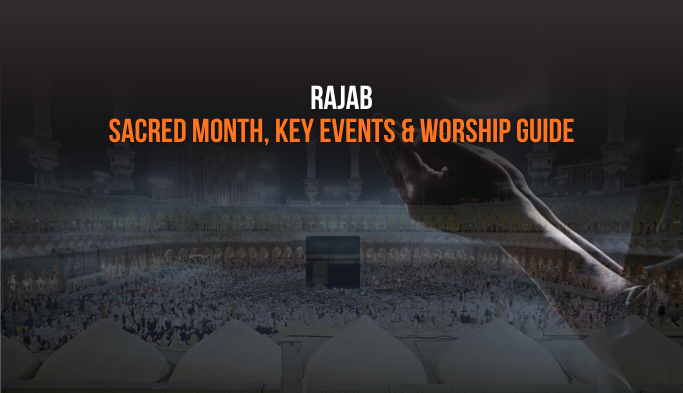
Rajab is one of the four sacred months that Allah distinguished in the Quran (Surah al-Tawbah, 9:36). Classical Islamic tradition, drawing on narrations from the Prophet (s) and the Ahlul Bayt (as), refers to it as Shahr Allah — the Month of Allah — to convey that its sanctity is direct and primary, not derived from any human or political convention. It stands immediately before Sha’ban and Ramadan, forming the first step of the three-month spiritual ascent that the tradition describes as a stairway: Rajab for repentance and seeking forgiveness, Sha’ban for salawat and deepening love for the Prophet (s) and his household, and Ramadan for the full harvest of worship that those preparations make possible.
The Prophet (s) is reported to have said: “Rajab is the month of seeking forgiveness for my people; so implore forgiveness repeatedly in this month, for Allah is forgiving and merciful.” (Iqbal al-A’mal, Sayyid Ibn Tawus; Mafatih al-Jinan, Shaykh Abbas Qumi)
What important events and anniversaries fall in Rajab?
Rajab is among the most event-rich months in the Shia calendar. The major commemorated dates are: the 1st of Rajab, the Wiladat of Imam Muhammad al-Baqir (as), the fifth Imam; the 2nd of Rajab, the Wiladat of Imam Ali al-Hadi (as), the tenth Imam; the 3rd of Rajab, the Shahadat of Imam Ali al-Hadi (as); the 9th of Rajab, the Wiladat of Hazrat Ali Asghar (as), the infant martyr of Karbala; the 10th of Rajab, the Wiladat of Imam Muhammad al-Jawad (as), the ninth Imam; the 13th of Rajab, the Wiladat of Imam Ali ibn Abi Talib (as), the first Imam, born inside the Ka’bah; the 25th of Rajab, the Shahadat of Imam Musa al-Kazim (as), the seventh Imam; the 26th of Rajab, the Wafat of Hazrat Abu Talib (as), the guardian of the Prophet (s); the 27th of Rajab, Eid al-Mab’ath, the day the Prophet (s) received the first revelation; and the 28th of Rajab, the departure of Imam Hussain (as) from Madinah — the beginning of the journey to Karbala.
Is Rajab considered a month of celebration or mourning?
Both — and that is part of what makes it distinctive. The month contains some of the greatest Wiladat celebrations in the Shia calendar (Imam Ali’s birth on the 13th, Eid al-Mab’ath on the 27th) as well as significant days of grief (Shahadat of Imam al-Hadi on the 3rd, Shahadat of Imam al-Kazim on the 25th, Wafat of Abu Talib on the 26th, Imam Hussain’s departure on the 28th). Believers move between these tones within the same month — which is itself a reflection of how the Ahlul Bayt (as) lived: joy and grief were never far from each other, and both were held with the same depth of faith.
Is it true that Rajab is inauspicious for weddings or important events?
No — this is a cultural superstition with no basis in Islamic teaching. Rajab is a sacred month — one of the four months Allah has distinguished in the Quran. There is no hadith from the Prophet (s) or the Ahlul Bayt (as) discouraging marriage or significant events in Rajab. Treating a sacred month as inauspicious is the opposite of what the tradition teaches: these are months of heightened divine mercy and reward, and any positive act — including marriage — performed within them carries its own blessing.
Acts of Worship in Rajab
What acts of worship are recommended throughout Rajab?
The core acts emphasized throughout the month in classical Shia devotional literature — principally Mafatih al-Jinan (Shaykh Abbas Qumi) and Iqbal al-A’mal (Sayyid Ibn Tawus) — are voluntary fasting, abundant istighfar (seeking forgiveness), salawat upon the Prophet (s) and Ahlul Bayt (as), recitation of the Quran, charity, and personal supplication. On Thursday nights, Dua Kumayl — transmitted from Imam Ali (as) via Kumayl ibn Ziyad, with its powerful emphasis on repentance — is especially recommended. The Imams consistently taught that the believer who uses the sacred months for genuine repentance and sincere worship arrives at Ramadan in a different spiritual state than one who does not.
What is the reward for fasting in Rajab?
Imam Musa al-Kazim (as) is reported to have said: “If one fasts one day in Rajab, Hellfire will be removed from him at a distance of one year’s walking. One who fasts three days will inherit Paradise.” He is also reported to have said: “Rajab is a river in Paradise whiter than milk and sweeter than honey — and one who fasts even a single day in Rajab, Allah will let him drink from that river.” (Iqbal al-A’mal, Sayyid Ibn Tawus) The rewards described for fasting in the sacred months across hadith literature are consistently remarkable — reflecting the elevated weight that all worship carries in these months.
What are the Ayyam al-Beed (Bright Days) of Rajab?
The Ayyam al-Beed — the Bright Days — are the 13th, 14th, and 15th of every lunar month, named for the full or near-full moon that makes them the brightest nights of the month. Fasting on these three days is recommended throughout the year and carries additional significance in the sacred months. The 13th of Rajab is also the Wiladat of Imam Ali (as), giving these three days in Rajab a particular significance. In some seminaries and mosques, believers observe i’tikaf — spiritual retreat within the mosque — during these days.
What is Laylat al-Raghaib?
Laylat al-Raghaib — the Night of Wishes — refers to the eve of the first Friday of Rajab. A narration describes this night as carrying immense reward for a specific twelve-unit prayer performed between Maghrib and Isha, with the promise that Allah will fulfil the legitimate needs of those who observe it sincerely. (Iqbal al-A’mal; Mafatih al-Jinan) It is one of the nights for which a specific prayer has been transmitted in the devotional literature, and it is observed by many believers as an opportunity for intensive worship and supplication at the very opening of the month.
What are Amal Umm Dawud?
Amal Umm Dawud is a lengthy and powerful act of worship observed on the 15th of Rajab — specifically in the afternoon of that day. According to a narration transmitted by Imam Ja’far al-Sadiq (as), he taught this practice to a woman named Umm Dawud when her son was unjustly imprisoned, and upon her completion of the Amal, her son was released. (Iqbal al-A’mal, Sayyid Ibn Tawus) The practice involves fasting for three consecutive days (13th, 14th, and 15th of Rajab), then on the afternoon of the 15th performing Ghusl and reciting specific Quranic chapters and a long supplication. Believers today observe it for the relief of difficult needs and the safety of those who are oppressed or imprisoned. The full text is in Mafatih al-Jinan.
What is the “Niaz” or “Koonday” of the 22nd Rajab?
The practice of preparing food and distributing it on the 22nd of Rajab — known in South Asian communities as Koonday, often associated with the name of Imam Ja’far al-Sadiq (as) — is a cultural tradition observed in parts of Pakistan, India, and diaspora communities. It is rooted in the concept of tawassul (seeking nearness to Allah through the Ahlul Bayt) and the general tradition of food distribution as sadaqah and communal gratitude. It should be understood as a cultural practice of devotion rather than a date specifically designated in classical hadith collections with narrated amaal. Believers who observe it do so as an expression of love for the sixth Imam and gratitude for fulfilled needs.
Key Dates — Deeper Questions
Why is the 27th of Rajab considered the greatest Eid?
Imam Ja’far al-Sadiq (as) is reported to have said that Eid al-Mab’ath — the 27th of Rajab — is the greatest of the four Eids observed by believers. (Iqbal al-A’mal; Mafatih al-Jinan) This is because it marks the moment when humanity was not left without guidance: the Prophet Muhammad (s) received the first revelation in the Cave of Hira, was appointed as the final Messenger, and began the mission that the Quran was sent to carry. The other three Eids — Fitr, Adha, and Ghadir — are celebrated within the context of that mission. Mab’ath is celebrated as the origin of it.
Why did Imam Hussain (as) leave Madinah on the 28th of Rajab?
When Mu’awiyah died in 60 AH, Yazid assumed the caliphate and immediately demanded bay’ah (allegiance) from Imam Hussain (as). The Imam’s response was categorical: “A person like me will never give bay’ah to a person like Yazid.” The threat to his life became immediate. Aware that bloodshed within the city of the Prophet (s) would violate Madinah’s sanctity, the Imam resolved to depart. He wrote a letter to his brother Muhammad ibn Hanafiyyah before leaving, stating clearly that he was not rising for political power but to reform the ummah of his grandfather — to command what is good and forbid what is evil. He departed on the 28th of Rajab, 60 AH, fully aware — as he affirmed to Umm Salamah — of the martyrdom that awaited him at the end of the road. (Bihar al-Anwar, Allama Majlisi, vol. 45; Maqtal al-Khwarizmi)
How does observing Rajab prepare a believer for Ramadan?
The three-month sequence of Rajab, Sha’ban, and Ramadan is described in the tradition as a stairway — each month building on the one before. Rajab is the month of istighfar: clearing the account of accumulated sins, returning to Allah with honesty about where one has fallen short, and beginning the work of spiritual repair. Sha’ban deepens the connection to the Prophet (s) and his household through salawat and preparation of the heart. Ramadan, when it arrives, finds a believer who has already done the preliminary work — whose heart has been softened by a month of repentance, whose love for the Prophet has been renewed, and who can therefore receive the Quran and the nightly prayers of Ramadan not as obligations to endure but as gifts to be used. Without Rajab, the full harvest of Ramadan is harder to reach.
Practical Guidance
Is it recommended to travel for Ziyarat during Rajab?
Yes — Rajab is one of the best times to perform Ziyarat. The month contains Wiladat celebrations, Shahadat commemorations, and Eid al-Mab’ath, all of which are observed at the holy shrines with particular intensity. Kadhimiya in Baghdad — the shrine of Imam Musa al-Kazim (as), martyred on the 25th of Rajab — and Samarra, where Imam Ali al-Hadi (as) is buried and where his birth and martyrdom both fall in this month, draw especially large numbers of pilgrims during Rajab. Najaf observes Imam Ali’s (as) birth anniversary on the 13th. The month transforms all four major shrine cities of Iraq into sites of concentrated communal worship and remembrance.
What is the simplest way to honour Rajab if one has limited time?
The tradition consistently emphasises sincerity over scale. Even one day of sincere voluntary fasting, one night of genuine istighfar, one act of charity given with awareness of the month’s blessing — these are described in the narrations as carrying significant reward. The Imams never placed the benefit of Rajab behind a requirement of perfect observance. For a believer with limited time, the minimum that honours the month is to remember it consciously — to say istighfar more than usual, to send salawat more than usual, and to treat the month as a gift rather than simply a passage of time.
For those who want to mark Rajab in the fullest possible way — standing at the shrines of the Ahlul Bayt (as) in Iraq during the very days their anniversaries fall — our 2026–2027 Iraq Ziyarat Packages are open throughout Rajab. Karbala, Najaf, Kadhimiya, and Samarra are waiting.
Visit: www.ziaratplanner.com





 04-Jun-2026