The Night and Day of an Imam’s Birth
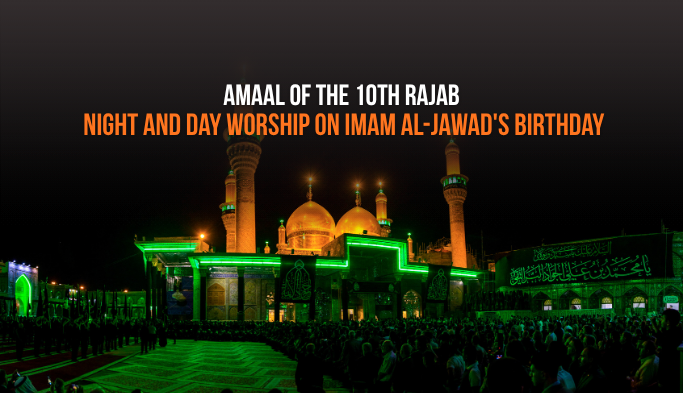
The 10th of Rajab is the Wiladat of Imam Muhammad al-Jawad (as) — the ninth Imam, born in Madinah in 195 AH, the youngest Imam to assume the Imamate, and the man whose title al-Jawad — the Generous — was earned through a lifetime of giving knowledge, compassion, and himself to those who came to him. For a full account of his life, his great debate with the Abbasid chief judge, and his shrine in Kadhimiya, see our dedicated post on his Wiladat.
What this guide addresses is how to spend the night and day of his birthday in worship — using the amaal transmitted in the devotional tradition of the Ahlul Bayt (as), preserved in Mafatih al-Jinan (Shaykh Abbas Qumi) and Iqbal al-A’mal (Sayyid Ibn Tawus). A day that celebrates the birth of the Generous Imam is a day to be generous with worship.
Night Amaal: From Maghrib to Fajr
Ghusl
Begin the night of the 10th of Rajab with Ghusl — the ritual bath of purification. The act is outward in form and inward in meaning: cleansing the body as a preparation for presenting the soul before Allah in worship. Many of the nights specifically highlighted in Rajab begin with this act. Set the intention clearly before beginning: this Ghusl is for the night of the 10th of Rajab, in the sacred month, for the sake of Allah alone.
Two-Rakaat Prayer
A two-unit prayer is recommended for this night, performed in the manner of the Fajr prayer. In each rakaat, recite Surah al-Fatiha once followed by Surah al-Ikhlas three times. Perform it with unhurried presence — not as a formula to complete but as a conversation to begin. After the prayer, remain seated and raise your hands in supplication: ask for forgiveness, for guidance, for the fulfilment of what you need, and for the wellbeing of those you love. These moments immediately after prayer are among the most receptive for dua. (Mafatih al-Jinan, Shaykh Abbas Qumi; Iqbal al-A’mal, Sayyid Ibn Tawus)
Istighfar
Imam Ja’far al-Sadiq (as) described Rajab as the month of seeking forgiveness for the Prophet’s community — and the nights of this month are the prime time for that turning. Recite the following 100 times:
أَسْتَغْفِرُ اللهَ وَأَتُوبُ إِلَيْهِ
Transliteration: “Astaghfirullaha wa atubu ilayh” — “I seek Allah’s forgiveness and I turn repentantly to Him.”
The number is a guide rather than a ceiling. Recite with presence of heart — naming, at least in your awareness, what you are asking to be forgiven for. The point is not volume but sincerity.
Salawat upon the Prophet (s) and His Household
Sending salawat is among the most consistently emphasized acts throughout Rajab. On the night of Imam al-Jawad’s birth, it carries particular meaning: the Imam whose Wiladat we celebrate is part of the household the salawat addresses. Recite abundantly throughout the night:
اللَّهُمَّ صَلِّ عَلَى مُحَمَّدٍ وَآلِ مُحَمَّدٍ
“O Allah, send blessings upon Muhammad and the family of Muhammad.”
Reflection and Personal Dua
The Islamic tradition describes sincere self-reflection — muhasabah — as among the most valuable acts of worship available to a believer. The night of Rajab is an invitation to that honesty: to sit quietly, to examine the distance between where you are and where you want to be, and to address Allah about it directly. No formula is required for this. What is required is presence and truthfulness. Allah hears the sincere heart before it has formed its words.
Day Amaal: From Fajr to Maghrib
Fasting
Voluntary fasting on the 10th of Rajab is highly recommended. The narration from Imam Musa al-Kazim (as) that fasting one day in Rajab distances a person from Hell at the length of a year’s journey applies on this day as on every day of the month. To fast on the birthday of the generous Imam, who gave so much of himself to others, and to mark it with an act of voluntary sacrifice, is to honour him in a way he would recognise. (Iqbal al-A’mal, Sayyid Ibn Tawus)
The Rajab Supplication from Mafatih al-Jinan
One of the most beautiful and widely recited duas of the month is the supplication that begins:
اللَّهُمَّ إِنِّي أَسْأَلُكَ بِمَعَانِي جَمِيعِ مَا يَدْعُوكَ بِهِ وُلَاةُ أَمْرِكَ
Translation: “O Allah, I ask You by the meanings of all that the guardians of Your command call upon You with…”
This dua, transmitted from the Imams and preserved in Mafatih al-Jinan in the section on Rajab, asks Allah through the spiritual authority of His appointed guides. Reciting it on the birthday of one of those guides carries its own layered meaning. The full text is in Mafatih al-Jinan.
Recitation of the Quran
Reconnecting with the Quran during Rajab — even a few verses read slowly, with reflection rather than speed — is among the acts consistently recommended across the month. On the birthday of Imam al-Jawad (as), whose life was defined by knowledge and by the transmission of authentic understanding of the Quran and Islamic law, dedicating time to its recitation is a fitting tribute. Any surah recited with presence and intention carries reward; Surah Yasin, Surah al-Rahman, and Surah al-Ikhlas are particularly mentioned for blessed days.
Charity
The Imam whose birthday falls today was called al-Jawad — the Generous — because of the openness with which he gave: his knowledge, his time, his wealth, his kindness. Giving charity on his birthday is the most direct way to participate in the virtue his title commemorates. Even a small amount given sincerely, with awareness of the day and gratitude for the blessings that make giving possible, carries the weight of a sacred month. Imam Ja’far al-Sadiq (as) taught that sadaqah protects from calamity and is among the acts most beloved to Allah in these months. (Al-Kafi, vol. 4)
Learning About the Imam
One of the most fitting ways to honour the birthday of an Imam is to learn who he was — to read about his life, his knowledge, his conduct, and the community he guided. Imam al-Jawad (as) became Imam at approximately eight years of age and spent his short life demonstrating that the divine appointment of the Ahlul Bayt (as) is not constrained by age, political circumstance, or the preferences of caliphs. His example carries lessons that do not age. For his full story — including the famous debate that silenced the Abbasid court’s chief judge — see our dedicated Wiladat post.
A Day Worth Every Moment Given to It
The tradition is clear that even a single act of sincere worship in a sacred month carries a weight disproportionate to its apparent size. A single rakaat offered with full presence, a single istighfar said with genuine regret, a single coin of charity given with gratitude — none of these are wasted in Rajab, and none are wasted on the birthday of the ninth Imam.
For those whose devotion to the Imam calls them toward something more than home worship — toward standing at his shrine in Kadhimiya, Baghdad, on the same soil where he is buried — our 2026–2027 Iraq Ziyarat Packages are open throughout Rajab. His shrine, shared with his grandfather Imam Musa al-Kazim (as), is one of the most spiritually concentrated sites in the world. Come and celebrate his birthday where he rests.
Visit: www.ziaratplanner.com





 04-Jun-2026