The Day Jibrail Came to Give Her a Name
The Prophet Muhammad (s) was away from Madinah on the 5th of Jamadi al-Awwal, 5 AH, when his granddaughter was born. When he returned and was told that Imam Ali (as) and Lady Fatima (sa) had a daughter, he went to them. He took the newborn in his arms.
Then, according to narrations transmitted in classical sources, the Angel Jibrail (as) descended with a divine command: name the child Zainab. The name carries within it the word Zayn — beauty, adornment — combined with Ab — father. Zainab: the adornment of her father, the beauty and honor of Ali. (Bihar al-Anwar, Allama Majlisi, vol. 43; Kashf al-Ghummah, Ali ibn Isa al-Arbili)
The Prophet held his granddaughter and wept. Those around him asked why. He said he was weeping for what she would face — the trials that awaited her and the role she would play in them. This is the birth narrative of Lady Zainab bint Ali (sa) — a name given from the heavens, and a life whose shape the Prophet already saw.
This date — the 5th of Jamadi al-Awwal — is the birth anniversary observed according to the narration in Bihar al-Anwar and Kashf al-Ghummah. It is also the occasion to revisit who she was before Karbala made her famous: the scholar, the teacher, the woman Imam Zayn al-Abidin (as) called “a scholar without being taught.”
Biography at a Glance
| Full Name: |
Zainab bint Ali ibn Abi Talib (sa) |
| Kunyat: |
Umm Abdillah |
| Titles: |
Sayyidat Nisa’ al-Alamin, Al-Aqila, Sharikat al-Hussain |
| Father: |
Imam Ali ibn Abi Talib (as) |
| Mother: |
Lady Fatima al-Zahra (sa) |
| Husband: |
Abdullah ibn Ja’far al-Tayyar (ra) |
| Wiladat (Birth): |
5th Jamadi al-Awwal, 5 AH — Madinah (also observed on 5th Sha’ban in some traditions) |
| Wafat (Passing): |
15th Rajab, 62 AH (approximate) — Damascus, Syria |
| Shrine: |
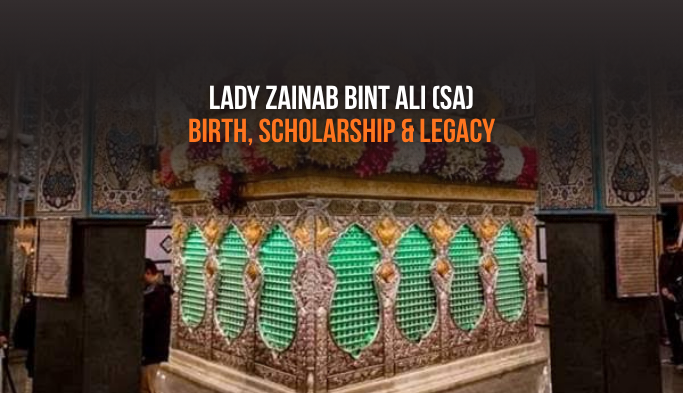
Damascus (Sayyida Zainab Mosque), Syria |
The Household That Formed Her
Lady Zainab (sa) grew up in a household where the Quran was not a text studied at a distance but a lived reality. Her grandfather was the Prophet (s), the source of revelation. Her mother was Lady Fatima al-Zahra (sa), whose purity and devotion the Quran declared. Her father was Imam Ali (as), the Gate of the Prophet’s knowledge. Her brothers were Imam Hasan and Imam Hussain (as) — the leaders of the youth of Paradise.
What this environment produced in her is captured in a statement from Imam Ali ibn al-Hussain Zayn al-Abidin (as) — her nephew, the one she had protected at Karbala and Damascus, the one who had watched her speak before Yazid in chains. He said about her:
“You are, praise be to Allah, a scholar without being taught.” (Bihar al-Anwar, Allama Majlisi, vol. 45)
This is the testimony of the fourth Imam about his aunt — that her knowledge was not the product of formal instruction but of something rooted in her proximity to revelation itself. She had grown up inside the household the Quran had declared purified. The knowledge that came from that environment was not ordinary.
The Scholar Before Karbala
Before the events of 61 AH placed Lady Zainab (sa) on the plain of Karbala and then in the courts of Kufa and Damascus, she was known in Madinah as a teacher. She held regular gatherings — for women primarily, though her reputation extended more broadly — in which she explained the Quran, transmitted hadith, and guided her community through the principles of Islamic ethics and jurisprudence.
The classical biographical sources describe these gatherings as marked by the same qualities that would later define her sermons under oppression: clarity, depth, eloquence, and the capacity to reach the heart of a matter without unnecessary ornamentation. (A’yan al-Shia, Allama Amin al-Amili)
She had absorbed her father Imam Ali’s (as) way with language — the precision and force of a mind that understood both what it wanted to say and how to make those who heard it unable to dismiss it. When Imam Ali (as) was described as the Gate of the Prophet’s knowledge, the knowledge that passed through that gate also reached his daughter. She carried it, taught it, and when the time came, deployed it in circumstances her father could not have imagined she would face.
“I Saw Nothing But Beauty”
After the Day of Ashura, Lady Zainab (sa) was taken as a prisoner from Karbala to Kufa, and from Kufa to Damascus. In the court of Yazid, she was asked with contempt: how did she find what Allah had done to her brother and his companions?
Her answer has been quoted in every generation since: “I saw nothing but beauty.” (Bihar al-Anwar, vol. 45)
This is not the statement of a person in denial. It is the statement of a person who understood what Karbala was for — who knew that Imam Hussain (as) had not gone to Karbala by accident or miscalculation, but with full awareness, full acceptance, and a commitment to preserving something more important than survival. In that framework, what happened at Karbala was exactly what it was meant to be. She had been present for it. She had witnessed its full cost. And from within that witnessing, she looked at Yazid and told him she had seen beauty.
The effect on his court is recorded. He had expected grief, despair, perhaps pleading. He received theology — a theological reading of Karbala that he could not answer and could not suppress.
In her sermon before the people of Kufa, and in her address to Yazid in Damascus, she did what Imam Hussain’s (as) blood had begun: she ensured that the story of what happened in Karbala would not be shaped by the people who ordered it. The references for those sermons are Al-Irshad (Shaykh al-Mufid) and Al-Ihtijaj (Shaykh al-Tabrisi), and they remain among the most significant documents in Islamic history.
For the full account of her sermons and her role at Karbala, see our dedicated post in the Sha’ban series.
What Her Birthday Calls Us To
The 5th of Jamadi al-Awwal commemorates the moment a name was given from the heavens for a child whose grandfather already knew what she would carry. The Prophet (s) held her and wept for the trials ahead, and then he gave her back to her parents and the household continued.
Honoring that birthday means engaging with what she actually did — not as an abstract symbol of courage, but as a specific example of what knowledge, preparation, and proximity to truth produce in a human being when the worst that political power can do is brought to bear on them. She was in chains. She was a prisoner. She had just watched her brother and her sons and her nephews die. And she produced, from within that, one of the most theologically precise refutations of tyranny in Islamic history.
Lady Zainab (sa) is buried in Damascus, Syria — not in Iraq. But the mission she completed at Karbala and in Yazid’s court is honoured wherever her family is honoured. Our 2026–2027 Iraq Ziyarat Packages bring you to the shrine of her brother Imam Hussain (as) in Karbala, the shrine of her father Imam Ali (as) in Najaf, and the shrines of the Imams who came after in Kadhimiya and Samarra — the household she spent her life protecting.
Visit: www.ziaratplanner.com





 06-Jun-2026