Introduction
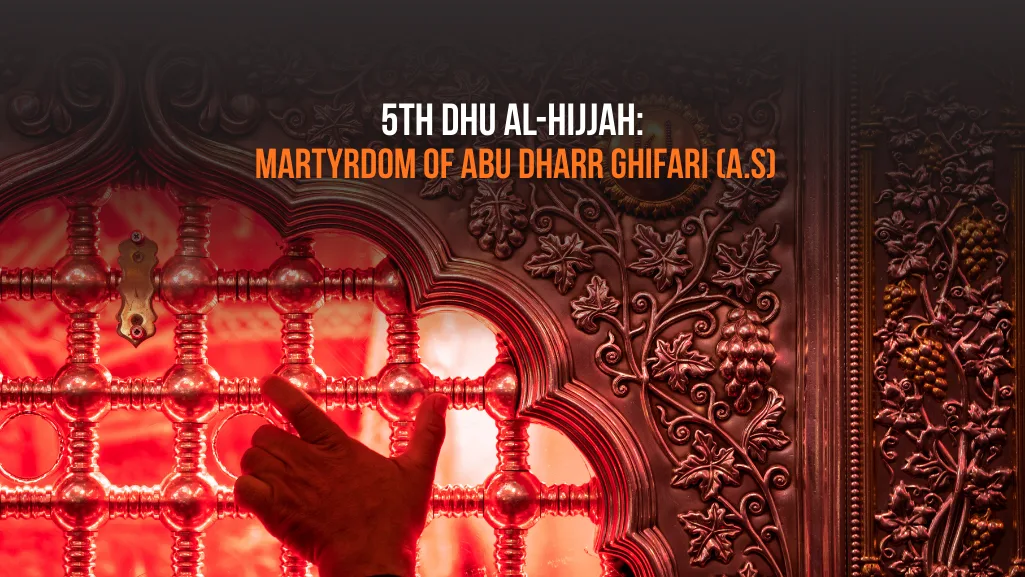
Abu Dharr al-Ghifari, a companion of the Prophet Muhammad (PBUH), renowned for his piety, asceticism, and unwavering commitment to social justice. Abu Dharr al-Ghifari stands as one of the most compelling and influential figures in early Islamic history. He is one of the earliest converts to Islam, who is renowned for his staunch advocacy for social justice. His life was a testament to the core Islamic values of truth, justice, and asceticism, and his contributions continue to resonate through the centuries.
Abu Dharr al-Ghifari's relationships with the Prophet Muhammad (PBUH) and other companions such as Ali ibn Abi Talib (AS) were instrumental in shaping his character and actions. His close bond with the Prophet (PBUH) provided spiritual and ethical guidance, while his interactions with other companions reflected a shared commitment to justice and equity, albeit sometimes leading to conflicts. This biography aims to explore the multifaceted personality of Abu Dharr, delving into his life, beliefs, personality traits and contributions to early Islamic society.
His Birth and Family Background
Abu Dharr, whose full name was Jundub ibn Junadah, was born into the Ghifar tribe. The Ghifar were a nomadic tribe located in the Hijaz region of the Arabian Peninsula. The tribe was known for its skills in trade and occasional acts of brigandage, which were common among the nomadic tribes of that time. This background influenced Abu Dharr's later emphasis on moral rectitude and social justice, as he had firsthand experience with the inequities and harsh realities of pre-Islamic Arabian society.
His Early Life and Character
The historical accounts of Abu Dharr suggest that he was a person of strong principles even before his conversion to Islam. He was known for his honesty and courage, traits that would later define his approach to Islamic teachings. His tribal background and the socio-economic conditions of his time likely contributed to his deep-seated disdain for the exploitation and corruption that he witnessed.
Abu Dharr's journey to Islam began with his curiosity about the new faith being preached by Muhammad (PBUH) in Mecca. Hearing about the Prophet's message, he traveled to Mecca to learn more. His conversion story is marked by his fearless nature and determination.
Upon reaching Mecca, Abu Dharr approached the Kaaba and openly inquired about Muhammad (PBUH). This was a bold move, considering the hostile environment towards Muslims at that time. He was eventually taken to the Prophet Muhammad (PBUH) by Ali ibn Abi Talib (AS). After listening to the Prophet's teachings, he embraced Islam without hesitation. Thus, Abu Dharr al-Ghifari is one of the earliest converts to Islam. His immediate acceptance of the faith highlights his innate inclination towards truth and justice.
Demonstrating his fearless character, Abu Dharr publicly declared his new faith in front of the Quraysh, enduring physical assaults as a result. His willingness to suffer for his beliefs foreshadowed his future activism and uncompromising stance on issues of morality and justice.
After conversion, Abu Dharr returned to his tribe and successfully called them to Islam, showcasing his early dedication to spreading the faith. His tribe's conversion had a significant impact, as it strengthened the Muslim community during its formative years.
His Personality Traits
Abu Dharr al-Ghifari is remembered as a prominent companion of the Prophet Muhammad, notable for his piety, integrity, and advocacy for social justice. His personality traits, shaped by his early experiences and deep faith, left a lasting impact on Islamic history and thought.
Piety and Asceticism
Abu Dharr's piety and asceticism are among his most defining characteristics. He lived a life of simplicity, eschewing material wealth and luxury.
Devotion to Worship: Abu Dharr was deeply devoted to worship and spirituality. He spent considerable time in prayer and contemplation, embodying the Islamic principle of tawakkul (reliance on God).
Simplicity: He adopted an austere lifestyle, living minimally and often criticizing the accumulation of wealth. Abu Dharr is quoted as saying, "I would rather have a stomach full of pus than a stomach full of wealth." This reflects his disdain for materialism and his commitment to asceticism.
Integrity and Honesty
Abu Dharr's integrity and honesty were unwavering, earning him respect and sometimes controversy.
— Majlisi, Bihar al-Anwar, vol. 22, p. 404
Truthfulness: Abu Dharr was known for his uncompromising honesty. He spoke the truth even when it was unpopular or dangerous. The Prophet Muhammad (PBUH) described Abu Dharr as a paragon of truthfulness, saying:
“"There is no one more truthful, that the sky has shaded and the earth has carried, than Abu Dharr."”
— Jami at-Tirmidhi 3801
Ethical Conduct: His adherence to ethical conduct was evident in his interactions and his fearless criticism of those he perceived as corrupt. Abu Dharr's ethical stance is highlighted through his opposition to the caliph Uthman's policies, particularly regarding the distribution of wealth and governance.
Courage and Bravery
Abu Dharr's courage and bravery were demonstrated through his actions and his willingness to stand up for his beliefs. He fearlessly advocated for social justice and criticized the elites, regardless of the consequences. Al-Tabari in his Tarikh recounts several instances where Abu Dharr openly challenged the caliph Uthman and other powerful figures, showing his courage in speaking out against perceived injustices.
Humility
Abu Dharr's humbleness and humility were central to his character, influencing his lifestyle and interactions with others.
Modest Living: He lived modestly, often sharing whatever little he had with others, embodying the Islamic values of charity and brotherhood. Ibn Kathir's historical works note that Abu Dharr would often give away his food and possessions, reflecting his humble nature and commitment to communal welfare.
His Major Contributions and Activities
Abu Dharr al-Ghifari is recognized for his significant contributions and activities that left a lasting impact on the early Islamic community and Islamic thought. His actions and teachings focused on social justice, ethical conduct, and unwavering commitment to the principles of Islam.
Advocacy for Social Justice
One of Abu Dharr's most notable contributions was his steadfast advocacy for social justice and the equitable distribution of wealth.
Critique of Wealth Accumulation: Abu Dharr was vocal about the dangers of accumulating wealth and the responsibility of the wealthy to support the less fortunate.
Promotion of Zakat and Charity: He emphasized the importance of zakat (obligatory charity) and voluntary charity (sadaqah) as means to achieve social equity.
Opposition to Corruption: He openly criticized the ruling authorities, including Caliph Uthman, for policies he perceived as unjust or corrupt.
Support for Ethical Leadership: Abu Dharr supported leaders who embodied Islamic ethical principles, such as Ali ibn Abi Talib (AS), whom he viewed as just and equitable. His alignment with Ali's (AS) views on justice and governance is noted in historical texts like Ibn Kathir's Al-Bidaya wa'l-Nihaya, demonstrating his consistent support for ethical governance.
The Legacy of Faith and Sacrifice
The Four Pillars
Abu Dharr is revered as one of the "Four Pillars" (Arkan al-Arba'a), alongside Salman al-Farsi, Miqdad, and Ammar ibn Yasir.
A Predicted Fate
Prophet Muhammad (PBUH) famously foretold his lonely end during the Battle of Tabouk, stating:
“"You will live alone, die alone, and be resurrected alone."”
Social Justice
Abu Dharr is the champion of the poor. He was exiled for criticizing the accumulation of wealth by the ruling class and their deviation from the Prophet's (PBUH) sunnah.
Loyalty to the Ahl al-Bayt
His sacrifice is deeply tied to his unwavering support for the succession of Imam Ali (AS), whom he viewed as the rightful successor of the Prophet.
The Martyrdom in Al-Rabadha
Banishment
After being exiled to Syria and then returned to Medina, he was ultimately banished to the desolate desert of al-Rabadha by Caliph Uthman.
Final Moments
He passed away in extreme poverty and isolation. His wife, Umm Dharr, was left with no shroud (kafan) for his body until a caravan from Iraq, including the companion Abdullah ibn Mas'ud, arrived by chance to provide for his burial.
Spiritual Martyrdom
Though he died of natural causes exacerbated by harsh conditions and hunger, he is regarded as a martyr (Shaheed) in the spiritual sense for losing his life as a direct result of his principled opposition to oppression.
Conflicts and Forced Exile
Abu Dharr al-Ghifari's life was defined by his role as the "Truth-Teller" of Islam, a title bestowed upon him by the Prophet Muhammad (PBUH). His primary conflict arose from his refusal to remain silent while the egalitarian spirit of the Prophet's message was being dismantled. Abu Dharr was one of the Four Pillars (the most loyal companions of Imam Ali (AS)), and his opposition to the ruling elite was rooted in his belief that the leadership had deviated from the divine path established at Ghadir Khumm.
His most significant confrontation was with the third caliph, Uthman ibn Affan, and his governor in Syria, Mu'awiya ibn Abi Sufyan. Abu Dharr became a thorn in the side of the Umayyad clan, vehemently protesting their hoarding of the Bayt al-Mal (Public Treasury). He famously stood in the markets of Damascus, reciting the Quranic warning:
“"And those who hoard gold and silver and spend it not in the way of Allah—give them tidings of a painful punishment."”
— Quran 9:34
He accused the administration of transforming the "Wealth of Muslims" into the "Wealth of the Umayyads," viewing this nepotism as a betrayal of Islamic social justice.
When Mu'awiya could no longer silence him, Uthman recalled him to Medina and subsequently forcibly exiled him to the desolate desert of al-Rabadha. Uthman forbade any citizen from speaking to or seeing Abu Dharr off. However, in an act of profound solidarity, Imam Ali (AS), alongside his sons Imam Hassan (AS) and Imam Hussain (AS), broke the caliph's decree to bid him farewell. Imam Ali (AS) comforted him, saying:
“"O Abu Dharr, you were angry for the sake of Allah, so have hope in Him for whom you were angry."”
Abu Dharr's final days in al-Rabadha were marked by extreme hardship and state-imposed isolation, yet he remained a moral beacon of asceticism. He died in Dhul al-Hijjah 32 AH / 653 AD, fulfilling the Prophet's (PBUH) haunting prophecy: "Abu Dharr, you will live alone, die alone, and be raised alone." While he passed away with only his daughter (or wife) by his side in a state of dire poverty, his funeral was eventually attended by a group of righteous companions, including Abdullah ibn Mas'ud, who wept at the sight of the Prophet's (PBUH) beloved companion left to die in the wilderness for the crime of speaking the truth.
Conclusion
Abu Dharr al-Ghifari's life exemplifies unwavering commitment to Islamic values of truth, justice, and asceticism. As a close companion of the Prophet Muhammad (PBUH), his advocacy for social justice, criticism of wealth accumulation, and political activism, particularly against Caliph Uthman, highlight his dedication to ethical governance and equitable wealth distribution. Despite facing exile, Abu Dharr's legacy as a champion for the poor and a critic of corruption endures, continuing to inspire contemporary Islamic thought and social justice movements. His life serves as a powerful reminder of the importance of steadfast faith and ethical principles in pursuing a just society.
Abu Dharr al-Ghifari's relationships with the Prophet Muhammad (PBUH) and other companions played a significant role in shaping his personality, beliefs, and actions. These relationships were characterized by mutual respect, mentorship, and a shared commitment to Islamic principles.
For more information or any queries, feel free to contact us. We are always ready to help you plan a peaceful and blessed journey.