Introductory Words
One of the often-overlooked yet profoundly significant chapters in the great journey of Karbala is the sacrifice of Hazrat Muslim ibn Aqeel (A.S.). He was a loyal ambassador who carried the message of Imam Hussain (A.S.) to the people of Kufa. However, in the city that once pledged loyalty, he was met with betrayal. Let us reflect upon his heartfelt journey, filled with unwavering faith and devotion.
Lineage and Beginning of Life
The respected individual whose heartfelt life story we want to write is named Muslim. He is the shining light of Janab Aqeel, the son of Hazrat Abu Talib, the honorable uncle of the Prophet Muhammad (PBUH). Janab Amir al-Mu'minin Ali al-Murtaza (A.S.) was his actual uncle. He belongs to the noble family of prophethood and is a well-known personality from the household of the Prophet.
Muslim’s Mother
Aqeel had great expertise in genealogy. People would consult him before marriage proposals. He must have chosen for himself a daughter from the best tribe and clan. Arbab Tareek has written that Muslim’s mother was a Nabatean woman of foreign descent, belonging to the Farzandi family of Iran. Aqeel purchased her by obtaining 10,000 dinars from the treasury of Muawiyah.
In ancient Arabia, there was a widespread practice of buying and selling slaves and servants. However, it was not necessary that those who appeared in the market were of low status. Like Prophet Yusuf (A.S.), even people from noble families could be found in the markets.
The most important part of a biography is the discussion of the parents’ personalities. Hazrat Muslim was noble and honorable from both his maternal and paternal sides.
Birth and Appearance
Muslim was born during the era of Imam Ali (A.S.).
Growing Up Under Noble Shadows
He grew up under the esteemed guidance of the Pride of the Universe, his uncle, and alongside the innocent brothers, Hasan and Husayn (A.S.).
Resemblance to the Prophet (PBUH)
From his early years, Muslim’s appearance and character showed a remarkable resemblance to the Prophet of God, making him a distinguished member of the noble family.
Name and Title
The name Muslim was divinely destined for him, reflecting his peaceful nature. He was truly deserving of this name, as neither he nor his ancestors ever supported discord or rebellion. His mission was to unite all Muslims under one banner. For this commitment, he faced great trials and was ultimately martyred, remembered as a noble martyr. In Ziyarat, he is also honored with the title Abd-e-Saleh — meaning a servant of good character.
Upbringing of Muslim
Muslim and his brothers grew up under the compassionate guardianship of Imam Ali (A.S.), enduring hardships and poverty that deeply shaped their character. Imam Ali once said in a sermon:
“I saw Aqil’s children whose faces had darkened from hunger and poverty, as if the color of brass had settled on their delicate skin.”
Despite wearing torn clothes and eating dried dates, their spiritual nourishment and educational training remained uncompromised. For acquiring knowledge, the gates of Medina itself were sufficient, and the art of war was a family legacy. Showing utmost respect to the elders, Muslim attained such mastery that Imam Hussain (A.S.), the beloved son of the Prophet, appointed him as his trusted deputy and called him ‘Thiqah’ — the trustworthy.
Personal Qualities of Hazrat Muslim ibn Aqeel (A.S.)
When we examine the life of Hazrat Muslim ibn Aqeel (A.S.), we find in him every individual quality that could rightfully be titled as a subject of praise. These traits were not just superficial — they define his mission, character, and legacy.
His Intellectual Distinction
Had Muslim not possessed intellectual excellence, Imam Hussain (A.S.) would not have chosen him as his representative to Kufa. Being appointed as a deputy meant he had to cater to the religious and scholarly needs of the people of Kufa, which he fulfilled with distinction.
Embodiment of Justice
His sense of justice was so firm that he was assigned the responsibility of leading prayers in the Great Mosque of Kufa. This was an honor no other companion of Imam Hussain (A.S.) received, despite their presence in Karbala. For two full months, Muslim led the prayers for a congregation that included Qur’an memorizers, companions of Imam Ali (A.S.), and renowned jurists — whose scholarship was acknowledged even by the Imams themselves.
Excellence in Worship
Muslim was unmatched in worship and devotion. Whether he stayed at the house of Mukhtar, Muhammad bin Kathir, or Hani ibn Urwah, the air echoed with the sound of his takbeer (exaltation of God) and tahleel (declaring God's oneness). In Ziyarat, it is testified:
“You established prayer and gave zakat.”
Unparalleled Bravery
His courage and valor were legendary. The streets of Kufa still echo with tales of his lone resistance against the army of Ibn Ziyad. Every soldier of the enemy spoke of his bravery with awe. In Ziyarat, his valor is praised with the words:
“I bear witness that you surpassed even the warriors of Badr in your courage.”
Marriage and Family Life
These noble traits were evident in him from his youth. Recognizing his virtue, Imam Ali (A.S.) selected him as a son-in-law, marrying him to his daughter Lady Ruqayya. It was common among the Banu Hashim to marry within the noble family, ensuring both spiritual and moral alignment.
It is also narrated that Muslim had a second wife, who was a maidservant residing in Medina. Since she was not from Banu Hashim and stayed in Medina, she did not accompany him during the events of Karbala.
The Journey of Life: Trials and Turning Points
The early life of Muslim ibn Aqeel was filled with trials. During his youth, he witnessed the demise of Imam Ali (A.S.), his noble uncle. Soon after, he suffered the sorrowful loss of his own father, Aqeel ibn Abi Talib. He then saw the quiet, withdrawn life of Imam Hasan (A.S.), lived under the heavy shadow of Muawiyah's political maneuvering.
The Rise of Oppression
He witnessed the martyrdom of Imam Hasan (A.S.) through deceit and poison. Eventually, Muawiyah appointed Yazid as his successor and left the world, opening a dark new chapter of tyranny. With the establishment of Yazid’s rule, the Household of the Prophet (S.A.W.W) faced grave threats. Yazid’s demand for allegiance from Imam Hussain (A.S.) ignited a spiritual and moral crisis.
Imam Hussain’s Response and Migration
Realizing the time for patience had passed, Imam Hussain (A.S.) refused to pledge allegiance to a wine-drinking tyrant. Declaring Yazid's caliphate illegitimate, he left Medina with a select group of family and companions, including Muslim ibn Aqeel, and headed toward Makkah.
On Friday night, 3rd of Sha’ban, Imam Hussain arrived in Makkah. He stayed there, and people began visiting his home frequently to meet and pledge loyalty.
Kufa Awakens: A Call for Justice
As news of Muawiyah’s death spread, people began to inquire about Yazid’s character. Word also reached them that Imam Hussain (A.S.) and Abdullah ibn Zubair had refused to give bay'ah (allegiance) and had both taken refuge in Makkah.
In Kufa, the Shi’as gathered at the house of Sulayman ibn Surad al-Khuzai. Upon hearing the confirmation of Muawiyah's death, they praised Allah and expressed hope for change.
Sulayman ibn Surad, along with other loyal Shi’a leaders, took a solemn pledge:
“If Imam Hussain (A.S.) were to respond to their plea, they would stand by him, support him, and give their lives for his cause.”
Thousands of Letters of Allegiance
As a result, hundreds of letters were sent from Kufa to Imam Hussain (A.S.). On some days, as many as 600 letters arrived, and the Imam did not respond immediately. The number eventually surpassed 12,000 letters.
Imam Hussain (A.S.) Responds
When the final messengers, Hani ibn Hani and Sa’id ibn Abdullah, reached Imam Hussain (A.S.) with yet more appeals from Kufa, the Imam finally responded. He entrusted them with a formal letter, addressing the people of Kufa and acknowledging their support.
This marked the beginning of the mission of Muslim ibn Aqeel, the faithful envoy who would carry the Imam’s response to Kufa — a journey of sacrifice, betrayal, and ultimate martyrdom.
The Historic Letter from Imam Hussain (A.S.) to the People of Kufa
“This letter is from Hussain ibn Ali to the group of believers and Muslims.
Hani and Sa’eed were your final messengers. They delivered your letters and conveyed your messages to me. I am fully aware of everything you said through them.
Most of you stated that you have no Imam or leader, and that I should come to you, so that Allah may unite you under the banner of truth and guidance through me.
Therefore, I am sending to you my cousin, a man from my family in whom I place complete trust and confidence — Muslim ibn Aqeel.
If he writes back to me confirming that your collective view and intentions match what your messengers and letters state, then, God willing, I shall soon come to you.
By my life, an Imam is none other than one who judges by the Book of Allah, establishes justice, upholds the true religion, and dedicates himself to the path of truth.”
The Appointment of Muslim ibn Aqeel (A.S.) as Envoy
Imam Hussain (A.S.) summoned Muslim ibn Aqeel, entrusting him with the sacred duty of representing him in Kufa. Along with Muslim, the Imam sent companions including:
- Qais ibn Mus-hir
- Amarah ibn Abdullah
- Abdullah ibn Shaddad
- Abdur Rahman ibn Shaddad
Before their departure, the Imam gave clear instructions to Muslim ibn Aqeel:
- Maintain piety and God-consciousness
- Keep your mission discreet and confidential
- Treat the people of Kufa with kindness and justice
- If you find them united and loyal, inform me immediately
Departure from Makkah: A Mission of Faith
Muslim ibn Aqeel departed from Makkah on the 15th of Ramadan, heading towards Kufa. Upon reaching Madinah, he prayed in the Prophet’s Mosque, bade farewell to his family, and set out with two guides toward Iraq.
A Trial in the Desert: The Death of the Guides
On the journey, tragedy struck. The two guides lost their way and eventually died of thirst in the scorching desert. Yet, despite the sorrow, Muslim ibn Aqeel continued his journey, firmly committed to fulfilling his duty to Imam Hussain (A.S.).
Arrival in Kufa: The Beginning of a Difficult Mission
Muslim ibn Aqeel finally reached Kufa on the 5th of Shawwal. His first place of residence was the home of Mukhtar ibn Abi Ubaidah Al-Thaqafi, a known sympathizer of Ahlul Bayt.
This marked the beginning of a courageous and spiritually significant mission that would eventually lead to one of the most heart-wrenching sacrifices in Islamic history.
18,000 Allegiances to Muslim ibn Aqeel (A.S.) in Kufa
Shortly after his arrival in Kufa, an astounding 18,000 residents pledged allegiance to Muslim ibn Aqeel (A.S.). In response, Muslim wrote a detailed letter to Imam Hussain (A.S.), informing him about the overwhelming support from the people and urging him to come to Kufa. This important letter was written 27 days before Muslim's martyrdom.
Rising Tensions: The Secret Leaks
Muslim ibn Aqeel’s growing popularity could not be kept hidden for long. The house where he was staying became a hub of Shi’a activity. The constant visits of influential figures eventually exposed the secret of his presence.
The Arrival of Ibn Ziyad in Kufa
At the time, Nu’man ibn Basheer was the governor of Kufa — first appointed by Muawiyah, then retained under Yazid. Once he became aware of the developments, alarm bells began ringing.
Several prominent individuals in Kufa, including ‘Umar ibn Sa’d, wrote letters to Yazid warning him about Muslim ibn Aqeel’s activities and the growing support he was receiving. This news alarmed Yazid.
Yazid immediately responded by sending Ubaydullah ibn Ziyad — then the governor of Basra — to take charge of Kufa. He issued clear and brutal orders:
““Devise a strategy to kill Hussain and his companions. They are soon to enter Kufa. Do whatever you wish, for my satisfaction lies in this task.””
The Deception: Ibn Ziyad Enters Kufa in Disguise
Ibn Ziyad, known for his cunning nature, devised a clever trick. He entered Kufa at night, with a black turban wrapped around his head and his face covered, adopting a noble and solemn posture, imitating Imam Hussain’s demeanor. The people of Kufa, eagerly awaiting Imam Hussain’s arrival, mistakenly believed it was him.
They welcomed Ibn Ziyad joyfully, offering greetings and praises, thinking they were honoring the grandson of the Prophet (PBUH).
“This incident is a bitter reminder of how politicians, even in modern times, disguise evil under the veil of piety, deceiving the masses by impersonating sacred figures and noble ideals.”
Terror Begins: Ibn Ziyad’s Ruthless Threats
Upon entering Kufa, Ibn Ziyad headed straight to Dar al-Imarah (the Governor’s Palace). The next morning, he appeared in the mosque and publicly addressed the people. In his speech, he issued stern threats to the city's nobles and general population:
““Whoever disobeys me will be hanged,
his property will be confiscated,
and he will be denied his share from the public treasury.””
With this, the entire atmosphere of Kufa shifted overnight. Fear took root in the hearts of the people. The once-rising support for Muslim ibn Aqeel now began to waver under the threat of persecution and loss.
Seeking Shelter: Muslim Moves to Hani ibn Urwah’s House
When Muslim heard about Ibn Ziyad’s arrival and his violent threats, he left Mukhtar’s house and sought refuge at the residence of Hani ibn Urwah. Initially, Hani hesitated, fearing for his safety. But Muslim replied:
““I seek your protection. I am your guest.””
Despite the danger, Hani eventually offered him shelter. Meanwhile, Shi’as began visiting Hani’s house with extreme secrecy and caution, continuing to renew their allegiance to Muslim ibn Aqeel. According to Ibn Shahr Ashub, their numbers soon reached 25,000, and the plan for an uprising began taking shape.
The Spy: Ibn Ziyad's Counter-Strategy
In a counter-move, Ibn Ziyad sent one of his trusted slaves named Ma'qil, handing him 3,000 dirhams and strict instructions:
““Find Muslim ibn Aqeel and his companions.
Win their trust. Do not reveal yourself.
Use this money as a disguise to earn their confidence.
Your mission is to gather intelligence and report back.””
This act of infiltration would mark the beginning of betrayal that would ultimately lead to the tragedy of Muslim ibn Aqeel (A.S.) and set the stage for the heartbreaking events of Karbala.
The Spy Named Ma'qil Infiltrates the Ranks of the Shi'a
Ibn Ziyad's spy, Ma'qil, successfully infiltrated the Shi’a circles in Kufa. With his deceitful strategy and generous use of bribes, he was able to gain the trust of the supporters of Muslim ibn Aqeel (A.S.). He began carefully gathering intelligence on Muslim and his associates, setting the stage for the upcoming betrayal.
A Missed Opportunity: When Ibn Ziyad Came to Hani’s House
One day, Ibn Ziyad visited Hani ibn Urwah’s residence under the pretense of meeting someone. Muslim ibn Aqeel (A.S.) was present at the house at that time. Hani suggested to Muslim:
““Now is your chance. You should kill him before he causes destruction.””
But Muslim (A.S.) refused. When Hani asked why, he gave a powerful reply:
““Faith prevents deceit. A believer does not betray, nor does he act treacherously.””
This moment reflects the unshakable ethics of Ahlul Bayt (A.S.), even in the face of grave danger.
The Arrest and Torture of Hani ibn Urwah
Following his refusal to betray Muslim ibn Aqeel (A.S.), Hani ibn Urwah was summoned to the governor’s palace. When Hani continued to stand firm in support of Muslim, Ibn Ziyad lost his temper.
He beat Hani severely, smashing his nasal bone and causing blood to gush from his face. At one point, Ibn Ziyad struck him on the skull with an iron rod, leaving him unconscious and imprisoned.
The Siege of Ibn Ziyad’s Palace by the Tribe of Madh’hij
When the news of Hani’s brutal imprisonment reached ‘Amr ibn Hajjaj, he quickly mobilized the tribe of Madh’hij and surrounded Ibn Ziyad’s palace. In a panic, Ibn Ziyad sent a judge named Sharif to address the crowd, falsely assuring them:
““Hani is alive and well.””
But the Shi’a were not convinced. According to Sheikh Mufid and other classical historians, ‘Abdullah ibn Hizam was sent by Muslim ibn Aqeel to inquire about Hani’s condition. After discovering the harsh reality, he rushed back on horseback to deliver the tragic news to Muslim.
The Call to Action: “Ya Mansur Amet!” Echoes in Kufa
Upon hearing the news, Muslim ibn Aqeel (A.S.) issued a call for immediate resistance. His battle cry was:
““Ya Mansur Amet!” (O Victorious One, Advance!)”
This call spread rapidly through Kufa. Within moments, nearly four thousand armed supporters gathered at a house near the city center. With renewed energy, they marched toward Dar al-Imarah (the governor’s palace) to confront Ibn Ziyad.
Ibn Ziyad Goes into Hiding: The City of Kufa Rises
Frightened by the approaching crowd, Ibn Ziyad locked himself inside the palace and shut all its gates. Muslim ibn Aqeel and his supporters surrounded the palace, and the nearby mosques and marketplaces were filled with people joining the uprising.
By nightfall, Ibn Ziyad was left with only a few supporters:
- 30 palace guards
- 20 noblemen of Kufa
- His own family slaves
The rest of Kufa had seemingly turned against him.
Deception and Division: Ibn Ziyad’s Political Counterattack
Realizing that military strength alone would not save him, Ibn Ziyad resorted to deception and manipulation. He summoned Kathir ibn Shihab al-Harithi and ordered:
““Drive out those from the tribe of Madh’hij who are supporting Muslim. Roam the city and spread fear among the people. Break their unity.””
He also called Muhammad ibn Ash’ath and instructed him to:
““Raise the flag of safety and announce: Whoever comes under my banner will be granted protection.””
Meanwhile, he kept the city elders close to him, attempting to win them over with false kindness and personal attention, in hopes of isolating Muslim and weakening his support.
How Kufa Betrayed Muslim ibn Aqeel (A.S.): Fear and False Promises
As instructed by Ibn Ziyad, selected individuals roamed the streets of Kufa to disperse the supporters of Muslim ibn Aqeel (A.S.). At the same time, Kufa’s elite and tribal leaders were ordered to climb atop rooftops and address the crowds. They falsely assured the public of peace and pressured them to submit to Ibn Ziyad's authority.
Using a mix of intimidation and deceitful promises, they instilled fear. Gradually, the masses began to leave Muslim’s side, disillusioned and terrified.
Even Mothers Pulled Their Sons Away: The Abandonment of Loyalty
According to Sheikh Mufid, the situation deteriorated so drastically that even mothers came and pulled away their sons and brothers from the crowd. One by one, people abandoned the cause of Muslim ibn Aqeel (A.S.).
By the time of Maghrib (sunset) prayer, only thirty people remained with him in the mosque. After the prayer, when Muslim looked around, only ten companions were left. As he walked toward the Gate of Kindah, even they slipped away.
Soon, Muslim ibn Aqeel (A.S.) was entirely alone — in the same city where 18,000 had pledged allegiance to him.
Wandering the Streets of Kufa: A Heartbreaking Sight
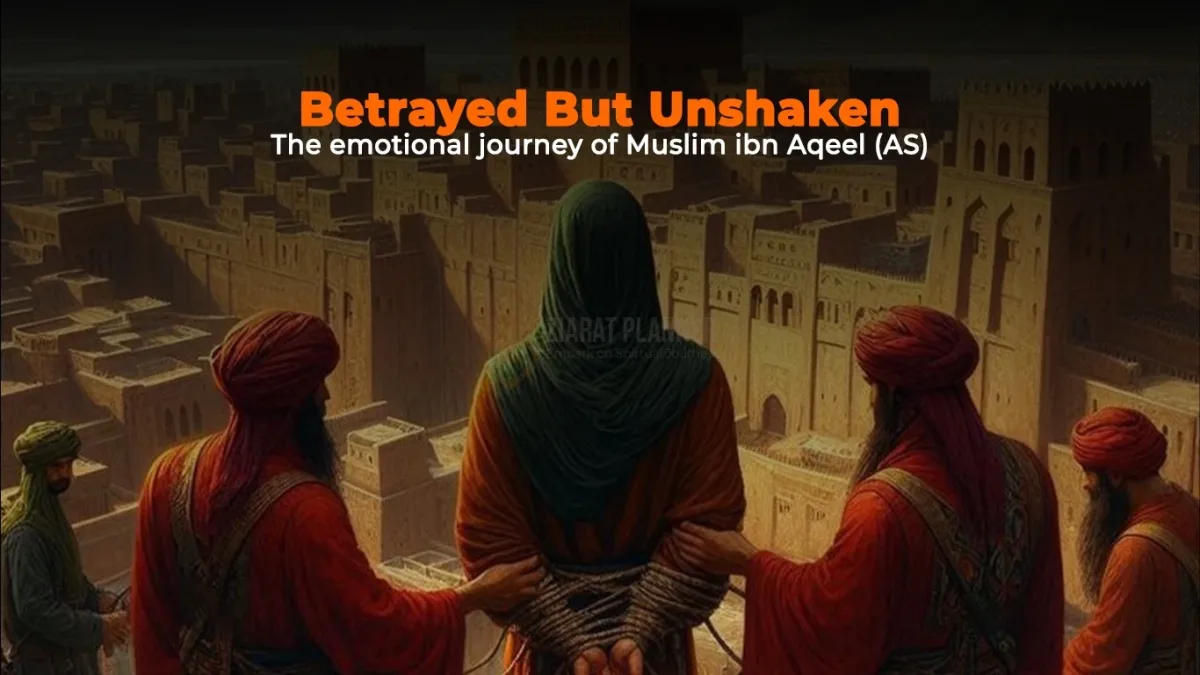
Finding himself utterly abandoned, Muslim ibn Aqeel (A.S.) dismounted his horse, confused and lost in the dark alleys of Kufa. With no guide, no refuge, and no companion, he walked aimlessly, heartbroken and betrayed.
Eventually, he stopped at the door of a house where a woman stood, waiting for her son to return from the crowds. She was a former slave of Ash'ath ibn Qays, now married to Asad ibn al-Hadrami, and mother to a son named Bilal.
A Drink of Water and an Unexpected Shelter
Muslim ibn Aqeel (A.S.) greeted the woman and politely requested a drink of water. She handed him the water, which he drank and then sat quietly near her door.
She politely urged him multiple times to return to his home, but Muslim stayed silent. On her third request, he replied:
““I have no home, no tribe, and no family in this city. You are in a position to do a virtuous act for the sake of God. Perhaps one day, I can repay this favor.””
Her name was Taw’a. Realizing his condition, she asked:
““Who are you?””
He replied:
““I am Muslim ibn Aqeel. The people deceived me and led me into a revolt under false pretenses.””
Moved by his honesty and nobility, Taw’a offered him shelter. She led him inside, gave him a private room, laid out a bed, and offered him food. But Muslim did not eat.
A Child’s Discovery: The Secret That Changed Everything
Soon after, her son Bilal returned and noticed his mother frequently visiting the guest room. Suspicious, he asked about it. Despite her efforts to keep it secret, he eventually learned that Muslim ibn Aqeel was hiding in their home.
Though she made him promise secrecy, the seed of betrayal had already been planted.
Ibn Ziyad Declares a Bounty on Muslim ibn Aqeel
That night, as no more protest voices were heard outside his palace, Ibn Ziyad sensed victory. He instructed his guards to check the surroundings, and when they confirmed that the streets were empty, he confidently went to the mosque before Isha (night) prayer.
He surrounded himself with his commanders and declared from the pulpit:
““Whoever does not appear at the night prayer will have his blood spilled.
Whoever shelters Muslim ibn Aqeel, his blood is lawful (halal).
But whoever brings him to me will be rewarded with 1,000 gold dinars.””
He then ordered Husayn ibn Amir, the head of police, to seal off the city’s alleys and begin house-to-house searches for Muslim ibn Aqeel (A.S.).
A Son’s Betrayal: Muslim ibn Aqeel’s Location Exposed
Despite his mother’s plea for secrecy, Bilal, the son of Taw’a, could not contain the truth. He secretly informed Ibn Ziyad that Muslim ibn Aqeel (A.S.) was hiding in their house.
Ibn Ziyad wasted no time. He dispatched a large military force to surround the house and capture the noble envoy of Imam Hussain (A.S.).
Lion of Banu Hashim: Muslim ibn Aqeel’s Unmatched Valor
When the enemy troops arrived, Muslim ibn Aqeel (A.S.) fearlessly stepped out, embodying the courage of his uncle, Imam Ali (A.S.), the Lion of Allah. He fought with such bravery and strength that the soldiers were forced to retreat from Taw’a’s home.
Muslim’s sword sliced through the enemy ranks with unmatched ferocity. His courage was such that his enemies could hardly believe one man could fight so powerfully alone.
Seventy Warriors vs. One Brave Soul
Muhammad ibn Ash'ath, a seasoned commander, was sent with 70 elite soldiers to subdue Muslim ibn Aqeel. When the siege began, Muslim stormed out and launched a solo attack, killing 41 of them with his sword.
This devastating blow shook the entire force. The soldiers scattered in fear, and even Ibn Ziyad was outraged by their defeat.
He scolded Muhammad ibn Ash'ath, saying:
““How did you let so many of my men die?””
Muhammad replied:
““You sent me to fight not an ordinary man, but a warrior from the best of all families — a man whose sword cuts like fire and who fights like a roaring lion.””
The Beast of the Battlefield: A Warrior of Strength and Fury
Renowned scholars like Allama Majlisi (quoting Muhammad ibn Abi Talib) report that Muslim fought with such power and might that he picked up enemy soldiers with his bare hands and threw them from rooftops and battlements.
He was no ordinary warrior. He was a ferocious lion, the embodiment of Hashemite strength, fighting a righteous battle alone against an army.
Ibn Ziyad’s Desperation: Offering False Safety to End the Battle
Unable to defeat him through force, Ibn Ziyad resorted to deception. He sent word to Muhammad ibn Ash'ath:
““Offer him safety and amnesty, for without this, you will never capture him.””
Even the commander acknowledged that Muslim’s strength was unmatched, saying:
““Did you think you were sending me to capture a fruit vendor or a helpless foreigner? You sent me to subdue a raging lion, a warrior of noble blood armed with a cutting sword and unwavering resolve.””
False Promise of Safety
Following Ibn Ziyad’s command, Muhammad ibn Ash'ath approached Muslim ibn Aqeel (A.S.) with a false promise of safety. But the wise warrior, aware of the enemy’s deceitful nature, firmly responded:
““I do not trust your promise of safety.””
Despite his resistance, Muslim fought valiantly, sustaining numerous wounds. Eventually, one cowardly soldier struck him from behind with a spear, bringing the wounded hero to the ground.
Surrounded, Injured, and Alone
Some accounts state that arrows and stones rained down upon Muslim, weakening him further. Bloodied and battered, he leaned against a wall for support. Muhammad ibn Ash’ath again insisted:
““You are under my protection now.””
Muslim replied, “Am I really under your protection?”
“Yes,” said Muhammad.
Captured by Treachery, Grieving for Imam Hussain (A.S.)
A mule was brought to carry the wounded captive. Even while he was being escorted, the soldiers around him kept striking him with swords. Feeling betrayed and surrounded by treachery, Muslim began to weep.
When asked, “Why do you cry at a time like this?” Muslim replied with deep sorrow:
““By Allah, I do not cry for myself or fear death. I cry for Hussain (A.S.) and the Ahl al-Bayt (A.S.) who are coming toward Kufa. They are walking into a trap of betrayal and death.””
No Salaam for the Tyrant: Facing Ibn Ziyad
Upon arrival at the palace, Muslim refused to greet Ibn Ziyad, saying:
““Should I greet the one who wants to kill me? If he does not intend to kill me, then I will greet him many times over.””
Ibn Ziyad replied, “I will personally kill you!”
Muslim said, “If that is your intention, then allow me to make my final will.”
The Final Will of Muslim ibn Aqeel (A.S.)
Muslim turned to Umar ibn Sa’ad, who was his relative, and requested a private conversation. Ibn Ziyad agreed.
In their short exchange, Muslim gave three final wishes:
- “I owe 700 dirhams in Kufa. Sell my sword and armor to pay the debt.”
- “After I am martyred, bury my body respectfully.”
- “Send a message to Hussain (A.S.): Do not come to Kufa, for the people have betrayed me.”
Umar ibn Sa’ad conveyed these words back to Ibn Ziyad, but the cruel governor remained unmoved.
Final Moments: Supplication on the Rooftop
Ibn Ziyad ordered that Muslim ibn Aqeel be taken to the rooftop of the palace and executed. As he ascended, Muslim’s lips were engaged in the remembrance of Allah. He prayed with deep humility:
““O Allah! Judge between me and this deceitful nation. They lied to us, betrayed us, and abandoned us in our time of need.””
Martyrdom on the Rooftop: The First of Banu Hashim
A wretched executioner beheaded Muslim ibn Aqeel (A.S.) atop the palace and threw his blessed body to the ground. Shortly afterward, his head was also thrown down.
According to al-Mas'udi, Ibn Ziyad ordered:
- Muslim’s body to be hung on a wooden scaffold, making him the first Hashemite whose body was crucified in public.
- His head to be sent to Damascus, marking the first severed head from the family of Banu Hashim to reach Yazid.
Legacy of Loyalty and Courage
The martyrdom of Muslim ibn Aqeel (A.S.) stands as a timeless symbol of loyalty, bravery, and sacrifice. Betrayed by the people of Kufa, he remained steadfast in his duty to Imam Hussain (A.S.), setting a precedent of faith and honor for generations to come.
Martyrdom of Muslim ibn Aqeel (A.S.) on the Day of Arafah
According to historical narrations, Muslim ibn Aqeel (A.S.) was martyred on Wednesday, 9th Dhul Hijjah, in the year 60 AH, which coincided with the Day of Arafah — a sacred day in the Islamic calendar.
His Age at the Time of Martyrdom
It is recorded that when Aqeel ibn Abi Talib, the father of Muslim, passed away in 50 AH, Muslim ibn Aqeel was only 18 years old. Based on this, at the time of his martyrdom in 60 AH, he was just 28 years old — a young man with unwavering faith, unmatched courage, and deep loyalty to Imam Hussain (A.S.).
His Sacred Shrine in the Holy City of Kufa
The blessed shrine of Muslim ibn Aqeel (A.S.) is located in Masjid al-Kufa, to the left of the Qibla direction, near the shrine of Hani ibn Urwah. The grave is beautifully built, covered by a green dome, and visited by thousands of pilgrims throughout the year.
This holy site is a place of immense spiritual value. Pilgrims believe that their prayers and supplications are answered here. Even complicated legal matters, which sometimes baffle worldly authorities, find resolution through tawassul (intercession) with Muslim ibn Aqeel (A.S.).
Conclusion
““Among the believers are men who stayed true to the promise they made to Allah.” — Surah Al-Ahzab (33:23)”
Muslim ibn Aqeel’s martyrdom stands as a prelude to the tragedy of Karbala — a voice that echoed loyalty, sacrifice, and unwavering faith before the battle had even begun. His short but meaningful life is a beacon of light for every truth-seeker, every loyal heart, and every lover of Ahlul Bayt (A.S.).
Lessons from the Life of Muslim ibn Aqeel (A.S.)
- His unshakable loyalty to Imam Hussain (A.S.) teaches us to stand by the truth even when abandoned by the world.
- His patience and valor in the face of betrayal remind us to endure hardship for the sake of righteousness.
- His martyrdom was the gateway that exposed the battle between truth and falsehood, setting the stage for the events of Karbala.
Final Reflections: A Legacy of Honor and Sacrifice
May Allah (SWT) grant us the ability to follow in the footsteps of Muslim ibn Aqeel (A.S.) — the one who kept his pledge to his Imam, never hesitated to sacrifice his life, and became an eternal symbol of devotion, courage, and divine loyalty.
References
- Sardar-e-Karbala
- Sawaneh-e-Hayat Hazrat Muslim ibn Aqeel (A.S.)
For more information or any queries, feel free to contact us. We are always ready to help you plan a peaceful and blessed journey.