The Man Who Served 21 Years in Silence
The 18th of Sha’ban, 326 AH. In Baghdad, Hussain ibn Ruh al-Nawbakhti (ra) — the third special deputy of Imam al-Mahdi (atfs), the man who had maintained the connection between the Hidden Imam and the Shia community for twenty-one years — died. He had been imprisoned, pressured, and watched. He had revealed nothing. He had kept a network intact across the Muslim world through two decades of Abbasid surveillance, using intelligence, compartmentalization, and an absolute silence that his enemies could not crack.
He is not a figure whose name most Muslims know. He served during one of the most invisible and therefore most essential chapters in Shia Islamic history — the Minor Occultation — when the survival of authentic guidance depended entirely on people like him doing their work without recognition. Three days after Nisf Sha’ban, on the 18th, we mark his passing.
Allah says in the Quran:
إِنَّ الَّذِينَ قَالُوا رَبُّنَا اللَّهُ ثُمَّ اسْتَقَامُوا تَتَنَزَّلُ عَلَيْهِمُ الْمَلَائِكَةُ
Translation: “Indeed, those who say ‘Our Lord is Allah’ and then remain steadfast — the angels will descend upon them…” (Surah Fussilat, 41:30)
Steadfastness in concealment over two decades of danger is what this verse looks like in a life.
Biography at a Glance
| Full Name: |
Abu al-Qasim Hussain ibn Ruh al-Nawbakhti |
| Kunyat: |
Abu al-Qasim |
| Title: |
Al-Safir al-Thalith (The Third Deputy) — third Na’ib of Imam al-Mahdi (atfs) |
| Family: |
Al-Nawbakhti — a prominent Shia scholarly family in Baghdad |
| Birth: |
Exact date unknown — 3rd century AH, likely Baghdad |
| Wafat: |
18th Sha’ban, 326 AH (938 CE) — Baghdad, Iraq |
| Period of Deputyship: |
~21 years (305–326 AH) — the longest of all four deputies |
| Preceded by: |
Muhammad ibn Uthman (ra) — the second deputy |
| Succeeded by: |
Ali ibn Muhammad al-Samarri (ra) — the fourth and final deputy |
| Shrine: |
Baghdad, Iraq |
The Nawbakhti Family and Why It Mattered
The Nawbakhti family was not ordinary. They were Baghdad’s most prominent Shia scholarly family — scholars, theologians, and thinkers who had produced generations of defenders of Shia doctrine, including responses to Mu’tazilite theology and systematic expositions of Imami belief. They were known in Abbasid intellectual circles, which gave them a form of protection that pure obscurity could not provide: they were visible enough to be regarded as scholars rather than revolutionaries, and that visibility was a kind of cover.
Growing up in that family gave Hussain ibn Ruh (ra) something no training program could provide: the instincts of a person who had lived at the intersection of theological precision and political danger from childhood. He knew how Abbasid bureaucracy worked. He knew how scholarly networks operated. He knew when to speak and when silence was the safer and the more effective act. He had been shaped, before he was chosen, for exactly the role he was called to fill.
Before his formal appointment, he served as a close associate of Muhammad ibn Uthman (ra) — the second deputy — assisting with correspondence, financial management, and the evaluation of those who sought contact with the network. He was known among the scholars of his time for his discretion and his reliability. When Muhammad ibn Uthman, by instruction of the Imam (atfs), publicly appointed him as the third deputy before his own death, the community received the news with confidence. The preparation had been visible. (Kitab al-Ghaybah, Shaykh al-Tusi; Al-Irshad, Shaykh al-Mufid)
Twenty-One Years: The Longest Deputyship
From 305 AH to 326 AH — twenty-one years — Hussain ibn Ruh (ra) carried the deputyship. This is longer than any of the other three deputies. He served through multiple Abbasid caliphs, through shifting political climates, through the constant threat of infiltration and exposure, and through the ongoing challenge of false claimants who tried to exploit the opacity of the occultation period to insert themselves as representatives of the Imam.
His primary role was maintaining communication: collecting questions from scholars and community members across the Muslim world, transmitting them through secure channels, receiving the Imam’s responses — the tawqi’at — and distributing them with accuracy and appropriate confidentiality. This was not secretarial work. Each interaction was a potential point of exposure. Each question received and each response distributed required a judgment about who could be trusted, how much they needed to know, and what protecting the broader network required in each specific case.
He also managed the financial infrastructure of the Shia community: the collection and distribution of Khums and charitable funds through a network of regional representatives. The integrity with which he handled this — acknowledged by contemporaries including some outside the Shia community — was among the foundations of the community’s trust in the deputyship system. (Kitab al-Ghaybah, Shaykh al-Tusi)
The Imprisonment That Revealed Nothing
At some point during his deputyship — the sources do not specify precisely when — Hussain ibn Ruh (ra) was imprisoned by the Abbasid authorities on suspicion of being the Imam’s representative. The imprisonment lasted for a period. The Abbasids applied the standard instruments of pressure available to a state that controlled the legal system, the prisons, and the enforcement apparatus.
He said nothing. He revealed no names, no network structure, no communication channels, no financial arrangements. The people whose safety depended on his silence were not compromised. When he was eventually released, the network he had kept silent about was still intact.
This is the kind of service that does not produce dramatic narrative. There are no swords, no speeches, no public confrontations. There is only a man in a cell, under pressure, making the same choice repeatedly: silence. And because of that repeated choice, the Shia community’s connection to its Imam survived a period when disclosure would have been catastrophic. (Kitab al-Ghaybah, Shaykh al-Tusi; Bihar al-Anwar, Allama Majlisi, vol. 51)
His Death and the Deputy He Left Behind
Before his death on the 18th of Sha’ban 326 AH, Hussain ibn Ruh (ra) appointed Ali ibn Muhammad al-Samarri (ra) as the fourth deputy — doing so, as all deputy appointments were made, by instruction of the Imam (atfs). The transition was structured to prevent the confusion and potential exploitation that a period of uncertainty might create. One deputy died; another was already named. The community knew who their contact was.
Three years later, Ali ibn Muhammad al-Samarri received the Imam’s final letter informing him that he would die within six days and that no fifth deputy would be appointed. The Minor Occultation ended. The Major Occultation began. The architecture that Hussain ibn Ruh (ra) and his predecessors had built over sixty-six years had served its purpose: it had carried the community across the transition from visible to hidden Imamate without collapse, without fracture, and without the Imam’s opponents being able to exploit the transition to destroy the faith.
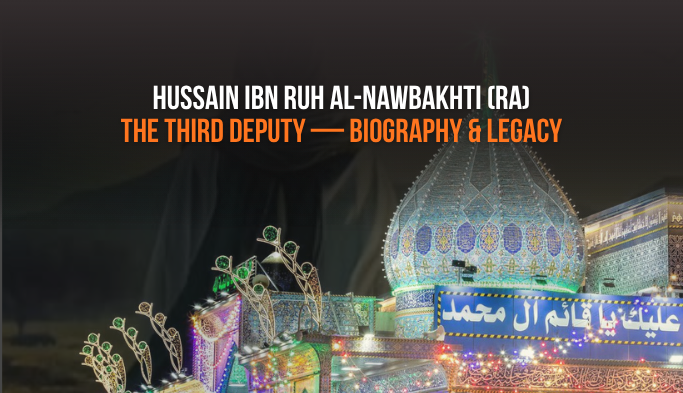
His shrine is in Baghdad, Iraq — in the historic district associated with the Nawbakhti family. For those making Iraq Ziyarat who wish to visit the third deputy whose twenty-one years of silent service helped preserve what they now travel to honour, our 2026–2027 Iraq Ziyarat Packages serve all of Iraq’s holy sites. Ask about including the shrines of the deputies in your journey. For the fourth deputy, Ali ibn Muhammad al-Samarri, see our companion post.
Visit: www.ziaratplanner.com






 06-Jun-2026