The Imam Who Was Buried Alive in a Garrison Town
On the 3rd of Rajab, 254 AH, the tenth Imam of the Ahlul Bayt (as) was martyred in Samarra — poisoned on the orders of the Abbasid caliph al-Mu’tazz. He was forty-two years old and had been Imam for approximately thirty-five years, most of them spent under surveillance, house arrest, and deliberate isolation in a military city far from his home. Imam Ali ibn Muhammad al-Hadi (as) — known by his primary titles al-Hadi (the Guide) and al-Naqi (the Pure) — was killed the same way almost every Imam before him was killed: quietly, in the dark, by a power that could not face him openly.
This same date, the 3rd of Rajab, is also immediately after his Wiladat on the 2nd. Within two days, the month of Rajab holds both his birth and his death — a tenderness and a grief standing almost side by side at the very opening of the month.
We extend our condolences to the Prophet (s), to Imam al-Mahdi (atfs), to the Ahlul Bayt (as), and to all believers on this day of mourning.
Biography at a Glance
| Full Name: |
Ali ibn Muhammad ibn Ali ibn Musa al-Ridha (as) |
| Kunyat: |
Abu al-Hasan |
| Titles: |
Al-Hadi (The Guide), Al-Naqi (The Pure), Al-Faqih (The Jurist), Al-‘Askari |
| Father: |
Imam Muhammad al-Jawad (as), the ninth Imam |
| Mother: |
Lady Summanah Khatun |
| Wiladat (Birth): |
2nd Rajab, 212 AH — Sariya (near Madinah) |
| Shahadat (Martyrdom): |
3rd Rajab, 254 AH — Samarra, Iraq |
| Age at Imamate: |
~6 years (second youngest Imam to assume the role) |
| Age at Martyrdom: |
42 years |
| Period of Imamate: |
~35 years |
| Son: |
Imam Hasan al-Askari (as), the eleventh Imam |
| Shrine: |
Samarra, Iraq — shared with his son Imam Hasan al-Askari (as) |
From Madinah to Samarra: A Forced Exile
Imam al-Hadi (as) became Imam at approximately six years of age, following the martyrdom of his father Imam al-Jawad (as) in 220 AH. Like his father before him, he assumed one of the heaviest responsibilities in Islamic history as a child — and like his father, he bore it with a maturity that the scholars and faithful who sat with him could not explain by any ordinary measure.
His early years of Imamate were spent in Madinah, where he guided the community, answered legal and theological questions, and maintained the traditions of the Ahlul Bayt (as) through direct teaching and a network of trusted representatives (wukala). Several Abbasid caliphs came and went during this period; some, like al-Wathiq, allowed a degree of space; others were more hostile. The true crisis came with al-Mutawakkil.
In approximately 243 AH, al-Mutawakkil summoned the Imam from Madinah to Samarra — the garrison city the Abbasids had built to house their Turkish military forces. The invitation was diplomatic in its language and threatening in its intent. The Imam understood the danger of refusing and complied. When he arrived, al-Mutawakkil received him not with the honor he had promised but with a calculated humiliation: the Imam was initially lodged in an inn for beggars and the destitute. The message was deliberate. The caliph wanted the Imam to know what he thought of him — and he wanted everyone watching to see it too.
Twenty Years Under Watch
From his arrival in Samarra until his martyrdom more than a decade later, Imam al-Hadi (as) lived under continuous surveillance. Al-Mutawakkil appointed guards, sent spies, and periodically ordered raids on the Imam’s home — searching, according to the stated pretexts, for weapons or evidence of conspiracy. What the soldiers found on every occasion was the same: the Imam sitting on a mat, reciting the Quran, with no fine furniture and no visible possessions. The raids returned empty-handed. The Imam continued.
Al-Mutawakkil’s fear of the Imam’s influence was not irrational from his own perspective. The Imam had not raised an army, not issued a political manifesto, not called for the caliph’s removal. He had simply existed — and the people, including soldiers and courtiers who came into contact with him, continued to be drawn to him. Classical sources record that even the guards appointed to oversee him were eventually affected: one hardened man assigned to his custody, Zurafah, had his enmity transformed into devotion within a short time. When al-Mutawakkil learned of this, he replaced the guard with another, equally severe. (Al-Irshad, Shaykh al-Mufid; I’lam al-Wara, Al-Tabrisi)
What the caliph could not understand — and what the Imam understood completely — was that the influence he was trying to contain was not political. It was spiritual. And spiritual influence does not stop at locked doors or armed guards.
His Contributions Under Confinement
Despite the restrictions, Imam al-Hadi (as) continued to lead the Shia community through one of the most consequential structural innovations in the history of the Imamate: the systematic development of the wikala network — a web of trusted agents and representatives distributed across the Muslim world who communicated his guidance, collected religious dues, and maintained the connection between the Imam and his community without requiring direct physical access to him.
This network was not merely a practical workaround for his imprisonment. It was a preparation. The same structure that allowed the tenth and eleventh Imams to guide their community from confinement would become, under Imam Hasan al-Askari (as) and then through the Major Occultation, the template for the community’s relationship with the Hidden Imam. Imam al-Hadi (as) built the architecture that the Imamate would inhabit for generations.
He also continued to teach — through letters, through the students who managed to reach him, and through his own conduct in Samarra. Classical sources describe him as a man whose spiritual state was unmistakable even under the worst conditions. He had dug a grave beside his prayer mat, his followers once discovered — not out of despair, but as a daily reminder of where every act of worship was ultimately directed. The grave was not a sign of resignation. It was a sign of clarity. (Bihar al-Anwar, Allama Majlisi)
His generosity, too, was uncompromising. While al-Mutawakkil sent gifts of gold to the Imam in attempts to purchase his silence or his complicity, the Imam returned them. Yet those around him reported that under the cover of night, he arranged food for widows and orphans in Samarra — giving from what little he had to those who had less.
Martyrdom and the Shrine That Remained
Al-Mutawakkil was assassinated in 247 AH — ironically killed by the very Turkish military commanders whose power he had helped to consolidate. His successors continued the same policy toward the Imam: surveillance, restriction, and hostility. It was under the caliph al-Mu’tazz that the final order was given. The Imam was poisoned and died on the 3rd of Rajab, 254 AH. His funeral prayer was led by his son, Imam Hasan al-Askari (as), who then assumed the Imamate. (Al-Irshad, Shaykh al-Mufid)
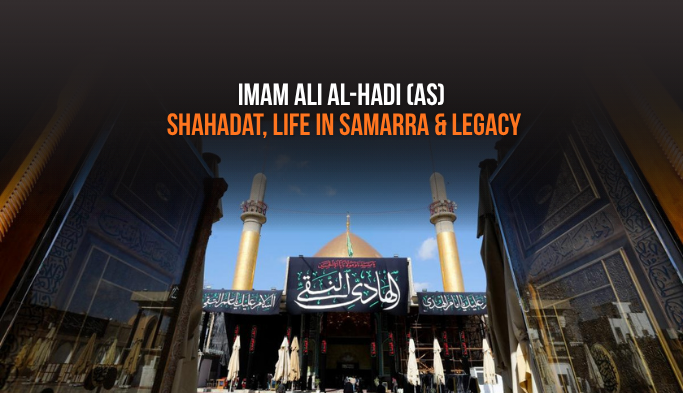
He was buried in his house in Samarra — the same house where he had been watched, searched, and contained for more than a decade. That house became a shrine. The shrine became one of the most visited sites in the Shia world, its golden dome visible for miles across the flat Iraqi plain. The caliph who imprisoned him is a name in a history book. The Imam he imprisoned is visited by millions.
On this day of his Shahadat, the most fitting response is the one the Imam himself modeled: to remain in the presence of Allah, to use whatever space one has for knowledge and for service, and to build — even in confinement — what the generations after you will need.
His shrine in Samarra is part of every 2026–2027 Iraq Ziyarat Package we offer — along with Karbala, Najaf, and Kadhimiya. To stand at his golden dome, and at the shrine of his son Imam Hasan al-Askari (as) beside it, is to stand in the presence of two of the most extraordinary lives this world has witnessed.
Visit: www.ziaratplanner.com





 04-Jun-2026