The Imam Who Recited a Poem That Made a Caliph Weep
The 2nd of Rajab is the birth anniversary of the tenth Imam — Ali ibn Muhammad al-Hadi (as) — and we open it with a scene that captures his life in a single image.
One night, Abbasid soldiers raided his home in Samarra on orders from the caliph al-Mutawakkil. They searched every room for weapons, hidden wealth, evidence of conspiracy. They found the Imam seated on sand and gravel, wearing wool, facing the qiblah, reciting the Quran. Nothing else. They brought him before al-Mutawakkil, who was drinking. The caliph first tried to offer the Imam wine. The Imam refused: “By God, never has it mixed with my flesh and blood at all — so excuse me.” Al-Mutawakkil then demanded he recite poetry.
The Imam recited verses about the graves of kings — their beds and crowns reduced to dust, their pampered faces consumed by worms, their great houses standing empty as the owners traveled to holes in the earth. The court fell silent. Al-Mutawakkil wept. And then, having wept, he changed nothing. (Sirat al-A’immah, Shaykh Ja’far Subhani, pp. 519–520)
That scene — the Imam’s unbroken clarity, the caliph’s temporary remorse, the poem that cut through every pretension — is who Imam al-Hadi (as) was. Today we celebrate his birth.
Biography at a Glance
| Full Name: |
Ali ibn Muhammad ibn Ali al-Jawad (as) |
| Kunyat: |
Abu al-Hasan al-Thalith (the Third) |
| Titles: |
Al-Hadi (The Guide), Al-Naqi (The Pure), Al-Faqih (The Jurist), Al-‘Askari |
| Father: |
Imam Muhammad al-Jawad (as), the ninth Imam |
| Mother: |
Lady Summanah Khatun |
| Wiladat (Birth): |
2nd Rajab, 212 AH — Sariya (near Madinah) |
| Shahadat (Martyrdom): |
3rd Rajab, 254 AH — Samarra, Iraq |
| Age at Martyrdom: |
42 years |
| Son: |
Imam Hasan al-Askari (as), the eleventh Imam |
| Shrine: |
Samarra, Iraq — shared with his son Imam Hasan al-Askari (as) |
A Child Imam in a Dangerous World
Imam al-Hadi (as) was born in Sariya, near Madinah, in 212 AH. When his father Imam Muhammad al-Jawad (as) was martyred, the mantle of Imamate descended on a child. Classical sources give his age at approximately six to eight years — young enough that the Abbasid authorities and some within the community itself raised doubts about his readiness to lead.
Those doubts did not survive contact with him for long. The scholar Yahya ibn Aksam — who a generation earlier had been famously outclassed in debate by Imam al-Jawad (as) himself — attempted to repeat the exercise with the young Imam al-Hadi (as), framing a deliberately difficult question about Prophet Yaqub (as). The Quran describes Yaqub and his sons prostrating before Yusuf (as) in Egypt — how, Yahya asked, could a Prophet prostrate before another person, given that prostration is for Allah alone?
Imam al-Hadi (as) answered without hesitation: the prostration was not directed to Yusuf — it was an act of thanksgiving to Allah for the miracle of their reunion, just as the angels’ prostration before Adam at creation was directed to Allah and not to Adam. (Bihar al-Anwar, Allama Majlisi, vol. 50) The question that was meant to embarrass a child became an occasion for a lesson that those present did not forget.
Imam al-Hadi (as) spent more than two decades under effective house arrest in Samarra — moved there by al-Mutawakkil to be watched, isolated, and controlled. From within those conditions he gave the Shia community three contributions whose effects are still felt today.
The first was Ziyarat al-Jami’a al-Kabira — the Great Comprehensive Salutation. This is one of the most theologically significant texts in Shia Islam: a comprehensive, precisely worded articulation of the station of the Imams, the nature of the Imamate, and the relationship between the believer and the household of the Prophet (s). Transmitted by the Imam himself and preserved in classical hadith collections, it is recited by believers across the world as both a salutation and a statement of faith. That it was composed and transmitted from a military garrison, under surveillance, says something about the conditions that spiritual precision can be achieved in when the source of that precision is not external circumstance but internal clarity.
The second was the systematic development of the wikala network — the organised system of trusted representatives who maintained communication between the Imam and his community across the Muslim world when direct contact was impossible. This was not merely administrative ingenuity. It was a theological preparation: the same architecture that allowed Imam al-Hadi (as) and his son Imam al-Askari (as) to guide the community from confinement would become the template for the relationship between believers and the Hidden Imam during the Major Occultation. He built what would sustain the community for the centuries that followed.
The third gift was his uncompromising moral example under conditions designed to erode it. When al-Mutawakkil ordered the demolition of the shrine of Imam Hussain (as) in Karbala and stationed guards to prevent pilgrims from visiting, the Imam neither submitted nor staged a confrontation he could not win. He maintained the inner sovereignty that oppression could not reach — the same sovereignty expressed in that poem he recited to a weeping caliph who then changed nothing.
His Words on the World and What Awaits
The Imam said: “The world is a market: some people gain in it, while others lose.” (Tuhaf al-‘Uqul, Shaykh al-Harrani)
And in a longer reflection on death: “Indeed, Allah has made this world an abode of trials, and the Hereafter an abode of outcome. He made the trials of this world to be a cause for the reward of the Hereafter, and the reward of the Hereafter a compensation for the trials of this world… Think of your death, in the arms of your family, while no doctor can stop you, and no loved one can do you any good.” (Tuhaf al-‘Uqul, Shaykh al-Harrani)
These are not the words of a man broken by his circumstances. They are the words of a man whose circumstances have clarified his vision. He knew exactly what the world was and what it was worth — and that knowledge is what made him unbreakable.
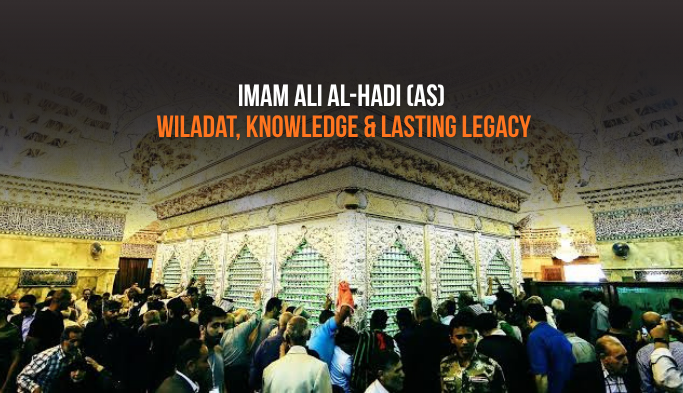
His title al-‘Askari — the one of the military camp — was given to him because of where he was forced to live. It is among the most telling titles in the history of the Imamate: a name that originated as a form of confinement became, for his followers, a mark of honour. The military camp that was meant to contain him is now a footnote. His golden dome in Samarra draws millions.
Celebrating His Birth — and Following His Path
The Wiladat of Imam al-Hadi (as) on the 2nd of Rajab is a day to learn from him — not only about him. His life is an argument, made not in words but in conduct, that faith cannot be imprisoned, that knowledge serves the community even from a garrison town, and that the person who knows what this world is worth cannot be corrupted by what it offers.
For those whose love for the Imam calls them toward something more than reading — toward standing at the golden dome in Samarra where he is buried alongside his son Imam al-Askari (as) — our 2026–2027 Iraq Ziyarat Packages include Samarra alongside Karbala, Najaf, and Kadhimiya. Come and stand where the poem was lived.
Visit: www.ziaratplanner.com





 04-Jun-2026