The Imam Who Was Called to the Throne — and Refused to Sit on It
On the 11th of Dhul Qa’dah, 148 AH, a child was born in Madinah whose life would become one of the most studied and celebrated in Islamic history. Imam Ali ibn Musa al-Ridha (as) — the eighth Imam of the Ahlul Bayt (as) — is remembered for many things: his vast learning, his patience under persecution, his years as the only Imam to carry the title of Crown Prince of the Abbasid caliphate. But above all, he is remembered for something far simpler: that in every circumstance of his life, he remained exactly what an Imam is — a guide toward Allah, unbothered by the titles men assigned him and unmoved by the power they dangled before him.
His birth anniversary falls in the blessed month of Dhul Qa’dah, just ten days after the Wiladat of his sister, Lady Fatima Masooma (sa). The month that contains them both is one of the sacred months of the Islamic calendar — a month in which remembering the Ahlul Bayt (as) is itself an act of worship.
Biography at a Glance
| Full Name: |
Ali ibn Musa al-Ridha (as) |
| Kunyat: |
Abu al-Hasan |
| Titles: |
Al-Ridha (The One Pleased by Allah), Al-‘Alim Aal Muhammad, Sabir, Wali Allah |
| Father: |
Imam Musa al-Kazim (as), the seventh Imam |
| Mother: |
Lady Najma (also known as Tuktam or Tahira) |
| Wiladat (Birth): |
11th Dhul Qa’dah, 148 AH — Madinah |
| Shahadat (Martyrdom): |
29th Safar, 203 AH — Tus (present-day Mashhad), Iran |
| Age at Martyrdom: |
55 years |
| Wife: |
Lady Sabika (also known as Khaizuran) |
| Son: |
Imam Muhammad al-Jawad (as), the ninth Imam |
| Notable Siblings: |
Lady Fatima Masooma (sa), Hazrat Ahmad ibn Musa (Shah Cheragh), Hazrat Zayd ibn Musa |
| Shrine: |
Mashhad, Iran |
His Birth and Early Life
Imam Ali al-Ridha (as) was born in Madinah on the 11th of Dhul Qa’dah, 148 AH, into a household that was simultaneously the most spiritually revered and most politically persecuted family in the Muslim world. His father, Imam Musa al-Kazim (as), was a man of extraordinary patience and worship — yet the Abbasid rulers kept him under constant surveillance and eventually imprisoned him for years, martyring him in captivity. His mother, Lady Najma (sa), raised her son with the Quran, Islamic ethics, and deep love for the path of the Ahlul Bayt (as). (Uyun Akhbar al-Ridha, Shaykh Saduq; Usul al-Kafi, Shaykh Kulayni, vol. 1)
From childhood, Imam Ridha (as) showed a depth of knowledge that astonished those around him. His father, recognizing what had been entrusted to this son, pointed openly to his wisdom and prepared him for the immense responsibility that would follow. Growing up inside a home that was watched, restricted, and deliberately marginalized by state power, the young Imam learned the qualities that would define his Imamate: patience that did not break, knowledge that could not be suppressed, and a character that drew people to truth without the need for any throne.
When his father was martyred, Imam Ridha (as) assumed the Imamate at approximately thirty-five years of age. He inherited not a position of comfort, but a community in need of guidance and a world intent on silence. (Bihar al-Anwar, Allama Majlisi, vol. 49)
An Ocean of Knowledge: His Contributions to Islam
Imam Ridha (as) carried the title Al-‘Alim Aal Muhammad — the Most Learned of the Family of Muhammad — and it was not an honorary decoration. His contributions to Islamic thought, scholarship, and community life were substantive and lasting.
At a time when foreign philosophies and misappropriated religious arguments were reshaping Muslim intellectual life, Imam Ridha (as) engaged directly with the challenge. He participated in scholarly debates with theologians, philosophers, and representatives of other religious traditions — not with hostility, but with logic, Quranic evidence, and the calm authority of a man who had nothing to prove and everything to clarify. These debates are preserved in the classical work Uyun Akhbar al-Ridha by Shaykh Saduq and in Al-Ihtijaj by Al-Tabrisi, and they remain among the most important documents of early Islamic theological discourse.
He also strengthened the religious life of the Shia community during a period when practicing their faith openly carried real risk. Through letters, trusted students, and quiet networks of guidance, he ensured that authentic Islamic teachings — rooted in the Quran and the tradition of the Prophet (s) and his household — continued to reach those who sought them. (Usul al-Kafi, vol. 1)
His moral example was itself a contribution. Imam Ridha (as) was known for his humility, his generosity to the poor, his kindness to those who came to him, and a dignity that neither power nor suffering could disturb. He taught, in word and in life, that faith is not completed by ritual alone — it requires good character, compassion, and a refusal to treat any human being with contempt. (Bihar al-Anwar, vol. 49)
The Crown Prince: A Struggle Without a Sword
The most dramatic chapter of Imam Ridha’s (as) life began when the Abbasid caliph Ma’mun compelled him to leave Madinah and travel to Khurasan. Once there, Ma’mun announced that Imam Ridha (as) would be appointed Crown Prince — his successor and heir to the caliphate. The political calculation was clear: by associating his government with the most respected figure in the Muslim world, Ma’mun hoped to silence opposition and wrap his authority in spiritual legitimacy.
Imam Ridha (as) accepted the title under explicit conditions: he would play no role in governance, issue no decrees, appoint no one, and dismiss no one. He made these conditions public. He was not entering a palace — he was exposing one. (Al-Irshad, Shaykh Mufid, vol. 2; Bihar al-Anwar, vol. 49)
The result, from Ma’mun’s perspective, backfired entirely. Rather than diminishing the Imam’s authority by making him a state figure, the appointment increased his visibility and drew even greater love from the people. His presence at court did not lend legitimacy to the Abbasids — it reminded everyone of what legitimacy actually looked like. When Imam Ridha (as) led the prayers on Eid al-Fitr and the crowds responded with overwhelming devotion, Ma’mun cancelled the event mid-procession, unable to bear the spectacle of a people choosing their Imam.
He was martyred in Tus in 203 AH, poisoned by Ma’mun — his forced successor having become, in the end, his executioner. He was fifty-five years old. His son, Imam Muhammad al-Jawad (as), was designated his successor before his passing. (Al-Irshad, vol. 2)
His Legacy and the Reward of His Ziyarat
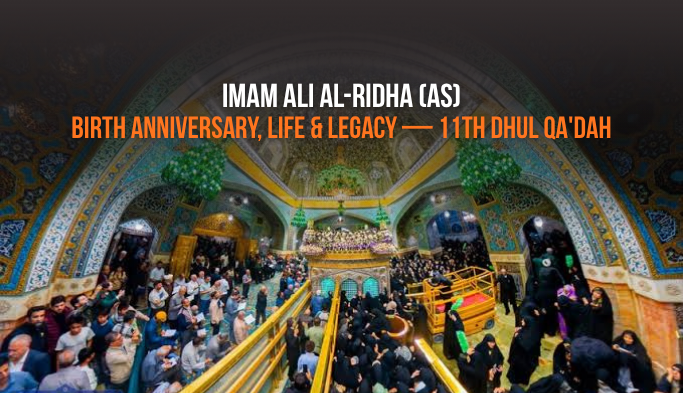
The holy shrine of Imam Ali al-Ridha (as) in Mashhad, Iran, is among the most visited sites in the entire Muslim world. Millions of pilgrims travel there each year — and the narrated reward for doing so is profound.
Imam Muhammad al-Jawad (as) said of his father’s shrine: “Whoever visits the grave of my father in Tus, Allah will forgive his past sins and grant him Paradise.” (Uyun Akhbar al-Ridha, Shaykh Saduq)
The legacy of Imam Ridha (as) is not contained within a shrine, however magnificent. It lives in the tradition of Islamic scholarship that traces back to his debates and his teachings. It lives in the example of a man who sat across from the most powerful ruler of his age and never once let that proximity corrupt him. It lives in the Shia community he protected and guided through decades of persecution, and whose survival across the centuries owes much to his quiet, unbreakable work.
Remembering him on his birth anniversary is not merely an act of historical commemoration. It is a renewal of commitment to what he stood for: knowledge over ignorance, patience over reaction, and the understanding that the path to Allah runs through the Ahlul Bayt (as) — not around them.
For those who wish to draw closer to the Imam and his family through Ziyarat, our 2026 Iraq Ziyarat Packages bring you to the shrines of his father Imam Musa al-Kazim (as) in Kadhimiya, and to Karbala, Najaf, and Samarra — the cities where the household he loved and defended are buried.
Visit: www.ziaratplanner.com





 04-Jun-2026