The Imam Who Was Twenty-Five Years Old When They Killed Him
On the 29th of Dhul Qa’dah, 220 AH, the ninth Imam of the Ahlul Bayt (as) was martyred in Baghdad. He was twenty-five years old. He had become Imam at the age of eight, following the martyrdom of his father Imam Ali al-Ridha (as) — and for seventeen years he guided a community, answered scholars, navigated the politics of two Abbasid caliphs, and never once moved from the line of truth.
Imam Muhammad ibn Ali al-Jawad (as) — known also as al-Taqi, the Pious — is remembered this month not because his life was long, but because of what he accomplished in the years he was given, and because the manner of his passing was the same as nearly every Imam before him: at the hands of the very rulers who feared what he represented.
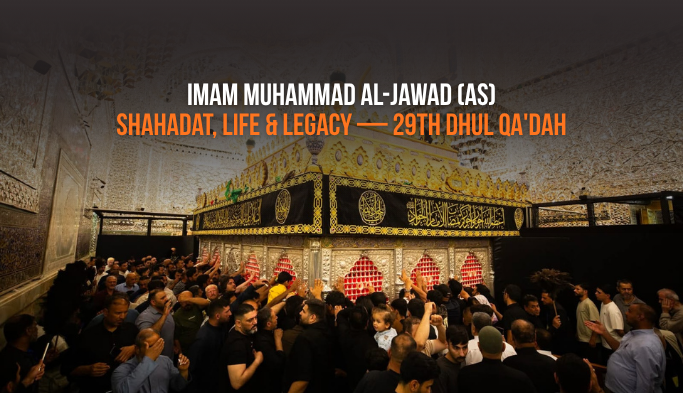
His shrine stands today in Kadhimiya, Baghdad — the same golden courtyard that holds his grandfather, Imam Musa al-Kazim (as). To stand between them is to stand in the presence of two generations of patience.
Biography at a Glance
| Full Name: |
Muhammad ibn Ali al-Jawad (as) |
| Kunyat: |
Abu Ja’far |
| Titles: |
Al-Jawad (The Generous), Al-Taqi (The Pious) |
| Father: |
Imam Ali al-Ridha (as), the eighth Imam |
| Mother: |
Lady Khaizuran (also known as Sabika) |
| Wiladat (Birth): |
10th Rajab, 195 AH — Madinah |
| Shahadat (Martyrdom): |
29th Dhul Qa’dah, 220 AH — Baghdad, Iraq |
| Age at Imamate: |
~8 years (youngest Imam to assume the role) |
| Age at Martyrdom: |
25 years |
| Wife: |
Umm al-Fadl (daughter of Ma’mun al-Abbasi) |
| Son: |
Imam Ali al-Hadi (as), the tenth Imam |
| Shrine: |
Kadhimiya, Baghdad, Iraq |
The Youngest Imam: His Early Life and Imamate
Imam Muhammad al-Jawad (as) was born on the 10th of Rajab, 195 AH, in Madinah. His father, Imam Ali al-Ridha (as), had been forced to Khurasan by the Abbasid caliph Ma’mun and was martyred there in 203 AH — leaving behind a son who was barely eight years old. This was the first time in the history of the Imamate that the Imam taking the mantle was so young, and it immediately became a source of doubt among some and amazement among all.
The questions came quickly. How could a child lead? How could he answer scholars who had spent decades in study? The Abbasids hoped the question of his age would weaken the community’s confidence in the Imamate itself. Instead, Imam al-Jawad (as) answered it — not with argument, but with knowledge.
Accounts from Shia historians describe scenes in which scholars, Abbasid officials, and learned men posed the most difficult questions of jurisprudence, theology, and Quranic interpretation — and the young Imam answered each one with a clarity that silenced the room. (Bihar al-Anwar, Allama Majlisi; Al-Irshad, Shaykh Mufid) His youth was not a limitation. For those who witnessed it, it was itself a sign — a continuation of the divine appointment that the Imams had always embodied.
He was raised by his mother, Lady Khaizuran, in the tradition of the Ahlul Bayt (as): Quran, ethics, the transmitted knowledge of his father and forefathers. The foundation laid in Madinah prepared him for everything that followed — including the court of the caliph.
His Knowledge and Contributions to Islam
The central contribution of Imam Muhammad al-Jawad (as) was the preservation and transmission of authentic Islamic knowledge at a time when the Abbasid court was actively reshaping religious discourse to serve its own authority. He taught scholars, guided communities, resolved disputes in Islamic jurisprudence, and clarified the teachings of the Quran and Sunnah for people who had no other reliable source of guidance.
He communicated through direct teaching in Madinah and Baghdad, but also through letters — written guidance sent to scholars and communities across the Muslim world, addressing questions of law, faith, and ethics with precision. (Uyun Akhbar al-Ridha; Bihar al-Anwar) These letters formed part of the living chain of Ahlul Bayt scholarship that connected each generation to the Prophet’s (s) household and their transmitted knowledge.
His teachings emphasized what each of his forebears had emphasized: that knowledge without action is hollow, that piety is not measured by status or age but by sincerity, and that the love of the Ahlul Bayt (as) is inseparable from the love of Allah and His Prophet (s). He taught that patience in hardship is not weakness but the highest expression of faith — and he lived that teaching in every year of his short Imamate.
Ma’mun al-Abbasi, who had also forced Imam al-Ridha (as) into his court, eventually gave his daughter Umm al-Fadl in marriage to the young Imam — another political maneuver to keep the Imam under surveillance and within the reach of state power. Imam al-Jawad (as) accepted the arrangement without allowing it to compromise his mission. His conduct at court continued to draw people toward the truth, not away from it.
Opposition, Surveillance, and Martyrdom
The Abbasid caliphs opposed Imam al-Jawad (as) for the same reason they opposed every Imam: because his existence was a living challenge to their legitimacy. The Imams did not need to raise armies to threaten the caliphate — they simply needed to exist, to be known, and to be loved. That was enough to expose what the rulers lacked.
After Ma’mun’s death, the caliph al-Mu’tasim continued and intensified the pressure. The Imam was compelled to move from Madinah to Baghdad — brought closer to power so that he could be watched more closely. The harassment and restrictions that had defined his father’s and grandfather’s lives defined his as well. The surveillance was constant. The intention behind it was clear.
On the 29th of Dhul Qa’dah, 220 AH, Imam Muhammad al-Jawad (as) was martyred at the age of twenty-five. Classical sources, including Al-Irshad by Shaykh Mufid, indicate he was poisoned — the instrument of so many of the Imams’ martyrdoms, chosen precisely because it leaves no visible battlefield, no moment of confrontation, no public act of courage for people to rally around. It simply ends a life quietly, in a household, in the dark.
He left behind a son — Imam Ali al-Hadi (as), the tenth Imam — and a community that had learned, once again, that the Ahlul Bayt (as) do not survive by the permission of caliphs. They survive because what they carry cannot be poisoned.
His Shrine in Kadhimiya — and What Visiting It Means
Imam Muhammad al-Jawad (as) is buried in Kadhimiya, Baghdad, in the same blessed shrine complex as his grandfather Imam Musa al-Kazim (as). Two Imams — the seventh and the ninth — rest beneath the same golden dome, separated by the eighth whose shrine is in Mashhad. Pilgrims who visit Kadhimiya stand in the presence of both, and scholars have described this as one of the most spiritually concentrated sites on earth for a lover of the Ahlul Bayt (as).
Imam Ali al-Hadi (as) — his son — is reported to have said that visiting the grave of his father carries immense reward, and that sincerity of heart at that threshold is answered. The shrine draws millions of pilgrims each year: those seeking relief from hardship, those seeking clarity in their affairs, those seeking simply to be near someone who was near Allah.
On this day of his Shahadat, one of the most fitting ways to honour Imam al-Jawad (as) is to plan the journey he invites — to come to Kadhimiya, to stand at his shrine, and to carry something of his patience back into your own life. Our 2026 Iraq Ziyarat Packages include Kadhimiya as a central stop alongside Karbala, Najaf, and Samarra — bringing you to the household the Imam served and the cities where his family rests.
He lived twenty-five years. He changed the world. Come and see where he is buried.
Visit: www.ziaratplanner.com





 06-Jun-2026