“A Person Like Me Will Never Give Bay’ah to a Person Like Yazid”
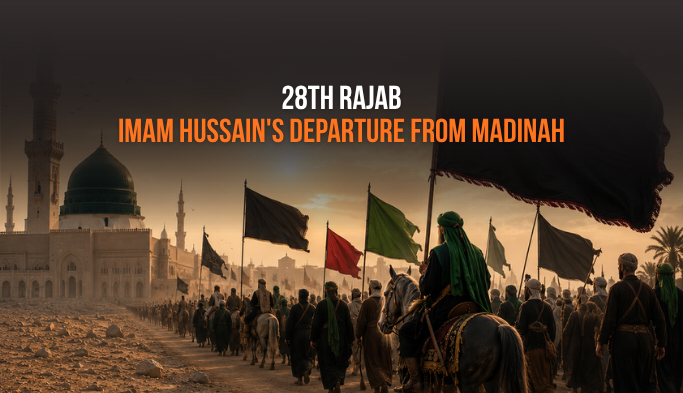
The 28th of Rajab, 60 AH. The city of the Prophet (s) is still. Before dawn, a caravan begins to form — family members, companions, children, the women who will survive Karbala and carry its message to every city they are dragged through afterward. At the head of the caravan is Imam Hussain ibn Ali (as), the grandson of the Prophet (s), the son of Lady Fatima al-Zahra (sa), the third Imam of the Ahlul Bayt (as).
He knows where this road ends. He has known since before he set foot on it.
The events that led to this departure had been building since the death of Mu’awiyah in Rajab of 60 AH. Yazid ibn Mu’awiyah — whose open corruption, contempt for Islamic law, and public indulgence in what Islam forbids were matters of public record — assumed the caliphate and immediately sent orders to the Governor of Madinah: obtain the bay’ah (pledge of allegiance) of Imam Hussain (as), and if he refuses, kill him and send his head to Damascus. The Imam was summoned to the governor’s court. When the demand was placed before him, his answer was immediate and exact: “A person like me will never give bay’ah to a person like Yazid.”
That sentence was not defiance for its own sake. It was a definition — of what Islamic leadership requires, and of what it excludes absolutely. It stood as a line the Imam would not cross, and it placed him on a path that ended at Karbala. He knew this. He left anyway.
The Encounter with Umm Salamah
Before the departure, Imam Hussain (as) went to visit Umm Salamah (sa) — the noble wife of the Prophet (s) who had lived long enough to witness the full unfolding of what her husband had warned about. She had in her possession a container of soil that the Prophet (s) had given her, saying that on the day it turned to blood, she would know that Hussain had been killed.
She reminded the Imam of what the Prophet (s) had told her: that Hussain would be martyred in a land called Karbala. She wept. She asked him not to go.
The Imam’s response, recorded in classical sources, was not reassurance that she was wrong. It was the confirmation that she was right, and that he was going anyway: he affirmed that he knew the day of his martyrdom, the place of his burial, and the names of those who would be killed with him. (Bihar al-Anwar, Allama Majlisi, vol. 45, p. 89)
This encounter is among the most significant details of the departure. It establishes beyond any doubt that Imam Hussain (as) did not walk into Karbala through miscalculation, bad intelligence, or misplaced optimism about outcomes. He walked into it with complete awareness of what awaited him — and with complete willingness to meet it. The journey from Madinah was not a journey into danger he hoped to escape. It was a journey toward a martyrdom he had accepted before he began.
The Will: A Manifesto for Every Age
Before leaving Madinah, Imam Hussain (as) wrote a letter to his brother Muhammad ibn Hanafiyyah — a letter that has been described by scholars as one of the most important documents in Islamic history precisely because it states the purpose of the mission in the Imam’s own words, with his own name attached, leaving no room for misinterpretation:
“I am not rising as an insolent, or an arrogant, or a mischief-monger or as a tyrant. I have risen as I seek to reform the ummah of my grandfather. I wish to bid the good and forbid the evil, and to follow the way of my grandfather and my father, Ali ibn Abi Talib.” (Maqtal al-Khwarizmi, vol. 1, p. 88)
This is islah — reform. Not regime change as an end in itself. Not personal ambition dressed in religious language. Not a reaction of grief or anger at what had been done to his family. The Imam named the Quranically mandated duty of commanding what is good and forbidding what is evil — a duty that every Muslim bears in proportion to their knowledge and capability — and he named it as the reason he was prepared to die. He was not being drawn into a conflict. He was choosing one, with the fullest clarity about its cost.
The Farewell at the Prophet’s Grave
On the nights before his departure, Imam Hussain (as) went repeatedly to the mosque of the Prophet (s) to pray at his grandfather’s grave. The narrations describe long hours of supplication and grief — a man taking leave of the one whose mission he was about to give his life to preserve.
Amali of Shaykh al-Saduq (session 30, h. 1) records that the Prophet (s) appeared to the Imam in a vision, embraced him, and informed him of the rank he would attain through martyrdom — a station in Paradise that could not be reached by any path other than the one now before him. The Imam awoke in tears. His resolution did not waver.
This spiritual farewell carries a theological weight that the physical journey alone cannot. The Imam was not simply leaving a city. He was accepting, from the Prophet (s) himself, the transfer of a mission: that what had begun in the Cave of Hira, what had been protected by Abu Talib through the years of persecution, what had been carried through the battles of Badr and Khandaq and Khaybar — would now be defended in a way that no army could accomplish and no political arrangement could achieve. It would be defended by blood, and by the witness of women and children who would survive to tell the world what they had seen.
The Family Who Came
The Imam did not travel alone. He was accompanied by Lady Zainab bint Ali (sa), Imam Ali ibn al-Hussain Zayn al-Abidin (as), his children, and the women of the household. Companions joined from among those who had made their choice.
This decision — to bring the family — has been misunderstood by some as evidence that the Imam did not know what he was going to. The opposite is true. He brought them because he knew. Lady Zainab (sa) was not an accidental presence at Karbala and in Kufa and in Damascus — she was a planned one. The message of what happened on the 10th of Muharram needed a voice that could not be silenced by killing, and that voice would belong to those who survived. Imam Zayn al-Abidin (as) needed to be present to assume the Imamate when his father fell. The caravan that left Madinah on the 28th of Rajab was assembled not for a military campaign but for a testimony — one that would be written in the sand of Karbala and proclaimed in every city that came after it.
Why the 28th of Rajab Still Matters
The departure from Madinah is not merely the beginning of an event that ended at Karbala. It is the moment when the line was drawn — when a member of the Prophet’s household, with full knowledge of the cost, chose truth over survival and reform over accommodation. Every act of standing for what is right against what is powerful finds its precedent here. Every generation that has refused to give its bay’ah to its own version of Yazid has been following a path that was first walked on this day.
The Imam said it himself: he was not rising for his own time alone. He rose in the footsteps of his grandfather and his father — and he rose for every age in which falsehood wears the mask of authority.
His shrine is in Karbala, where the journey ended. The earth of Karbala — the same plain where he was buried — is among the most sacred ground in the world. Our 2026–2027 Iraq Ziyarat Packages bring you to that ground, and to Najaf, Kadhimiya, and Samarra — to the family whose journey began on the 28th of Rajab and whose message has not ended.
Visit: www.ziaratplanner.com





 04-Jun-2026