Born in the House of Revelation
The 3rd of Sha’ban, 4 AH. In the household of Imam Ali (as) and Lady Fatima al-Zahra (sa) in Madinah, a child was born who was given a name by the Prophet (s) himself — a name, the tradition records, that had never been used among the Arabs before. Hussain ibn Ali (as) — the third Imam of the Ahlul Bayt (as), the Master of Martyrs, the Imam whose sacrifice sealed the meaning of Islam for every generation that came after it.
Allah says in the Quran:
وَلْتَكُن مِّنكُمْ أُمَّةٌ يَدْعُونَ إِلَى الْخَيْرِ وَيَأْمُرُونَ بِالْمَعْرُوفِ وَيَنْهَوْنَ عَنِ الْمُنكَرِ وَأُولَٰئِكَ هُمُ الْمُفْلِحُونَ
Translation: “And let there be from among you a community inviting to good, enjoining what is right, and forbidding what is wrong — and it is they who will be the successful.” (Surah Al Imran, 3:104)
Imam Hussain (as) did not merely teach this verse. He lived it until it cost him everything — and proved, in the process, that what cannot be preserved by armies can sometimes be preserved by blood.
Biography at a Glance
| Full Name: |
Hussain ibn Ali ibn Abi Talib (as) |
| Kunyat: |
Abu Abdillah |
| Titles: |
Sayyid al-Shuhada (Master of Martyrs), Al-Shahid, Shibr (the Prophet’s name for him) |
| Father: |
Imam Ali ibn Abi Talib (as), the first Imam |
| Mother: |
Lady Fatima al-Zahra (sa), daughter of the Prophet (s) |
| Wiladat (Birth): |
3rd Sha’ban, 4 AH — Madinah |
| Shahadat (Martyrdom): |
10th Muharram, 61 AH — Karbala, Iraq (Day of Ashura) |
| Age at Martyrdom: |
56–57 years |
| Notable siblings: |
Imam Hasan al-Mujtaba (as), Lady Zainab (sa), Lady Umm Kulthum (sa) |
| Sons: |
Imam Ali ibn al-Hussain Zayn al-Abidin (as), Ali al-Akbar (as), Ali al-Asghar (as) |
| Shrine: |
Karbala, Iraq — the most visited shrine in the world |
Early Life: Raised by the Prophet (s) Himself
Imam Hussain (as) grew up in a household that was unlike any other in history — a home in which the Prophet of Allah was a constant presence, in which the Quran was not a book but a way of breathing, and in which the standards of character were set by the people whom Allah had purified. His grandfather picked him up, played with him, wept for him in advance. The famous narration — “Hasan and Hussain are the leaders of the youth of Paradise” — was not a title given to honour children. It was a statement about what they were and what they would become.
He received his knowledge from the same sources as his brother Imam Hasan (as): the Quran as transmitted by his parents, the ethics of his father’s governance, the purity and sacrifice modeled by his mother. From his earliest years he was known for his compassion — particular concern for the poor, for those who had no one else to appeal to — combined with a dignity that never bent toward the powerful. These were not virtues he acquired through effort. They were the natural output of the household that formed him.
He stood alongside his father Imam Ali (as) during the battles of Jamal, Siffin, and Nahrawan. He witnessed, from within the family that bore the Imamate, the full history of how power uses religion and religion resists power. By the time the demand for bay’ah to Yazid reached him decades later, he had already spent a lifetime understanding what it meant and why it could not be given.
His Contribution: What Karbala Preserved
The contribution of Imam Hussain (as) to Islam is not primarily a list of scholarly works or administrative achievements. It is a single act, sustained over a single day, that permanently altered the trajectory of Islamic history.
When Yazid ibn Mu’awiyah assumed the caliphate, the demand for the Imam’s bay’ah was not a political negotiation — it was a request to endorse the transformation of Islam from a system of divine justice into a hereditary dynasty justified by religious language. Had the third Imam given that endorsement, the question of what authentic Islamic leadership looks like would have been closed. Every future tyrant who wrapped himself in religious authority would have had a precedent. The Prophet’s own grandson had agreed.
The Imam refused. His letter to Muhammad ibn Hanafiyyah before leaving Madinah stated the reasoning plainly: he was not rising out of arrogance, corruption, or ambition. He was rising to reform the ummah of his grandfather — to enjoin what is right and forbid what is wrong — in the footsteps of the Prophet (s) and Imam Ali (as). (Maqtal al-Khwarizmi; Bihar al-Anwar, Allama Majlisi)
What Karbala produced was not a political victory — there was no political victory, and the Imam had always known there would not be. What it produced was a permanent mark in Islamic conscience: that the Prophet’s household went to their deaths rather than legitimize a corrupt authority, and that this act of witness made authentic Islam visible again to anyone who had lost sight of it. Every subsequent movement of justice in Islamic history has referenced it. Every generation that has refused to mistake power for legitimacy has drawn from it.
Why He Was Opposed
The opposition to Imam Hussain (as) was, at its core, the opposition of those who benefit from unchecked power to the person whose existence made that power’s illegitimacy visible. The Imam did not need to raise an army or issue declarations. He simply needed to exist — to be the grandson of the Prophet (s), to be known as a man of unimpeachable character, to refuse bay’ah — and the contrast between what he represented and what Yazid represented was complete. The caliphate could not tolerate that contrast. It could not survive the comparison.
This is the pattern across the Imams: they were opposed not for what they did but for what they were. Their presence was the challenge, and their absence through imprisonment, exile, or martyrdom was always the solution their opponents chose when the contrast became unbearable.
His Words
Among the sayings attributed to Imam Hussain (as) in classical sources, the most famous and widely transmitted is his statement during the journey to Karbala:
“Death with dignity is better than a life of humiliation.” (Bihar al-Anwar, Allama Majlisi, vol. 44)
And in one of his final sermons before the battle of Ashura, addressing those who had come to kill him:
“Do not you see that the truth is not being acted upon and that falsehood is not being refrained from? Let the believer long to meet his Lord — and I do not see death as anything but happiness, and living with tyrants as anything but disgrace.” (Bihar al-Anwar, vol. 44)
These are not inspirational slogans. They are the spoken theology of a man who had worked out, with complete clarity, exactly what he was about to do and why.
His Shrine and the Journey That Answers His Call
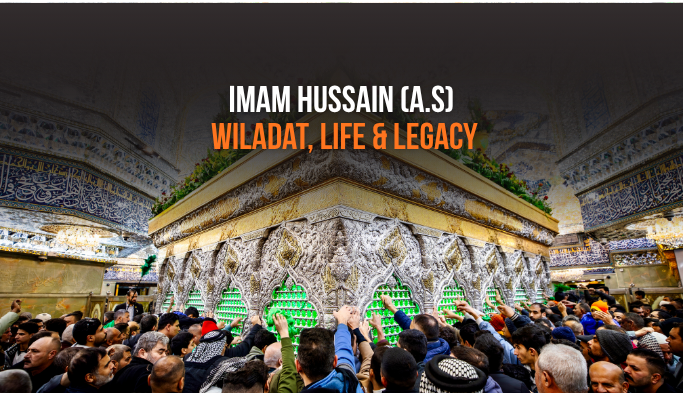
Imam Hussain (as) is buried in Karbala, Iraq, on the same plain where he fell. His shrine — one of the most visited sacred sites on earth — draws pilgrims from every corner of the world throughout the year, and in numbers that exceed all other gatherings on earth during Arba’een. The narrated reward for Ziyarat at his threshold is among the most emphatic in the entire Shia tradition. Imam Ali ibn al-Hussain Zayn al-Abidin (as), his son, is reported to have said that whoever visits his father’s grave has the equivalent of one hundred accepted Hajj pilgrimages. (Kamil al-Ziyarat, Ibn Qulawayh)
On the day of his birth — the 3rd of Sha’ban — the most fitting response to his life is the most honest one: to go. Our 2026–2027 Iraq Ziyarat Packages are built around Karbala as the central destination, alongside Najaf, Kadhimiya, and Samarra. Come and stand where the Master of Martyrs was buried — where the man who chose dignity over humiliation still receives those who come to say they understood.
Visit: www.ziaratplanner.com





 04-Jun-2026