The Fifth Imam: Born at the Intersection of Two Lines
On the 1st of Rajab, 57 AH, a child was born in Madinah whose lineage was unique in the entire history of the Imamate. Imam Muhammad ibn Ali al-Baqir (as) — the fifth Imam of the Ahlul Bayt (as) — was the son of Imam Ali Zayn al-Abidin (as) and Lady Fatima bint al-Hasan (sa). Through his father, he descended from Imam Hussain (as). Through his mother, he descended from Imam Hasan (as). He was the first Imam whose lineage united both branches of the Prophet’s blessed grandsons — and in that union he carried a symbol of what his Imamate would embody: the gathering and transmission of the full inheritance of the Prophet’s household to those who came after.
His full name was Muhammad ibn Ali ibn Hussain ibn Ali ibn Abi Talib (as). He was born in Madinah, the city where his father and grandfather had lived, taught, and endured. (Al-Kafi, Shaykh al-Kulayni, vol. 1; Kitab al-Irshad, Shaykh al-Mufid)
Biography at a Glance
| Full Name: |
Muhammad ibn Ali ibn Hussain ibn Ali ibn Abi Talib (as) |
| Kunyat: |
Abu Ja’far |
| Title: |
Al-Baqir — “The one who splits open knowledge and reveals its depths” |
| Father: |
Imam Ali ibn Hussain Zayn al-Abidin (as), the fourth Imam |
| Mother: |
Lady Fatima bint Hasan (sa), daughter of Imam Hasan al-Mujtaba (as) |
| Wiladat (Birth): |
1st Rajab, 57 AH — Madinah |
| Shahadat (Martyrdom): |
7th Dhul Hijjah, 114 AH — Madinah |
| Age at Martyrdom: |
57 years |
| Son: |
Imam Ja’far al-Sadiq (as), the sixth Imam |
| Shrine: |
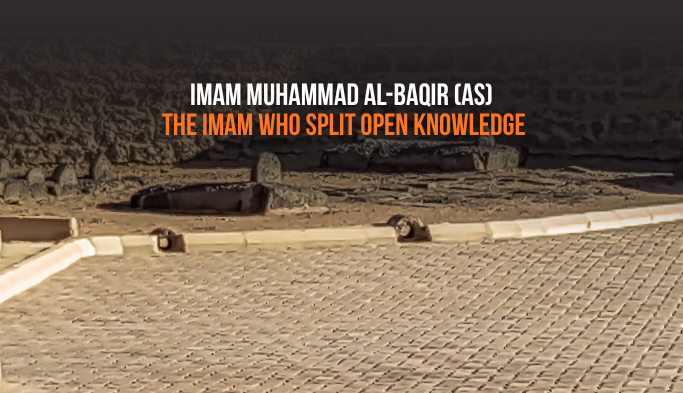
Jannat al-Baqi, Madinah, Saudi Arabia |
The World He Was Born Into
Imam al-Baqir (as) came into the world in 57 AH, during the rule of the Umayyad caliph Mu’awiya ibn Abi Sufyan. The surface of the Muslim empire at that moment appeared stable — the political machinery of the Umayyads was functioning, the territory was vast, and outward order was maintained. Beneath that surface, however, the Muslim community was carrying wounds that had not yet closed and tensions that had not yet resolved.
The Ahlul Bayt (as) lived under constant Umayyad surveillance. Their influence among the people was undeniable — the love that ordinary Muslims had for the Prophet’s family could not be suppressed by decree — and that love was precisely what the Umayyads feared. Members of the household were watched, their movements were restricted, and scholars who aligned with them were discouraged from public prominence. In this environment, the transmission of authentic Islamic knowledge became an act of quiet resistance: the Imams taught privately, trained their students carefully, and preserved what the political machinery was intent on distorting. (Al-Irshad, Shaykh al-Mufid; I’lam al-Wara, Al-Tabrisi)
The young Imam al-Baqir (as) grew up in the household of his father, Imam Zayn al-Abidin (as) — the Imam of prayer, the Imam of the prostration, the Imam whose response to the horror of Karbala was to turn inward and pour everything he felt into a relationship with Allah that expressed itself in supplication and worship. From his father, Imam al-Baqir (as) absorbed the Quran, the transmitted knowledge of the Prophet, and the patience that does not bend under oppression. He also grew up knowing what Karbala was — not as history, but as memory. He had been present as a child during those days, had witnessed the martyrdom of his grandfather Imam Hussain (as), and carried that knowledge as both a wound and a source of clarity for the rest of his life.
His Imamate: Opening the Schools of Knowledge
When Imam al-Baqir (as) assumed the Imamate following the passing of his father in 95 AH, the political landscape had begun to shift. The Umayyad caliphate was weakening from within — internal conflicts, succession disputes, and the strains of governing a vast empire were consuming its attention. In Madinah, this created a window: the rulers were less focused on controlling the intellectual life of the city, and Imam al-Baqir (as) used that window with precision and deliberate intent.
He established circles of learning — not formal institutions in the modern sense, but gatherings of serious students who came to sit with him and receive direct transmission of Quranic interpretation, Islamic jurisprudence, theology, and ethics. The breadth of what he taught was remarkable: he addressed legal questions with the authority of one who had received the tradition directly through the Prophet’s household, and he engaged theological and philosophical questions with the same clarity. Classical sources report that thousands of scholars, jurists, and students passed through his circle during the period of his Imamate. (Al-Kafi, vol. 1; I’lam al-Wara, Al-Tabrisi)
His title al-Baqir — given, according to narrations, by the Prophet (s) himself through the companion Jabir ibn Abdillah al-Ansari — means “the one who splits open knowledge and reveals its depths.” It captures exactly what his Imamate was: not merely the preservation of what had been transmitted, but the splitting open of that knowledge — making its inner dimensions accessible, clarifying what had been obscured, and preparing it to be carried further.
The Groundwork for Imam al-Sadiq (as)
The most enduring consequence of Imam al-Baqir’s (as) Imamate was what it made possible for his son. The intellectual movement he established in Madinah became, under Imam Ja’far al-Sadiq (as), one of the greatest centers of scholarship in Islamic history. Thousands of students are reported to have formally studied under Imam al-Sadiq (as) — scholars whose names appear throughout the chains of Islamic jurisprudence, hadith, and theology across both Shia and Sunni traditions. That school was built on the foundation that Imam al-Baqir (as) laid.
This was not accidental. The Imams understood their work across generations. Imam al-Baqir (as) was not preparing himself alone — he was preparing the conditions for what would follow. The tradition of the Ahlul Bayt (as) is precisely this: each generation transmitting to the next, not simply preserving but expanding the capacity of the next inheritor to carry and convey the Prophet’s legacy. (Al-Kafi, vol. 1; Uyun Akhbar al-Ridha, Shaykh al-Saduq)
His Legacy and His Anniversary
Imam Muhammad al-Baqir (as) was martyred on the 7th of Dhul Hijjah, 114 AH, at the age of fifty-seven — poisoned by the Umayyad authorities, as was the pattern for so many of the Imams. He is buried in Jannat al-Baqi in Madinah.
Observing his Wiladat on the 1st of Rajab is an invitation to think about what his life actually means — not as biography, but as instruction. He was a man who received the worst that political power can do to a family and responded by teaching. Who lived under surveillance and responded by training scholars. Whose grandfather was martyred in the most brutal circumstances, and who took that grief and made it the engine of an educational mission that reshaped Islamic intellectual life.
The 1st of Rajab opens the month with that example. It asks: what are we doing with the knowledge we have been given?
For those who wish to honour his memory by drawing closer to the Ahlul Bayt (as) through Ziyarat, our 2026–2027 Iraq Ziyarat Packages bring you to the shrines of his grandfather Imam Hussain (as) in Karbala, his great-grandfather Imam Ali (as) in Najaf, and his descendants in Kadhimiya and Samarra.
Visit: www.ziaratplanner.com





 06-Jun-2026