Bio Data
| Detail |
Information |
| Name |
Muhammad |
| Title |
Al-Baqir (Splitter of Knowledge) |
| Kunya |
Abu Ja’far |
| Father |
Ali ibn Hussain, Zayn al-Abidin (AS) |
| Mother |
Fatimah bint al-Hasan |
| Born |
1st Rajab, 57 AH / 676 CE in Madinah |
| Died |
7th Dhul-Hijjah, 114 AH / 733 CE (poisoned by Hisham) |
| Age at Martyrdom |
57 years |
| Period of Imamate |
19 years |
| Buried |
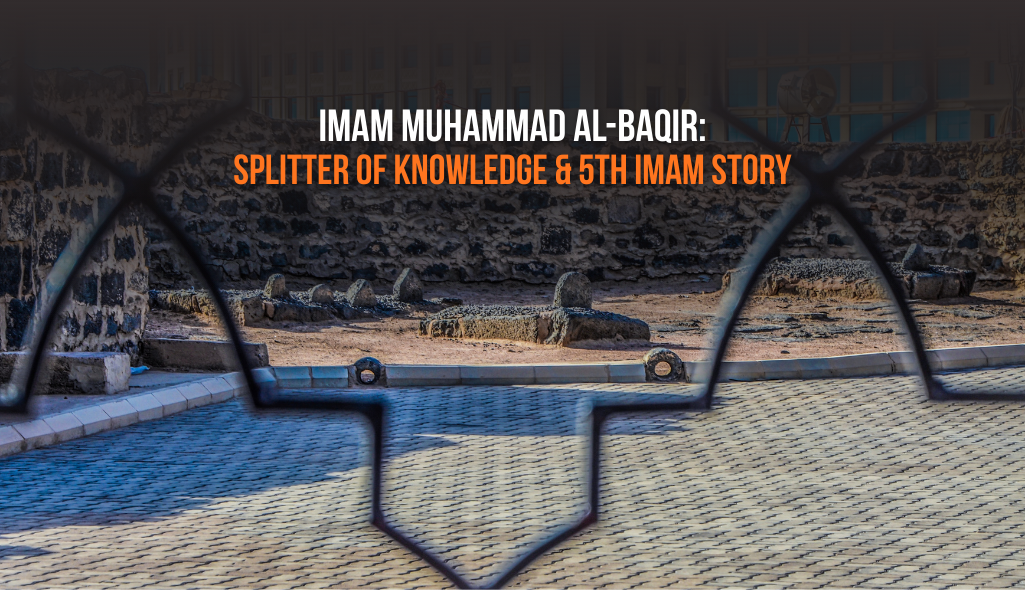
Al-Baqi’ cemetery, Madinah |
Introduction
Muhammad bin Ali bin al-Hussain bin Ali ibn Abi Talib (Arabic: محمد بن علي بن الحسين بن علي بن أبي طالب), known as Imam al-Baqir (AS) and Baqir al-‘Ulum, was the fifth Imam, whose period of Imamate lasted nineteen years.
Imam al-Baqir (AS) made a great scientific movement which reached its peak at the time of his son Imam al-Sadiq (AS). His narrations in religion, conduct of the Prophet (PBUH), Quran sciences, moral conduct, and manners are more than what is left from the children of Imam al-Hasan (AS) and Imam al-Hussain (AS). Thus, during his imamate, a great step was taken towards organized thought in different fields including ethics, jurisprudence, theology, exegesis, etc. According to historical sources he was present at the Battle of Karbala as a child.
Lineage
Muhammad bin Ali bin al-Hussain bin Ali bin Abi Talib, known as al-Baqir (AS) was the fifth Imam, son of Imam al-Sajjad (AS), the fourth Imam. His mother was Umm ‘Abd Allah, daughter of Imam al-Hasan al-Mujtaba (AS). Hence he is called Hashemite among Hashimites, ‘Alavi among ‘Alavis, and Fatimi among Fatimis.
Naming, Teknonym, and Epithets
Many years before Imam al-Baqir (AS) was born, the Prophet (PBUH) named him Muhammad and titled him as al-Baqir. Hadith al-Lawh transmitted by Jabir ibn ‘Abd Allah al-Ansari and others corroborate this. His epithets were, al-Baqir, al-Shakir (the thankful to God), and al-Hadi (the guide), the former of which is the most famous. The meaning of “al-Baqir” is “splitter.” Al-Ya’qubi wrote that, “He was named al-Baqir since he split knowledge.” His famous nickname is Abu Ja’far. In hadith references, he is mostly referred to as Abu Ja’far al-Awwal.
Birth
Imam al-Baqir (AS) was born on Friday Rajab 1, 57 / May 10, 677 in Medina. He was a small child and present in the Battle of Karbala.
At the young age of 3.5 years, Imam Al-Baqir (AS) was present during the massacre in Karbala. He witnessed the brutal martyrdoms of Imam Hussain (AS), members of the Bani Hashim, and the companions, as well as the ensuing tragedy. He later recounted the event’s profound impact, reportedly saying:
“The humans, the jinns, the birds, and the wild beasts (all) mourned and wept over (the tragedy which befell) Hussain ibn Ali (AS).”
— Kamil Al-Ziyarat
Wives and Children
In narrations, Umm Farwa is mentioned as the wife of Imam al-Baqir (AS), who was the mother of Imam al-Sadiq (AS). Also narrations mention another woman called Umm Hakim, daughter of Usayd al-Thaqafi as a wife of Imam, who was the mother of two of the Imam’s children and another wife of Imam who was a concubine and the mother of three other children of Imam.
The number of the children of Imam al-Baqir (AS) was seven, including five sons and two daughters:
- Ja’far
- ‘Abd Allah (mother: Umm Farwa, daughter of al-Qasim b. Muhammad)
- Ibrahim
- ‘Ubayd Allah (mother: Umm Hakim, daughter of Usayd al-Thaqafi)
- ‘Ali
- Zaynab (mother: a concubine)
- Umm Salama (mother: a concubine)
Imamate
Imam al-Baqir (AS) became the Imam in 95/713 after his father was martyred and had the responsibility until his martyrdom in 114/733 (or 117/735).
Proofs of Imamate
Jabir ibn ‘Abd Allah al-Ansari narrated, in his response to a question about Imams after Imam ‘Ali (AS), the Prophet (PBUH) said:
“al-Hassan (AS) and al-Hussain (AS), the two Masters of the Youths of Paradise, then the Master of Worshipers of his time ‘Ali b. al-Husayn (AS), then al-Baqir, Muhammad b. ‘Ali (AS), whom you will see, O Jabir…”
— Qummi al-Razi, Kifayat al-athar, p.144-145
Also, Imam al-Sajjad (AS) frequently attracted attention towards his son, Imam al-Baqir (AS). For example, when his other son ‘Umar asked him about why Imam al-Sajjad (AS) paid more attention to Imam al-Baqir (AS), Imam (AS) answered:
“It is because the imamate will remain in his descendants until the day our Upriser rises and will fill the world with justice and equality. So, he [al-Baqir] is both Imam and the father of Imams.”
— Qummi al-Razi, Kifayat al-athar, p. 237
Al-Shaykh al-Mufid said Imam al-Baqir (AS) was superior to all his brothers in knowledge, piety, and dignity. He had a higher position in relation to his siblings. Everyone praised him with glory and he was respected by the Sunni and Shia scholars. He had knowledge of religion, the Quran, ethics, and morals to such a great extent that even these had not been formally taught by any of the children of al-Hasan (AS) and al-Hussain (AS). The rest of the companions of the Prophet (PBUH), noble ones among the Followers, and highest ranking jurisprudence scholars have narrated from him. His position in merits and nobility reached a level of being exemplary among the people of knowledge. They wrote works and composed poems to praise his personality.
The Splitter of Knowledge
“O Jabir, you will live to see my descendant Muhammad (PBUH), son of ‘Ali (AS), son of Hussain (AS), son of ‘Ali (AS)… The one who is known in the (original) Torah as ‘al-Baqir’ (the Revealer of Knowledge). When you see him, deliver to him my greetings of Peace…”
These were the words of Prophet Muhammad (PBUH) to the righteous companion Jabir al-Ansari. Many years later, Jabir was an old man going on a visit to see the fourth Imam, Zayn al-Abidin (AS). As he entered the Imam’s home, he saw an intriguing young boy. Jabir began to examine the young boy… After which, he said, “By the Lord of the Ka’bah, (I see in him) the qualities of God’s Messenger (Prophet Muhammad) PBUH…”
Jabir then asked Imam Zayn al-Abidin (AS) about who the boy was. Imam Zayn al-Abidin (AS) responded, “This is my son and the commander of affairs after me – Muhammad al-Baqir.”
Upon hearing these words, Jabir humbled himself before the young boy, kissed him and said, “…O Descendant of God’s Messenger, accept the greetings of peace from your forefather. Indeed, the Messenger of God sends greetings of peace to you!”
Tears started to run down the young boy’s face, as he responded, “O Jabir, may peace be upon my forefather – the Messenger of God – for as long as the heavens and earth last – and upon you as well, O Jabir, for delivering this greeting of peace…”
— Bihar al-Anwar, Vol. 46, pp. 223-224, Allamah Majlisi
The Seal of All Prophets had prophesied that this young boy, Imam Muhammad al-Baqir (AS), would unlock the chests of knowledge. He would extract priceless treasures for the generations and further the spiritual advancement of humanity.
The Fifth Imam
During Imam Zayn al-Abidin’s (AS) lifetime, he was asked, “Who will be the Imam after you?” Imam Zayn al-Abidin replied, “Muhammad, my son – he will reveal and expand knowledge.”
— Bihar al-Anwar, Vol. 46, p. 230, Allamah Majlisi
Imam Muhammad al-Baqir (AS), the fifth immaculate Imam, was a young child during the tragedy of ‘Ashura’. The memories of his grandfather, Imam Hussain (AS), stuck with him throughout his life. He grew up in the spiritually enlightening care of his father, Imam Zayn al-Abidin (AS).
— Al-Kafi, Vol. 4, p. 223, Sh. al-Kulayni
The fifth Imam became known – by friend and foe, alike – for his knowledge, piety and virtue. Imam al-Baqir (AS) revealed more insight about the Islamic sciences than any other counterpart since the time of Imam Hassan (AS) and Imam Hussain (AS). He paved the way for the establishment of a massive Islamic university, which would reach its peak of development during the following Imam’s time.
— Seeratul A’immah, p. 270, Sh. Ja’far Subhani
Many of Imam al-Baqir’s (AS) contemporaries had written about his scholarly status. These prominent scholars were from different schools of thought. For instance, a notable contemporary by the name of ‘Abdullah ibn Ata’ stated, “I have never seen scholars, in the presence of anyone, (seem) lesser (in knowledge) than they did in the presence of Abu Ja’far (Imam al-Baqir) – Muhammad (PBUH), son of ‘Ali (AS), son of Hussain (AS)… Indeed, I saw Hakam ibn ‘Utaybah, with all of his (scholarly) splendor among the people, (look) like a boy in the presence of his teacher – when he was in the presence of (Imam al-Baqir) (AS).”
— Seeratul A’immah, p. 271, Sh. Ja’far Subhani
Becoming the Imam
Imam Muhammad al-Baqir (AS) assumed the imamate at the age of 38, following the martyrdom of his father, Imam Ali al-Sajjad (AS), on the 25th of Muharram, 95 AH. When Imam Sajjad (AS) was asked who would be the Imam after him, he reportedly said, “Muhammad (AS), my son – he will reveal and expand knowledge.”
— Bihar al-Anwar, v.46
His period of leadership spanned 19 years, during which he guided the community through turbulent times and preserved the essence of Islamic teachings.
Hadith
Imam al-Baqir (AS) paid particular attention to hadiths (or traditions) from the Prophet (PBUH) to the extent that Jabir ibn Yazid al-Ju’fi narrated 70,000 traditions from the noble Prophet (PBUH) from him. Also, Aban Taghlib and other students of Imam al-Baqir (AS) narrated a great number of this tremendous legacy from the Imam (AS).
Imam al-Baqir (AS) did not suffice to only narrate and spread traditions, but he also encouraged his companions to strive in understanding traditions and learning their meanings. In a statement, he said:
“Know the levels of our Shia by the number of hadiths from the Ahl al-Bayt they narrate and their knowledge to them, which is the knowledge to hadith (dirayat al-hadith); and it is through understanding of hadiths that the faithful reach highest levels of faith.”
— Sharif al-Qurashi, Hayat al-Imam Muhammad al-Baqir, vol. 1, pp. 140-141
In the Capital of Tyranny
Under the reign of Hisham, Imam al-Baqir (AS) was summoned to Damascus. The tyrant Hisham had been plotting to curtail the positive influence and prestige of Imam al-Baqir (AS). Hisham knew that his corrupt supporters could not challenge the Imam’s knowledge or piety, so he planned another type of challenge. Hisham attempted to surprise Imam al-Baqir (AS) with an archery match. The match would surely portray the elderly Imam in a humiliating position – or so the tyrant thought.
“O Muhammad, hit the target, along with the chiefs of your people,” ordered Hisham. “I am too old for archery, perhaps you can excuse me,” replied Imam al-Baqir (AS). Hisham insisted and would not take ‘no’ for an answer. Imam al-Baqir (AS) was handed a bow and arrow. He then aimed at the target…The Imam hit the target on the bullseye. He took another arrow, released it…and split the arrow! As the Imam continued to amaze the spectators, Hisham was extremely frustrated – this was happening in Hisham’s very own court.
After exchanging some words, Imam al-Baqir (AS) responded to Hisham’s questions about the ability of the Imams to perform such matters, saying:
“Indeed, we inherit the perfection and completion which God descended upon His Prophet, in His words (from the Holy Qur’an), ‘Today I have perfected your religion for you, I have completed My blessing upon you, and I have approved Islam as your religion.’ (Quran 5:3) And the earth is never empty of those who perfect these matters – which others fall short of (perfecting).”
— Bihar al-Anwar, Vol. 46, pp. 306-307, Allamah Majlisi
The Value of Hard Work
Oftentimes, there are those who may think of “religion” and “being religious” as something restricted to houses of worship, prayers, fasting, sermons, etc. But Imam al-Baqir (AS) reminds us of a very different aspect of religion…
On a hot, scorching day, there was a man who saw Imam Muhammad al-Baqir (AS) working. The burden of hard work was apparent on the Imam, as he leaned on a couple of servant helpers. The man started to think to himself, “Praise be to God! A chief among the chiefs of Quraysh (a major tribe) – at this hour, in this condition – seeking after the worldly (life)?! Indeed, I shall admonish him…”
The man approached Imam al-Baqir (AS) and greeted him. Dripping with sweat, the Imam responded to the greeting. The man then started to admonish, saying, “May God improve you… A chief among the chiefs of Quraysh – at this hour, in this condition – seeking after the worldly (life)?! What if your time (of death) comes while you are in this state? What would you do?”
The Holy Imam responded, “If death comes to me while I am in this state, it would come to me while I am in (a form of) obedience to God the Exalted, the Glorious. Through this (state of work), I provide for myself and my family to be free from needing you and other people. Indeed, I would be afraid, rather, if death comes to me while I am in (a form of) disobedience to God.” The man then conceded, “You have spoken truthfully, may God grant you Mercy… I had wanted to admonish you, but you admonished me!”
— Bihar al-Anwar, Vol. 46, p. 351, Allamah Majlisi
The True Shia
Imam Muhammad al-Baqir’s (AS) words of wisdom can spark the light of deep reflection within us. While these short lines can only relate a few words, a brief excerpt might renew our desire to seek further insight. In discussing the true meaning, Imam al-Baqir (AS) said the following:
“…Does the one who claims to be of the Shia think it is enough to (simply) speak of loving us, Ahl al-Bayt (the Prophet’s (PBUH) family)? By God, our Shia are only those who are mindful of God and obey Him. They were known…only (in light of their) modesty, humility, trustworthiness, abundant remembrance of God, fasting, prayer, honoring parents, caring for neighbors, the poor, people in need, those in debt, and orphans… (they were known for their) truthful words, the recitation of Qur’an, and holding their tongues back unless it was to speak good of people. They were the trustees (entrusted) by their people in (the various) affairs…”
— Al-Kafi, Vol. 2, p. 74, Sh. al-Kulayni
After the attempts of Hisham to undermine the Imam’s position utterly failed, Hisham was infuriated. He continued to receive news about the people’s high regard for Imam al-Baqir’s (AS) knowledge and virtue… Hisham thus resorted to assassination and had the Holy Imam poisoned. Imam Muhammad al-Baqir (AS) was buried in the Baqi’ cemetery of Madinah.
— Bihar al-Anwar, Vol. 46, p. 217, Allamah Majlisi
The Martyrdom of the Imam (AS)
The Imam attained martyrdom on the 7th of Dhul Hijjah, 114 AH, after being poisoned by Hisham ibn Abdul Malik (la). He was buried in Jannatul Baqi in Medina, alongside his grandfather, Imam Hassan (AS), his father, Imam Sajjad (AS), and later, his son, Imam Al-Sadiq (AS).
Imam Muhammad al-Baqir (AS) is a guiding light of scholarship, resilience, and piety in the rich history of Islam. His life serves as a testament to the power of knowledge, unrelenting dedication, and unwavering truth. May his teachings lead us in both spiritual and worldly endeavours.
Teachings of Imam Muhammad al-Baqir (AS)
Modesty and Faith
Imam Muhammad al-Baqir (AS) said:
“Modesty and faith are inseparable. If one is removed, the other departs as well.”
This is a reminder that true belief manifests in behavior, not just in self-proclaimed identity.
Three Eyes That Will Not Weep on the Day of Judgment
On the Day of Resurrection, the Book of Deeds will be opened and most eyes will shed tears of regret and fear. But Imam Muhammad al-Baqir (AS) mentions three types of eyes that will remain joyful:
- Eyes that stay awake at night in worship of Allah
- Eyes that weep out of fear of Allah
- Eyes that turn away from forbidden sights
These are the eyes of the sincere, the spiritually disciplined, and the God-conscious.
The Power of a Sincere Dua for Others
One of the signs of true sincerity in faith is praying for someone in their absence. Such prayers are more likely to be accepted, as they come from a pure heart without worldly expectation.
Imam al-Baqir (AS) said:
“The prayer made for a believer in his absence is quickly accepted, by the will of Allah.”
This highlights the selfless nature of true believers, who not only care for others but sincerely ask God to bless them even when they’re not around.
Conclusion
The Legacy of Imam Muhammad al-Baqir (AS): Light for All Generations
Imam Muhammad al-Baqir (AS) was not just a historical figure; he was a lighthouse of divine knowledge, a pioneer of Islamic sciences, and a beacon of moral and spiritual reform in an era plagued with political corruption and religious deviation. He revived the true teachings of the Qur’an and Sunnah through deep knowledge, patience, and unwavering faith. His efforts laid the foundation for the Islamic intellectual movement, later expanded by his son Imam Ja’far al-Sadiq (AS). Through his wise leadership, Imam al-Baqir (AS) proved that reformation doesn’t always require revolution; it can be achieved through education, integrity, and inner strength.






 13-Mar-2026