Born on the 10th of Rajab: The Imam of Generosity
The 10th of Rajab, 195 AH, marks the birth of Imam Muhammad ibn Ali al-Jawad (as) — the ninth Imam of the Ahlul Bayt (as) — in Madinah. He arrived in a world that was watching his family closely and a caliphate that feared what his father’s household represented. He would go on to become Imam at approximately eight years of age, silence the most learned jurist of the Abbasid court, guide his community through one of the most politically constrained periods in Shia history, and leave behind teachings that are still quoted fourteen centuries later.
His primary title is al-Jawad — the Generous — and it captures both his material generosity to those around him and the generosity with which he transmitted knowledge to a community hungry for authentic guidance. His second title, al-Taqi — the Pious — speaks to the interior quality that made the exterior generosity possible. He was generous because he was pious: a man who had already given everything to Allah had no difficulty giving what remained to others.
The Quran reminds the believers: “Say: I do not ask you any reward for this except love for my near relatives.” (Surah al-Shura, 42:23). The Imam who was born today embodied that love — and spent his life ensuring it was understood, not merely expressed.
Biography at a Glance
| Full Name: |
Muhammad ibn Ali ibn Musa al-Ridha (as) |
| Kunyat: |
Abu Ja’far al-Thani |
| Titles: |
Al-Jawad (The Generous), Al-Taqi (The Pious), Bab al-Murad (The Gate Through Which Prayers Are Answered) |
| Father: |
Imam Ali al-Ridha (as), the eighth Imam |
| Mother: |
Lady Khayzuran (also known as Sabika) |
| Wiladat (Birth): |
10th Rajab, 195 AH — Madinah |
| Shahadat (Martyrdom): |
29th Dhul Qa’dah, 220 AH — Baghdad, Iraq |
| Age at Imamate: |
~8 years |
| Age at Martyrdom: |
25 years |
| Son: |
Imam Ali al-Hadi (as), the tenth Imam |
| Shrine: |
Kadhimiya, Baghdad, Iraq — shared with his grandfather Imam Musa al-Kazim (as) |
The World He Was Born Into
Imam al-Jawad (as) was born during the caliphate of al-Amin, with the transition to al-Ma’mun already taking shape in the political currents of the time. His father, Imam Ali al-Ridha (as), was in Madinah — not yet summoned to Khurasan, not yet forced into the role of Crown Prince. For a brief window, the household had a degree of space in the city of the Prophet (s), and it was in that window that the ninth Imam entered the world.
The Abbasid court’s relationship with the Ahlul Bayt (as) was never one of simple hostility — it was more complicated and more cynical than that. The caliphs recognized that the Imams carried a moral authority that no political appointment could manufacture and no military force could destroy. Their response was not to ignore it but to contain it: through surveillance, forced relocations, strategic marriages, and the kind of polite imprisonment that looks like hospitality from a distance. Imam al-Jawad (as) would navigate all of this — and more — in the twenty-five years of his life.
The Debate That Announced Him
When his father was martyred in 203 AH, the community found itself in a situation that had not arisen in this form before: an Imam who was a child. The Abbasid court saw an opportunity. Al-Ma’mun invited the young Imam to Baghdad, arranged a marriage between him and his daughter Umm al-Fadl, and placed him where he could be watched — and where, the caliph likely hoped, he might be publicly exposed as unready for the role his followers ascribed to him.
The chief judge of the Abbasid court, Yahya ibn Aktham, was given the opportunity to question the young Imam in an assembled gathering. He posed what he considered a question complex enough to expose ignorance: a pilgrim in the state of ihram, he asked, kills game during Hajj — what is the ruling?
The Imam’s response was to ask a question in return: which pilgrim? Was the act committed inside or outside the sacred sanctuary? Was the animal wild or domesticated? Did the pilgrim act out of ignorance or deliberately? Was this his first offense or a repeated one? Was he free or enslaved? A child or an adult? Did he repent or not?
For each condition, the Imam explained, the ruling differs — and he proceeded to lay out the variations. The judge fell silent. The assembled scholars were astonished. The young Imam had not only answered the question — he had demonstrated that the question as posed was legally incomplete, and that the person asking it had not understood the full scope of what he was asking about. (Al-Irshad, Shaykh al-Mufid; Bihar al-Anwar, Allama Majlisi)
Al-Ma’mun’s plan to use the gathering as an occasion to diminish the Imam’s authority had produced exactly the opposite result. The Imam who was eight years old when he assumed the Imamate was, by the standards of Islamic scholarship, already its equal or superior to the men who had spent decades in study. The Shia community’s trust in the divine appointment of the Imam was not shaken — it was confirmed.
What He Left Behind
The Imam’s contributions to the community, given his constraints and his short life, were focused and deliberate. He transmitted Islamic jurisprudence, theology, and ethical teaching through direct circles of scholars in both Madinah and Baghdad. He maintained the network of representatives (wukala) across the Muslim world — the same network his son Imam al-Hadi (as) would develop further and that would sustain the community through the Occultation. And he modeled, in his own conduct, the qualities his teachings described.
Among the sayings attributed to him in classical sources: “The best form of worship is sincerity.” And: “Three qualities bring love: fairness in dealings, sharing hardship with others, and keeping a pure heart.” (Tuhaf al-‘Uqul, Shaykh al-Harrani)
These are not incidental observations. They are the distillation of a life lived under conditions where faith either becomes something real or collapses into performance. For the Imam, surrounded by a court that used the language of Islam to justify whatever it found politically convenient, sincerity was not a virtue among many — it was the foundation without which everything else was pretense.
He was martyred on the 29th of Dhul Qa’dah, 220 AH, at twenty-five years of age — poisoned, as classical sources record, on the orders of al-Mu’tasim. His life, his Shahadat, and his legacy are explored in full in our dedicated post on the Dhul Qa’dah series. What the 10th of Rajab asks of us is simpler: gratitude that he was born.
The Shrine in Kadhimiya — and the Journey It Invites
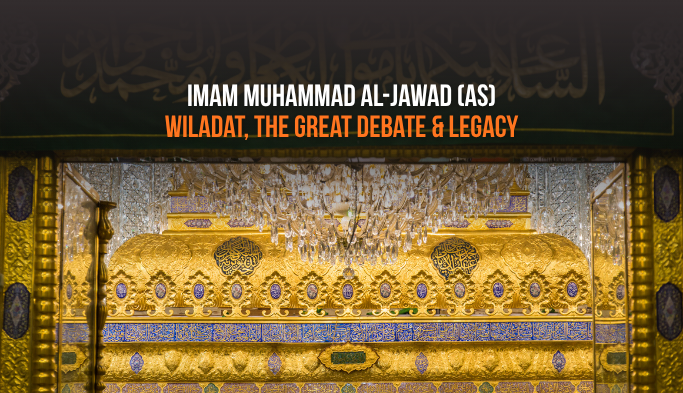
Imam al-Jawad (as) is buried in Kadhimiya, Baghdad, in the same golden shrine complex as his grandfather Imam Musa al-Kazim (as) — the seventh Imam. Two generations of patience, knowledge, and endurance rest beneath the same dome. To stand between their graves is an experience that pilgrims across the centuries have described in terms that no travel account fully captures.
His title Bab al-Murad — the Gate Through Which Prayers Are Answered — is not merely honorary. It reflects a living reality attested by the millions who have come to Kadhimiya seeking intercession and left with what they came for, or with something better.
On this 10th of Rajab, the birthday of the generous Imam, the most natural question is whether we will answer his invitation. Our 2026–2027 Iraq Ziyarat Packages include Kadhimiya as a central destination — alongside Karbala, Najaf, and Samarra — for pilgrims who wish to stand at the shrine of the Imam born today and the household he belongs to.
Visit: www.ziaratplanner.com





 04-Jun-2026