“I Thank Thee for the Opportunity to Worship”
During the final years of his life, Imam Musa al-Kazim (as) spent his days in a series of Baghdad prisons on the orders of the Abbasid caliph Harun al-Rashid. The conditions were harsh and the isolation was deliberate. From within that confinement, the seventh Imam of the Ahlul Bayt (as) was heard to say:
“I always asked Thee an opportunity to worship, and Thou have provided it for me. So I thank Thee.” (Al-Irshad, Shaykh al-Mufid, vol. 2, p. 240)
A man who can say that from a prison cell — and mean it — is a man whom no prison can actually contain. This is who Imam Musa al-Kazim (as) was. On the 25th of Rajab, 183 AH, he was martyred in that confinement, poisoned after years of unjust imprisonment. We extend our condolences to the Prophet (s), to Imam al-Mahdi (atfs), to the Ahlul Bayt (as), and to all believers on this day of grief and honour.
Biography at a Glance
| Full Name: |
Musa ibn Ja’far ibn Muhammad al-Sadiq (as) |
| Kunyat: |
Abu Ibrahim; Abu al-Hasan al-Awwal |
| Titles: |
Al-Kazim (He Who Suppresses Anger), Bab al-Hawa’ij (Gateway of Fulfilled Needs), Al-Abd al-Salih (The Righteous Servant) |
| Father: |
Imam Ja’far al-Sadiq (as), the sixth Imam |
| Mother: |
Lady Hamida al-Barbariyya (sa) |
| Wiladat (Birth): |
7th Safar, 128 AH — al-Abwa (between Makkah and Madinah) |
| Shahadat (Martyrdom): |
25th Rajab, 183 AH — Baghdad, Iraq |
| Period of Imamate: |
35 years |
| Age at Martyrdom: |
~55 years |
| Son: |
Imam Ali al-Ridha (as), the eighth Imam |
| Shrine: |
Kadhimiya, Baghdad, Iraq — shared with his grandson Imam Muhammad al-Jawad (as) |
Al-Abd al-Salih: The Man the Titles Describe
The Imam’s contemporaries gave him the title Al-Abd al-Salih — the Righteous Servant — because of what they personally witnessed: prostrations that lasted from sunrise to midday, a beard wet with the tears of his fear of Allah, a night given entirely to prayer and Quran. His title al-Kazim — the one who suppresses anger — was earned through specific, documented conduct. (Al-Irshad, Shaykh al-Mufid, vol. 2, pp. 227–236)
One narration transmitted in classical sources describes the news of his martyrdom reaching Baghdad. An old man wept inconsolably. When asked why, he narrated an encounter: his farmland had been destroyed by pests, his crops lost, and he was in debt with no means to repay it. The Imam approached him, asked about his loss — 120 dinars — then smiled and handed him a purse of 150 dinars. What the man remembered most was not the amount but the manner: “The Imam’s kind and affectionate look, which was without any air of pride or superiority, fascinated me.” He said: “I am crying this day because a great man has left us. The one whose humbleness and kindness were a byword and who always cared about the needy.”
Classical sources also record that the Imam would go out in the night, secretly, and leave provisions at the doors of the poor in Madinah without revealing who had left them. (Al-Irshad, vol. 2) The character that drew people to him was not performed for public consumption — it operated most fully in the dark, when no one was watching.
Prison to Prison — and the Jailors Who Changed
Harun al-Rashid had the Imam arrested from the Prophet’s Mosque in Madinah, where he was at prayer when the soldiers came. They did not wait for him to finish. As they led him away, he turned to the Prophet’s grave and said: “Do you see how your nation is treating your children?”
What followed was years of imprisonment in successive prisons — because in each one, the same thing happened. The jailer assigned to him, however hostile his initial disposition, eventually changed. ‘Isa ibn Ja’far, the first jailer in Basra — a violent man who believed the government’s portrait of the Imam as a seditious troublemaker — came to see him differently within months. He wrote to Harun: “Order them to come and take him back. Otherwise, I will set him free myself. I cannot keep such a man as a prisoner.” He had been asked by Harun to kill the Imam. He refused. (Qummi, Al-Anwar al-Bahiyya, pp. 192–196)
The pattern repeated in Baghdad. Fadl ibn Rabi’ softened. Fadl ibn Yahya Barmaki — whose father was an Iranian minister actively hostile to the Shia — began treating the Imam as a guest rather than a prisoner, at the cost of his own standing with Harun. Harun tried to use this against him. The ministry of hearts, it turned out, could not be suppressed by transferring the heart.
Even a young woman assigned to the Imam’s cell as part of a deliberate scheme to compromise his reputation — placed there so that his accusers could claim impropriety — emerged from the experience a worshipper. She began fasting, praying, and entering a state of continuous reflection. When officials asked what had happened, she replied that she understood for the first time what she was and how much she had neglected. She did not change her mind until she died. The scheme produced its opposite.
There is also the story of Bishr Hafi — a man known in Baghdad for his dissolute life, his house filled with music and revelry. The Imam, passing through the alleys of the city, heard the sounds and asked a servant whether the owner of the house was a free man or a slave. The servant replied that the owner was obviously free. The Imam said: “Yes — if he were a slave, such noises would not be coming from his house.” When Bishr heard what the Imam had said, he ran out barefoot into the street, found him, and threw himself before him. From that moment, he devoted himself entirely to Allah’s worship — and was known thereafter as one of the great ascetics of Baghdad.
The Final Refusal
In the last week of his life, Harun sent Yahya ibn Khalid al-Barmaki to the Imam with a message: it had been established that the Imam was innocent of any wrongdoing, but Harun had made an oath and could not break it publicly. All he needed was a private confession — in Yahya’s presence alone, with no witnesses. A few words. Then freedom.
The Imam’s response was brief: “Tell Harun that there is not much left of my life — and that is it.”
A week later he was dead, poisoned. He was approximately fifty-five years old. (Al-Irshad, Shaykh al-Mufid; Bihar al-Anwar, Allama Majlisi, vol. 48)
Before his death, he asked that a man from Madinah be brought to perform his ritual bath and burial — someone he trusted. He refused the jailor’s offer to provide a shroud: “We are a family whose wives’ marriage portions, the expense of the first Hajj, and the shrouds of our dead are supplied from our own purest properties. I have a shroud of my own.” He was buried in the Quraysh cemetery in Baghdad, in the section belonging to the Bani Hashim, with the shroud he himself had prepared.
The Shrine in Kadhimiya
Imam Ali al-Ridha (as) — his son and the eighth Imam — said of his father’s shrine: “Anyone who visits the grave of my father is like the one who visits the graves of the Prophet (s) and Ali ibn Abi Talib (as).” In another narration, the reward is described as equivalent to visiting the grave of Imam Hussain (as). (Al-Kafi, Shaykh al-Kulayni, vol. 4, p. 583)
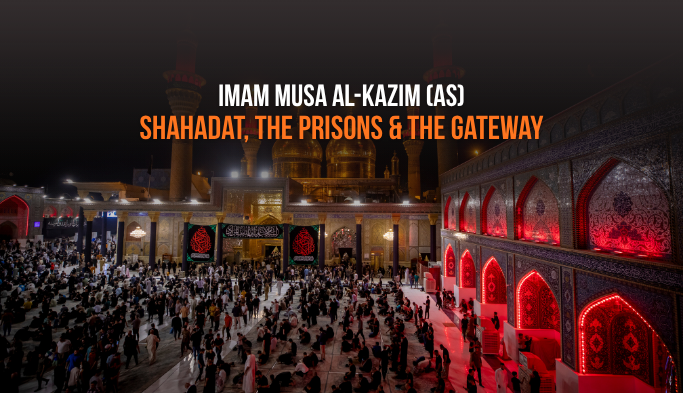
The shrine that now stands in Kadhimiya grew from the grave of a man buried in a city where he had been held prisoner. His grandson Imam Muhammad al-Jawad (as) was buried beside him — two Imams imprisoned, martyred, and visited. Harun al-Rashid, whose government imprisoned the seventh Imam, is a name in a history book. The Imam he imprisoned is called the Gateway of Fulfilled Needs, and the gateway remains open.
On this 25th of Rajab, for those who wish to stand at that gateway in person — to pray at the golden shrine where two Imams rest in Kadhimiya, and to visit Karbala, Najaf, and Samarra on the same journey — our 2026–2027 Iraq Ziyarat Packages are open for the coming season.
Visit: www.ziaratplanner.com






 06-Jun-2026