The Voice Karbala Could Not Silence
The 5th of Sha’ban, 5 AH. In the household of Imam Ali (as) and Lady Fatima al-Zahra (sa), a daughter was born who was named by the Prophet (s) himself: Zainab — a name composed of zain (beauty) and ab (father). The Prophet held her, wept, and said that she would face trials as great as his own. (Bihar al-Anwar, Allama Majlisi)
That prophecy was fulfilled at Karbala. And what followed Karbala — the sermons in Kufa, the confrontation with Yazid in Damascus, the preservation of everything Imam Hussain (as) had died to say — was fulfilled by the same woman. If the events of the 10th of Muharram are the wound, Lady Zainab (sa) is the voice that ensured the wound was witnessed. She was the continuation of a mission whose physical carrier had been martyred, and she discharged that continuation without compromise.
Allah says in the Quran:
إِنَّ الَّذِينَ آمَنُوا وَعَمِلُوا الصَّالِحَاتِ سَيَجْعَلُ لَهُمُ الرَّحْمَٰنُ وُدًّا
Translation: “Indeed, those who have believed and done righteous deeds — the Most Merciful will appoint for them affection.” (Surah Maryam, 19:96)
The affection that fourteen centuries of believers have felt toward Lady Zainab (sa) is the fulfillment of this verse in her.
Biography at a Glance
| Full Name: |
Zainab bint Ali ibn Abi Talib (sa) |
| Kunyat: |
Umm Abdillah |
| Titles: |
Sayyidat Nisa’ al-Alamin (Leader of the Women of the Worlds), Aqilat Bani Hashim (The Wise Woman of the Hashimites), Sharikat al-Hussain (Partner of Hussain) |
| Father: |
Imam Ali ibn Abi Talib (as), the first Imam |
| Mother: |
Lady Fatima al-Zahra (sa), daughter of the Prophet (s) |
| Husband: |
Abdullah ibn Ja’far al-Tayyar |
| Wiladat (Birth): |
5th Sha’ban, 5 AH — Madinah |
| Wafat (Passing): |
15th Rajab, 62 AH — Damascus, Syria (date differs across some narrations) |
| Notable siblings: |
Imam Hasan al-Mujtaba (as), Imam Hussain (as), Lady Umm Kulthum (sa) |
| Shrine: |
Damascus (Sayyida Zainab Mosque), Syria |
Her Formation: Three Teachers
Lady Zainab (sa) received an education that no school in history has replicated. Her grandfather was the Prophet Muhammad (s). Her father was Imam Ali (as). Her mother was Lady Fatima al-Zahra (sa). She grew up in a household where the Quran was not a text to be studied but a living practice witnessed in every interaction.
She memorized the Quran. She absorbed hadith. She witnessed Islamic ethics applied not in comfortable circumstances but under intense political pressure — her father’s household was marginalized, her mother died young under circumstances her family attributed to the events after the Prophet’s passing, her brothers faced the full weight of Umayyad hostility. By the time Karbala arrived, Lady Zainab (sa) had been in training for it her entire life — not because anyone had planned it that way, but because the circumstances of being in that family, in that era, were themselves the preparation.
The scholars of Kufah used to describe gatherings where Lady Zainab (sa) would explain the Quran and its deeper meanings to the women of the city — gatherings that her father Imam Ali (as) would sometimes listen to from outside, moved by her understanding. (Bihar al-Anwar; Maqtal al-Hussain, Abu Mikhnaf)
Karbala: Her Role on the Day and After
At Karbala, Lady Zainab (sa) occupied a role that is distinct from the roles of the martyrs — and no less important. While the men fought and fell, she was the one who kept the camp together: organizing the women and children, managing the terror that followed when the tents were set on fire, shielding the survivors physically when she could, protecting Imam Ali ibn al-Hussain Zayn al-Abidin (as) — the only surviving male of the Imam’s family — from the soldiers who might have killed him too.
When the soldiers came looking for Imam Zayn al-Abidin (as), gravely ill on his mat, intending to kill him, Lady Zainab (sa) threw herself over him and said: he will not be killed until I am killed first. The soldiers stopped. (Al-Luhuf, Sayyid Ibn Tawus)
This is not a small moment in the narrative of Karbala. It is the moment when the chain of the Imamate was protected. Without her intervention, the fourth Imam might have been killed with the rest. The tradition of the Ahlul Bayt (as) would have ended in Karbala’s sand rather than continuing through every subsequent generation.
The Sermons: Karbala’s Second Chapter
The captives were taken first to Kufa — the city that had invited Imam Hussain (as), sent him seventy thousand letters of support, and then stood aside while he was killed. Lady Zainab (sa) was brought into that city in the aftermath of Ashura, and she addressed the crowds who had gathered to watch the procession.
Her Kufa sermon is preserved in classical maqtal literature and is among the most powerful pieces of Arabic rhetoric in Islamic history. She addressed the people of Kufa directly, called them to account for their betrayal, described what they had done and what it would cost them before Allah, and spoke without fear despite being a captive in chains. The account says the crowd wept. She did not stop for their tears. (Al-Luhuf, Sayyid Ibn Tawus; Bihar al-Anwar, vol. 45)
In Damascus, before Yazid himself, she gave a second sermon — different in tone, equally devastating in argument. She addressed the caliph by name, told him the precise nature of what he had ordered, quoted the Quran back at him, and reminded him that oppression has always been temporary and accountability has always been permanent. Yazid was reportedly rattled. The tradition records him attempting a rebuttal and failing. (Al-Luhuf; Bihar al-Anwar, vol. 45)
These two sermons are not footnotes to the story of Karbala. They are the reason the story of Karbala was preserved. Without them, the events of Ashura might have been suppressed — dismissed as a failed rebellion, framed in Umayyad terms. Lady Zainab (sa) made sure that could not happen. She made the meaning of Karbala public, in the two most politically significant cities of the Islamic world, before the Umayyad narrative could settle.
Her Legacy and Her Shrine
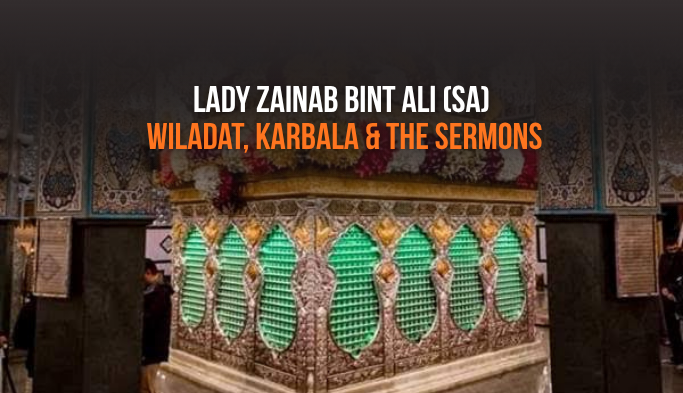
Lady Zainab (sa) passed away in Damascus and is buried there. Her shrine — the Sayyida Zainab Mosque in Damascus, Syria — is one of the most visited Shia sacred sites in the world. Pilgrims who reach it describe the experience of standing at her threshold as something that cannot be fully conveyed in the language used for ordinary sacred sites. She is present in that space in a way that her entire life — its courage, its losses, its refusal to be silenced — makes understandable.
Her birth anniversary on the 5th of Sha’ban is a day to remember what she represents: that Karbala was not only a martyrdom. It was a testimony, and the one who ensured that testimony reached the world was the daughter of Imam Ali (as) and Lady Fatima (sa), who stood over her nephew’s body to protect the future of the Imamate, and who looked the oppressor in the eye in his own court and told him the truth.
For those who wish to honour her memory by standing at the shrines of the family she spent her life protecting — the family buried in Iraq — our 2026–2027 Iraq Ziyarat Packages bring you to Karbala, where her brother is buried; to Najaf, where her father rests; and to Kadhimiya and Samarra, where the Imams who followed after her brother’s martyrdom are buried. The mission she completed in Damascus continues at every threshold where the Ahlul Bayt (as) are honoured.
Visit: www.ziaratplanner.com





 04-Jun-2026