Who Was Lady Fatima Masooma (sa)?
Every year on the 1st of Dhul Qa’dah, the lovers of the Ahlul Bayt (as) pause to remember a lady whose life was short, whose journey was painful, and whose legacy is eternal. Lady Fatima Masooma (sa) — daughter of the seventh Imam, sister of the eighth, and a scholar of her own right — did not live to old age, did not fight on a battlefield, and never held political authority. And yet her presence transformed a city, and her shrine became one of the greatest centers of Shia spirituality and learning in the world.
The Holy Quran declares:
إِنَّمَا يُرِيدُ اللَّهُ لِيُذْهِبَ عَنكُمُ الرِّجْسَ أَهْلَ الْبَيْتِ وَيُطَهِّرَكُمْ تَطْهِيرًا
Translation: “Indeed, Allah only desires to keep away all impurity from you, O People of the House, and to purify you with a thorough purification.” (Surah al-Ahzab, 33:33)
Lady Fatima Masooma (sa) was a shining member of this purified household. Her title Al-Masooma — the Pure and Innocent — was not given lightly. It reflected a life of unwavering faith, remarkable knowledge, and complete devotion to Allah and the Imam of her time.
Biography at a Glance
| Full Name: |
Fatima bint Musa ibn Ja’far (sa) |
| Titles: |
Al-Masooma (the Pure), Karimat Ahlul Bayt, Tahira, Sayyida-e-Qum |
| Father: |
Imam Musa al-Kazim (as), the seventh Imam |
| Mother: |
Lady Najma (sa), also the mother of Imam Ali al-Ridha (as) |
| Wiladat (Birth): |
1st Dhul Qa’dah, 173 AH — Madinah |
| Shahadat (Passing): |
10th Rabi’ al-Thani, 201 AH — Qum, Iran |
| Age at Passing: |
Approximately 28 years |
| Shrine: |
Qum, Iran |
Her Birth and Early Life
Lady Fatima Masooma (sa) was born on the 1st of Dhul Qa’dah, 173 AH, in the blessed city of Madinah, in the house of Imam Musa al-Kazim (as). (Muntaha al-Amaal, Shaykh Abbas Qumi; Bihar al-Anwar, Allama Majlisi)
She came into the world during one of the most difficult periods for the Ahlul Bayt (as). The Abbasid caliph Harun al-Rashid governed with fear and suspicion toward the Imams, whose spiritual authority and popular following he could not suppress. Her father, Imam Musa al-Kazim (as), known for his extraordinary patience and prolonged worship, spent years imprisoned by the Abbasids and was ultimately martyred in captivity. Despite these conditions, the household of the Imam remained a center of Quranic knowledge, Islamic manners, and quiet resistance to injustice.
Her mother, Lady Najma (sa) — also the mother of Imam Ali al-Ridha (as) — raised her children in deep piety, modesty, and love for the Ahlul Bayt (as). (Uyun Akhbar al-Ridha, Shaykh Saduq) Under this upbringing, Fatima Masooma (sa) grew into a woman of remarkable intelligence and religious learning. She was known in Madinah for her ability to answer complex religious questions and for embodying the qualities of Lady Fatima Zahra (sa) — her ancestor — in modesty, devotion, and simplicity.
After the martyrdom of her father, she remained deeply close to her brother, Imam Ali al-Ridha (as), who held her in the highest regard. The foundation of her early life — faith tested by oppression, knowledge pursued in the shadow of persecution — prepared her for the defining journey she would one day undertake.
Her Journey to Khurasan and Arrival in Qum
In 200 AH, the Abbasid caliph Ma’mun compelled Imam Ali al-Ridha (as) to leave Madinah and travel to Khurasan, intending to use his presence to legitimize his own rule. Separated from her brother — the Imam of her time — Lady Fatima Masooma (sa) could not remain in Madinah. The following year, she set out from Madinah with a group of companions to join him.
This journey was an act of devotion, loyalty, and courage. Shaykh Abbas Qumi writes in Muntaha al-Amaal that her departure was a public declaration of allegiance to the true Imam in the face of Abbasid manipulation. She was not fleeing. She was following.
Near the city of Saveh, her caravan was attacked by Abbasid soldiers. Many of her companions were killed. She fell gravely ill as a result of the violence and grief she endured. When she reached Qum, the noble family of Ash’ari — devout Shia Muslims — received her with honour and care. She lived among them for seventeen days before passing away on the 10th of Rabi’ al-Thani, 201 AH.
She never reached her brother. Yet her journey — and the city where it ended — became part of her eternal legacy.
Her Contributions to Islam
Lady Fatima Masooma (sa) contributed to Islam not through armies or political power, but through scholarship, loyalty, and sacrifice. Her influence has endured across more than twelve centuries.
During her years in Madinah, she was a transmitter of religious knowledge, answering questions about Islamic law and the teachings of the Ahlul Bayt (as). Imam Musa al-Kazim (as) himself praised her scholarly ability. (Bihar al-Anwar; Uyun Akhbar al-Ridha) In an era when the Imams were imprisoned or under surveillance, the women of the household carried knowledge forward.
Her journey to Khurasan was a form of public witnessing — declaring before the Shia community and the Abbasid court alike that the true Imam was Imam Ali al-Ridha (as), and that his family would not be silenced. This act of loyalty strengthened the resolve of Shia Muslims during one of the most oppressive periods in their history.
And through her burial in Qum, she gave that city an identity it carries to this day. Imam Ja’far al-Sadiq (as) is reported to have said, long before her birth, that a lady from his descendants named Fatima would be buried in Qum, and that whoever visited her would enter Paradise. (Bihar al-Anwar, Vol. 60) That prophecy was fulfilled. Qum became — and remains — the foremost center of Shia scholarship and spiritual learning in the world, in no small part because of her presence there.
Her Shrine and the Reward of Visiting Her
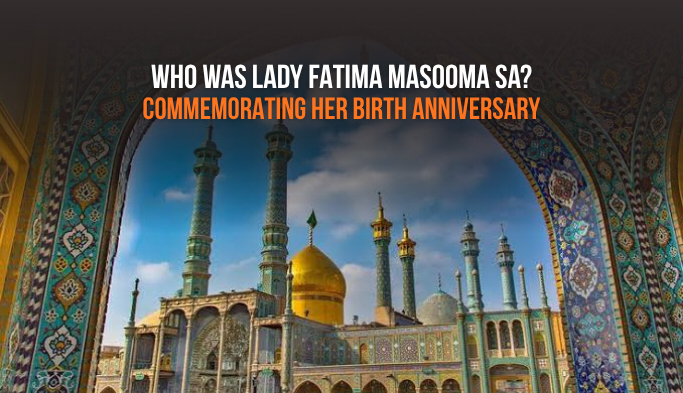
The shrine of Lady Fatima Masooma (sa) in Qum, Iran, is one of the most visited sites in the Shia world. Pilgrims travel from across the globe to offer their salutations and seek her intercession. The reward of this Ziyarat has been articulated by the Imams themselves.
Imam Ali al-Ridha (as) said:
“Whoever visits Fatima Masooma in Qum, it is as if he has visited me.” (Bihar al-Anwar, Vol. 102)
This statement — connecting the Ziyarat of a sister to the Ziyarat of an Imam — speaks to her spiritual rank. She is not merely honoured because of her lineage. She is honoured because of who she was: a woman of purity, courage, and complete devotion to the path of the Ahlul Bayt (as).
For those who cannot travel to Qum, remembering her on her birth anniversary — learning about her life, reciting salawat, and reflecting on the values she embodied — is itself a means of drawing closer to the Ahlul Bayt (as).
She was a role model for every believer: that faith is not measured by the scale of one’s actions, but by the sincerity with which they are offered. Her life was short. Her journey ended in illness and separation. And yet she is called Al-Masooma — the Pure — and her name is spoken with love in every corner of the world where Imam Hussain (as) is remembered.
To mark her birth anniversary by standing at the shrines of the Ahlul Bayt (as) in Iraq is one of the most beautiful ways to honour her memory. Our 2026 Iraq Ziyarat Packages bring you to Karbala, Najaf, Kadhimiya, and Samarra — to the household she served and the Imams she loved.
Visit: www.ziaratplanner.com





 04-Jun-2026