The 11th of Dhul Qa’dah: A Day Worth Pausing For
Dhul Qa’dah is one of the four sacred months of the Islamic calendar — a month in which the atmosphere itself carries an invitation to slow down, reflect, and draw closer to Allah. Within this month, the 11th of Dhul Qa’dah holds particular significance in Shia tradition. It is the birth anniversary of Imam Ali al-Ridha (as), the eighth Imam, and a day for which specific acts of worship have been transmitted through the Ahlul Bayt (as) and preserved by classical scholars including Sayyid Ibn Tawus in Iqbal al-A’mal and Shaykh Abbas Qumi in Mafatih al-Jinan.
These acts — known as the Amaal of the 11th Dhul Qa’dah — are not obligatory. They are gifts: opportunities offered to every believer, regardless of age, background, or level of knowledge, to seek forgiveness, renew faith, and ask Allah for what they need. This is a guide to observing them.
Preparing for the Day
Before beginning the Amaal, prepare both body and heart. Make a sincere intention (niyyah) for the sake of Allah alone. Perform Ghusl if able — washing the head and neck first, then the right side of the body, then the left, with the intention of the recommended Ghusl of the 11th of Dhul Qa’dah. This act of purification mirrors what the day itself invites: a spiritual fresh start, washing away what has accumulated and presenting yourself before Allah renewed. (Mafatih al-Jinan, Shaykh Abbas Qumi)
Wear clean clothes, choose a quiet place, and begin by sending salawat upon the Prophet (s) and his family — for salawat opens the doors of divine mercy and is itself the proper beginning of any act of worship.
The Recommended Amaal
Two-Rakaat Prayer
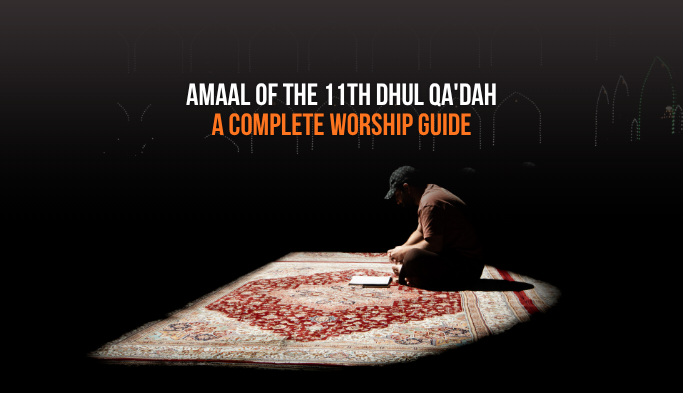
The central act of worship for this day is a two-unit prayer, performed in the manner of the morning (Fajr) prayer. In each rakaat, recite Surah al-Fatihah once, followed by Surah al-Ikhlas eleven times. After completing the prayer, send salawat upon the Prophet (s) and his family eleven times, then turn to Allah in supplication. (Iqbal al-A’mal, Sayyid Ibn Tawus; Mafatih al-Jinan, Shaykh Abbas Qumi)
After the prayer, the following supplication is recommended — asking Allah through the intercession of the Prophet (s) and his household:
“O Allah, I ask You by the right of Muhammad and the family of Muhammad: forgive my sins, accept my repentance, ease my difficulties, and fulfill my lawful needs. O Most Merciful of the merciful.”
After this, raise your hands and speak to Allah in your own words — your health, your family, your livelihood, whatever weighs on your heart. This is a moment of open conversation with Allah. He listens to every sincere heart.
Salawat
Sending salawat upon the Prophet (s) and the Ahlul Bayt (as) is strongly emphasized throughout this day. The tradition of the Ahlul Bayt (as) teaches that salawat brings peace to the heart, elevates spiritual rank, and draws a believer closer to the family of the Prophet (s). It is recommended to recite salawat at least one hundred times, though more is better. Let it accompany your other acts — before dua, after prayer, during moments of stillness. (Usul al-Kafi, Shaykh Kulayni, vol. 2)
Istighfar (Seeking Forgiveness)
The 11th of Dhul Qa’dah, falling in the sacred month, is an especially fitting time for sincere repentance. The recommended formula for istighfar on this day is:
أَسْتَغْفِرُ اللهَ رَبِّي وَأَتُوبُ إِلَيْهِ
Transliteration: “Astaghfirullaha Rabbi wa atubu ilayh” — “I seek the forgiveness of Allah, my Lord, and I turn to Him in repentance.”
Recite this at least one hundred times with genuine regret for past shortcomings and a firm intention to do better. Imam Ali (as) taught that sincere repentance opens the doors of divine mercy. (Nahj al-Balagha, Sermon 199) The number is less important than the sincerity — but the repetition itself helps focus the heart.
Recitation of the Holy Quran
Reciting the Quran on this day brings light to the heart and calm to the soul. Even a few verses read with reflection carry great reward in a sacred month. Classical sources recommend Surah al-Ikhlas, Surah al-Qadr, Surah al-Rahman, and Surah Yasin as particularly fitting on blessed days — but any recitation, offered sincerely, is a conversation with Allah. (Usul al-Kafi, vol. 2)
Charity (Sadaqah)
Giving charity on this day is highly encouraged. Imam Ja’far al-Sadiq (as) taught that sadaqah protects a person from calamities. (Al-Kafi, vol. 4) It need not be large — money to someone in need, food shared, a burden lifted from a neighbour’s shoulders. What matters is that it is given sincerely and in a spirit of gratitude for what Allah has provided. The earth was spread as a provision for all of creation; charity is a believer’s way of participating in that generosity.
Remembrance of the Ahlul Bayt (as)
Because this day is the birth anniversary of Imam Ali al-Ridha (as), it is especially fitting to spend time in his remembrance — reading about his life, reflecting on his teachings, reciting Ziyarat Jami’ah al-Kabirah if possible, and teaching younger family members about the Imams. The Hadith al-Thaqalayn, in which the Prophet (s) described the Quran and the Ahlul Bayt (as) as the two weighty things left for the Ummah, is a reminder that love and loyalty to them is not separate from worship — it is part of it.
Guarding Conduct
The sacred months carry a heightened call to moral awareness. The Quran explicitly warns that wrongdoing during the sacred months carries greater weight than at other times — and the converse is equally true: righteous conduct is amplified. Imam al-Baqir (as) taught that true worship is expressed in character as much as in prayer. (Al-Kafi, vol. 2) Guarding the tongue from backbiting, controlling anger, avoiding arguments, and treating others with justice and mercy are themselves acts of worship on this day.
An Invitation to Answer in Person
The Amaal of the 11th Dhul Qa’dah are acts that can be observed wherever you are — in your home, your mosque, your city. But for those whose hearts feel the pull of something more, there is the possibility of answering this sacred month with a journey: standing at the shrines of the Ahlul Bayt (as) in Iraq, in the cities where they are buried, and performing these same acts of worship — prayer, dua, Quran, salawat — in the presence of the Imams themselves.
Our 2026 Iraq Ziyarat Packages are open for those who feel that call. Karbala, Najaf, Kadhimiya, and Samarra are waiting.
Visit: www.ziaratplanner.com





 04-Jun-2026