Every Day of a Sacred Month Is Worth Something
The Islamic calendar marks some days with specific prayers, some nights with particular duas, and some dates with events that give them a name and a history. But within the sacred months — Muharram, Rajab, Dhul Qa’dah, and Dhul Hijjah — the tradition of the Ahlul Bayt (as) teaches something broader: that every day of these months carries a heightened spiritual weight, regardless of whether it has a named occasion.
The 19th of Dhul Qa’dah is one such day. No specific act of worship has been narrated for this date alone in the classical Shia devotional tradition. But the month it falls in is one that Allah has declared sacred — and the scholars who preserved our devotional literature, including Shaykh Abbas Qumi in Mafatih al-Jinan, understood this to mean that every day within it is an opportunity to fill with sincere worship and draw closer to Allah. The question is simply: how?
Why Dhul Qa’dah Elevates Every Act of Worship
Allah says in the Quran:
إِنَّ عِدَّةَ الشُّهُورِ عِندَ اللَّهِ اثْنَا عَشَرَ شَهْرًا فِي كِتَابِ اللَّهِ يَوْمَ خَلَقَ السَّمَاوَاتِ وَالْأَرْضَ مِنْهَا أَرْبَعَةٌ حُرُمٌ
Translation: “Indeed, the number of months with Allah is twelve months in the register of Allah, from the day He created the heavens and the earth; of these, four are sacred.” (Surah al-Tawbah, 9:36)
Dhul Qa’dah is one of those four. In Shia and Sunni scholarship alike, the sacred months carry a dual implication: sins committed within them weigh more heavily, and righteous deeds performed within them carry a greater reward. The logic is not mechanical — it is relational. A month that Allah has distinguished is one in which He is especially attentive to the turning of a servant’s heart. To perform even an ordinary act of worship in Dhul Qa’dah with sincerity is to take advantage of an open door.
This is the framework within which the 19th — and every other day of this month — should be approached.
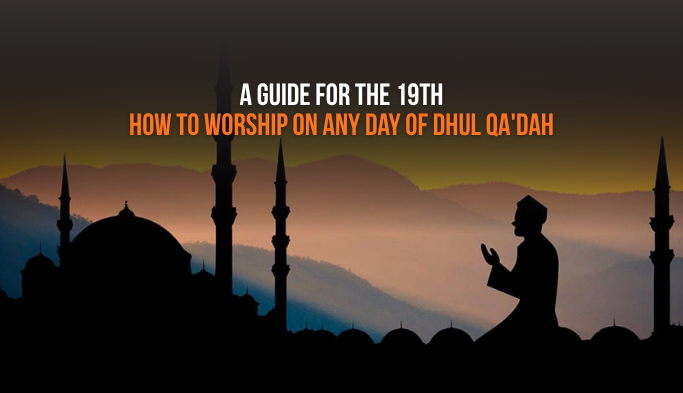
A Guide to Worship on Any Day of Dhul Qa’dah
The acts described below are not inventions. They are drawn from the general guidance of the Ahlul Bayt (as) as preserved in Mafatih al-Jinan, Iqbal al-A’mal, and the broader hadith tradition. They are recommended for any day of any sacred month, and on the 19th of Dhul Qa’dah — a day with no special obligations and therefore with the full freedom of voluntary devotion — they are as fitting as any amaal can be.
Begin with Intention and Ghusl
A sincere intention (niyyah) set at the start of the day — that you intend this day’s worship for the sake of Allah alone — multiplies the reward of everything that follows. If possible, begin with Ghusl, the ritual bath of purification that appears as a recommended act throughout the sacred months. It is a physical symbol of what the heart is attempting: a clean beginning.
Salawat
Sending blessings upon the Prophet (s) and his household is one of the most consistently emphasized acts in the devotional tradition of the Ahlul Bayt (as) — on ordinary days, on special days, and especially during the sacred months. It purifies the heart, strengthens love for those who carried the Prophet’s message, and is itself a form of proximity to Allah. Reciting it abundantly throughout the day, in any form, is among the simplest and most rewarding acts a believer can perform.
Istighfar
Seeking forgiveness is an act that the Quran, the Prophet (s), and the Imams (as) return to again and again — not as a sign of despair, but as a sign of awareness. A believer who knows what they carry and turns toward Allah with it is already on the path. The formula:
أَسْتَغْفِرُ اللهَ رَبِّي وَأَتُوبُ إِلَيْهِ
Transliteration: “Astaghfirullaha Rabbi wa atubu ilayh” — “I seek the forgiveness of Allah, my Lord, and I turn to Him in repentance.”
Reciting this one hundred times — or as many times as sincerity permits — is recommended throughout the sacred months. Imam Ali (as) taught that sincere repentance opens the doors of divine mercy. (Nahj al-Balagha, Sermon 199)
Quran Recitation
Even a few verses, read with reflection and presence, carry great weight in a sacred month. The Quran is not a text to be rushed through — it is a conversation with Allah. Reading it slowly, pausing to consider what is being said, and returning to it throughout the day is itself a form of dhikr. Classical sources recommend Surah al-Ikhlas, Surah al-Qadr, Surah al-Rahman, and Surah Yasin as particularly fitting on blessed days.
Voluntary Fasting
Voluntary fasting in the sacred months is a Sunnah that carries its own reward, independent of the month of Ramadan. The 13th, 14th, and 15th of any month — the white days — are especially recommended. If fasting was not observed earlier in the month, the 19th remains a valid and worthy day to fast with the intention of drawing closer to Allah in Dhul Qa’dah.
Dhikr
The continuous remembrance of Allah — SubhanAllah, Alhamdulillah, Allahu Akbar, La ilaha illa Allah — requires nothing but presence of heart. It can accompany any task: work, travel, household responsibilities. The Quran describes the people of understanding as those who remember Allah standing, sitting, and lying on their sides (Surah Aal Imran, 3:191). A sacred month invites the believer to carry that remembrance more consistently than usual.
Sadaqah
Giving in charity on a day within a sacred month is an act magnified by its timing. Imam Ja’far al-Sadiq (as) taught that charity protects a person from calamities. (Al-Kafi, vol. 4) This does not require a large sum — it requires sincerity and the intention to share from what Allah has provided.
Supplication for Personal Needs
The months that Allah has distinguished are the months in which turning to Him for what we need carries the fullest expectation of response. After the Fajr prayer, between Dhuhr and Asr, and in the quiet of the night before sleep — these are the times the tradition identifies as particularly receptive for personal dua. Raise your hands and ask. Speak plainly about what you carry. Allah hears every sincere heart.
The Day Is What You Make It
The 19th of Dhul Qa’dah has no named occasion, no required amaal, and no single prayer that defines it. That is not a limitation — it is an invitation. A day with no specific obligations is a day entirely at your disposal for voluntary devotion. The Ahlul Bayt (as) taught us that the believer who fills such days with sincerity, humility, and intention will find that Allah meets that effort with mercy in proportion to it.
Fill this day with what you can carry sincerely. That is enough.
For those who feel drawn to observe the sacred months in the fullest way possible — standing at the shrines of the Ahlul Bayt (as), performing these acts of worship at the sites where they are buried — our 2026 Iraq Ziyarat Packages bring you to Karbala, Najaf, Kadhimiya, and Samarra. No day of Dhul Qa’dah is wasted at those thresholds.
Visit: www.ziaratplanner.com





 04-Jun-2026