The Night of Desires: When It Falls and What It Means
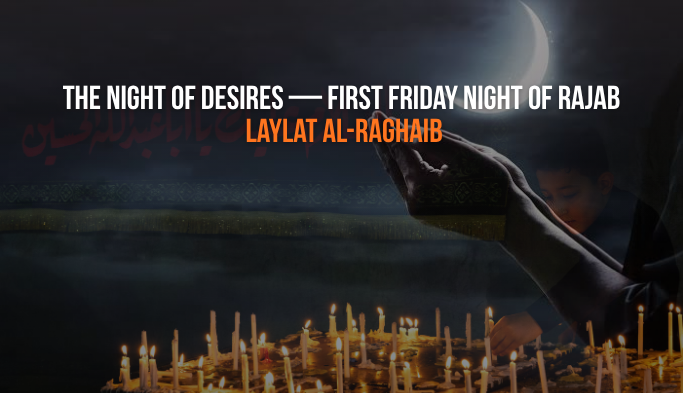
Laylat al-Raghaib — the Night of Desires — is observed on the eve of the first Friday of Rajab: the night between Thursday and Friday in the month’s opening week. The word raghaib comes from the Arabic root raghbah, meaning heartfelt desires, sincere longings, and deep hopes. It is the night when those desires are brought before Allah with the expectation that He hears them — because the month is sacred, the night is a Friday, and the believer has prepared through the fast of Thursday.
This night is not the same as the first night of Rajab. It falls on the first Friday night of the month, which may be the 1st, 2nd, or 3rd of Rajab depending on the year. Its observance is rooted in the classical Shia devotional tradition, preserved in Mafatih al-Jinan (Shaykh Abbas Qumi) and Iqbal al-A’mal (Sayyid Ibn Tawus) — scholars who compiled what was transmitted from the Ahlul Bayt (as) for the benefit of believers.
Some scholars have noted discussion around the specific hadith chain for this night’s prayer — this discussion exists primarily within the broader debates of hadith authentication and does not diminish the value of worship on this night, nor the fact that these amaal are transmitted in the classical Shia devotional manuals and have been practiced by generations of believers.
Preparation: Fasting on Thursday
The recommended preparation for Laylat al-Raghaib begins before sunset on Thursday — the day before. Fasting on the first Thursday of Rajab is itself a specifically recommended act, and it functions as the physical and spiritual preparation for the night that follows. It is not required in order to observe the night’s prayer, but the tradition pairs them deliberately: the hunger and awareness of the fast carry into the night’s worship, making the heart more present and the dua more sincere. (Mafatih al-Jinan, Shaykh Abbas Qumi)
Intend the fast before Fajr on Thursday: Qurbatan ilAllah — for the sake of Allah alone, for the first Thursday of Rajab.
The Prayer of Laylat al-Raghaib
The central act of Laylat al-Raghaib, transmitted in Mafatih al-Jinan and Iqbal al-A’mal, is a twelve-unit prayer performed between Maghrib and Isha — or, for those who prefer, after Isha. It is prayed in six sets of two rak’aat.
In each rak’at:
After Surah al-Fatiha, recite Surah al-Qadr (Surah 97: Inna anzalnahu fi laylat al-qadr) three times, followed by Surah al-Ikhlas (Surah 112: Qul huwa Allahu Ahad) twelve times. Perform this in each of the twelve units, without haste. The combination of al-Qadr — the surah of divine descent and the Night of Power — and al-Ikhlas — the surah of pure monotheism — is not incidental. Together they frame the night’s theology: Allah descends in mercy toward those who affirm His oneness. (Mafatih al-Jinan, Shaykh Abbas Qumi; Iqbal al-A’mal, Sayyid Ibn Tawus)
After completing all twelve rak’aat:
Recite a specific supplication for this night, which is preserved in Mafatih al-Jinan in the section on Laylat al-Raghaib. It asks Allah for mercy, forgiveness, and acceptance of the night’s worship. Then perform a prostration — sajdah — and address Allah in your own words. These moments of prostration, when the forehead is on the ground and the tongue speaks directly to the Creator, are among the most powerful available to a believer.
The Rest of the Night: Salawat, Dua, and Quran
After the prayer, the remainder of the night belongs to the wider devotional acts of Rajab: sending salawat upon the Prophet (s) and his household abundantly, reciting istighfar, engaging with the Quran, and making personal dua. This night, falling within the sacred month and on the most blessed day of the week, is one of the four nights described in classical sources as among the most elevated for worship in the entire year.
The name of the night says everything about what it asks of a believer. Raghaib — desires. What do you desire, deeply and honestly? What do you carry that you have not yet brought before Allah? This night is the occasion to bring it. Not with perfect words and composed sentences, but with whatever truth the heart contains when the world grows quiet and the prayer rug is on the floor.
The Prophet (s) taught believers to ask Allah for the gift of reaching Ramadan:
اللَّهُمَّ بَارِكْ لَنَا فِي رَجَبٍ وَشَعْبَانَ وَبَلِّغْنَا رَمَضَانَ
“O Allah, bless us in Rajab and Sha’ban, and deliver us to Ramadan.” (Bihar al-Anwar, Allama Majlisi)
Laylat al-Raghaib — falling in the first week of Rajab — is among the most fitting times to make this dua. The journey to Ramadan is long enough to need three months of preparation. This night is where many begin.
The Stairway: Rajab, Sha’ban, and Ramadan
The tradition consistently describes these three consecutive months as a single spiritual arc. Rajab is the month of repentance and turning — the planting of seeds. Sha’ban deepens the connection to the Prophet (s) through salawat and preparation. Ramadan is the harvest: the month of fasting, Quran, and divine closeness that the preceding months made possible.
Laylat al-Raghaib, on the first Friday night of Rajab, is the ideal opening of that journey. A night of specific, structured worship followed by sincere personal dua — offered in a sacred month, on the most blessed night of the week, after a day of fasting — is one of the strongest starting positions the Islamic calendar offers to a believer who wishes to arrive at Ramadan better than they left it.
For those who wish to observe Laylat al-Raghaib — and the rest of Rajab — at the shrines of the Ahlul Bayt (as) in Iraq, our 2026–2027 Iraq Ziyarat Packages include departures throughout Rajab. Karbala, Najaf, Kadhimiya, and Samarra are waiting for those who want to begin the three-month journey in the best possible place.
Visit: www.ziaratplanner.com






 06-Jun-2026