Three Days That Lead to One Night
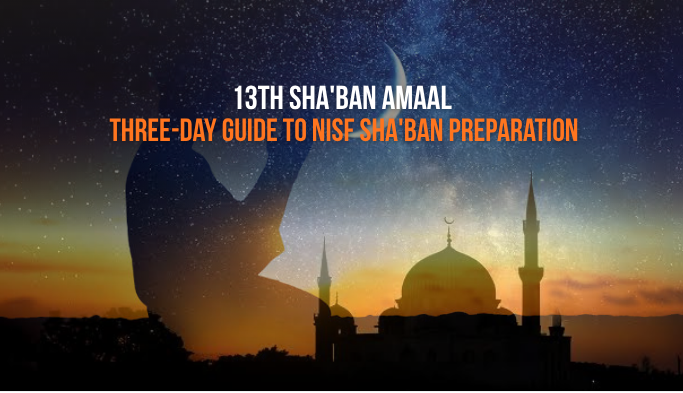
The 15th of Sha’ban — Nisf Sha’ban, the night of the mid-month — is one of the most significant nights in the Shia calendar. It is the night of Imam al-Mahdi’s (atfs) birth, a night of abundant divine mercy, and one of the four most elevated nights of the year for worship and supplication. The 13th of Sha’ban is where the preparation for it begins.
The 13th, 14th, and 15th of any lunar month are known as the Ayyam al-Beed — the Bright Days — named for the full or near-full moon that illuminates their nights. Fasting on these three days is recommended throughout the year and carries additional weight in Sha’ban, the Month of the Prophet (s). By beginning the three-day fast on the 13th, a believer arrives at the 15th night having already spent two days in a state of voluntary worship, physical discipline, and spiritual attention.
The 13th is not merely a prelude. It is the first step of a three-day ascent — and how that ascent begins determines how fully the 15th night can be received.
The Month It Falls In
Sha’ban is the eighth month of the Islamic calendar — the month immediately before Ramadan, and the month the Prophet (s) described as his own. It is reported that he would fast extensively throughout Sha’ban, increase his night prayers, and devote himself to worship in preparation for the full arrival of Ramadan. (Iqbal al-A’mal, Sayyid Ibn Tawus)
The tradition of the Ahlul Bayt (as) consistently describes Rajab, Sha’ban, and Ramadan as a single three-month spiritual arc: Rajab for repentance, Sha’ban for deepening devotion, and Ramadan for the harvest of both. A believer who has used Rajab for istighfar and enters Sha’ban with a softened heart is better placed to use Sha’ban’s gifts than one who arrives empty-handed. The 13th of Sha’ban is one of the clearest opportunities the month offers to begin that deepening.
Amaal of the 13th Sha’ban
Fasting
Fasting on the 13th of Sha’ban — and, if possible, continuing through the 14th and 15th — is the most emphasized act of these days. Fasting in Sha’ban is described as an expression of love for the Prophet (s) and a means of earning Allah’s mercy in preparation for Ramadan. Make the intention before Fajr: this fast is for the sake of Allah alone, for the 13th of Sha’ban, in the month of His Prophet. Even a single day’s fast carries the reward of the sacred month. (Iqbal al-A’mal; Mafatih al-Jinan, Shaykh Abbas Qumi)
Tawbah and Istighfar
Repentance is the appropriate opening act of any day that aspires toward closeness to Allah — and especially in a month consecrated to the Prophet (s), who was himself sent as a mercy and a guide back to what was lost. Begin the day with sincere tawbah: sitting quietly after Fajr, reflecting on what stands between you and Allah, and addressing it honestly. Then recite the following 70 times or more, with genuine attention to what you are saying:
أَسْتَغْفِرُ اللهَ وَأَتُوبُ إِلَيْهِ
Transliteration: “Astaghfirullaha wa atubu ilayh” — “I seek Allah’s forgiveness and I turn repentantly to Him.”
Salawat
Sha’ban is the month most associated with salawat upon the Prophet (s) and his household. The devotional tradition describes increasing salawat throughout Sha’ban as one of the central acts of the month — drawing the believer into the spirit of a month named for the one the salawat honours. Send salawat abundantly: after each prayer, in the moments between tasks, before sleep. Let it become the rhythm of the month.
اللَّهُمَّ صَلِّ عَلَى مُحَمَّدٍ وَآلِ مُحَمَّدٍ
“O Allah, send blessings upon Muhammad and the family of Muhammad.”
Munajat Sha’baniyah
Among all the supplications of the Islamic year, Munajat Sha’baniyah — the Whispered Prayer of Sha’ban — holds a singular place. It is transmitted from Imam Ali ibn Hussain Zayn al-Abidin (as), who said that all of the Ahlul Bayt (as) recited it in Sha’ban. It is not a dua in the ordinary sense of a list of requests. It is a conversation: the creature before the Creator, speaking with complete honesty about what it means to be small before something infinite, to have sinned and still be loved, to want nearness and not know how to reach it.
Recite Munajat Sha’baniyah at night — in a quiet moment, with the lights low and the world outside. Read it with the meanings in view. The full Arabic text is in Mafatih al-Jinan under the Amaal of Sha’ban. Those who have read it carefully describe it as one of the most spiritually penetrating texts in the Islamic devotional tradition. Beginning it on the 13th, and returning to it on the 14th and 15th, gives it the time it deserves. (Iqbal al-A’mal, Sayyid Ibn Tawus; Mafatih al-Jinan)
Quran
Reciting the Quran throughout Sha’ban — even a few verses read slowly, with reflection and with awareness of who authored them — aligns the heart with the same source that gave the month its meaning. Surah Yasin, Surah al-Waqi’ah, and Surah al-Rahman are particularly mentioned in the classical literature for nights and days of elevated worship. Read with presence rather than speed.
Night Prayer
After Isha on the night of the 13th, spend time in voluntary prayer. Even two additional rak’aat offered with full attention — Surah al-Fatiha recited as though for the first time, the words landed rather than performed — carry the weight of a sacred month. These nights leading toward the 15th are a preparation: each night of worship on the 13th and 14th is a layer placed beneath the 15th’s arrival, so that when it comes the heart is not starting from nothing.
Ziyarat and Charity
Reciting Ziyarat of Imam Hussain (as) or Ziyarat Jami’ah on this night connects the worship of the month to the household it honours. And giving charity — even a small amount offered with the clear intention of Sha’ban and the acknowledgment that Allah provided what is now being shared — carries the narrated reward of purification and increased blessing. Imam Ja’far al-Sadiq (as) described charity and istighfar as among the best deeds of Sha’ban. (Iqbal al-A’mal; Mafatih al-Jinan)
What the 13th Builds Toward
By Maghrib on the 13th, if the day has been used well — fast observed, istighfar recited, salawat sent, Munajat read, Quran touched, night prayer offered — the heart has been in a state of worship for an entire day. The 14th continues it. The 15th receives it. The night of Nisf Sha’ban does not descend on a heart that has done nothing to prepare for it and leave that heart transformed. It descends on a heart that has been opening for days, and it finds what it was looking for.
For those who wish to observe these three days — and the 15th night that follows — at the shrines of the Ahlul Bayt (as) in Iraq, our 2026–2027 Iraq Ziyarat Packages include Sha’ban departures. Karbala, Najaf, Kadhimiya, and Samarra welcome those who arrive in the Month of the Prophet (s) seeking proximity to his family.
Visit: www.ziaratplanner.com






 06-Jun-2026