Raised as the Trust of an Imam
His father died when he was three years old. His uncle took him in and raised him as his own. When the moment came that his father had written about — and had foreseen so clearly that he had prepared a letter for it — the boy who had grown up in that uncle’s household did not hesitate. He smiled when he read the letter, went to his uncle, and said: “O my uncle, death in the way of Allah is sweeter to me than honey.”
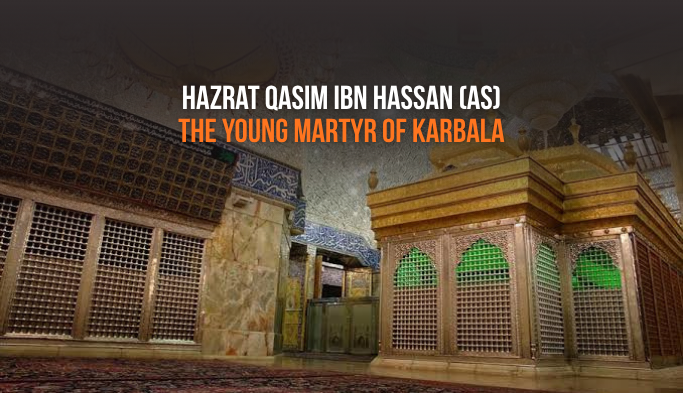
Qasim ibn Hassan ibn Ali (as) — the son of Imam Hasan al-Mujtaba (as), the nephew raised by Imam Hussain (as), the thirteen-year-old martyr of Karbala — was not simply a young person who happened to be present on the Day of Ashura. He was the son of the second Imam, raised in the household of the third, carrying a letter his father had written before his own martyrdom, addressed to a day he would not live to see.
Biography at a Glance
| Full Name: |
Qasim ibn Hassan ibn Ali ibn Abi Talib (as) |
| Father: |
Imam Hasan al-Mujtaba (as), the second Imam |
| Mother: |
Lady Umm al-Farwa (sa) |
| Notable uncles: |
Imam Hussain ibn Ali (as); Hazrat Abbas ibn Ali (as) |
| Birth: |
~47 AH — Madinah |
| Martyrdom: |
10th Muharram, 61 AH — Karbala, Iraq (Day of Ashura) |
| Age at Karbala: |
Approximately 13–14 years |
An Orphan Under the Care of His Uncle
Qasim ibn Hassan (as) lost his father when he was approximately three years old. After the martyrdom of Imam Hasan al-Mujtaba (as), the young Qasim became what the tradition calls the amanah — the trust — of Imam Hussain (as). The third Imam raised his brother’s son with the same care and attention he gave to his own children, ensuring that the boy who had been left fatherless grew up in a household defined by the Quran, by worship, and by the clarity of purpose that characterized every member of that family.
What this upbringing produced in Qasim (as) was visible to everyone who knew him. He bore a striking resemblance to his father Imam Hasan (as) — in appearance, in his manner of speaking, and in his patience. He was educated directly by Imam Hussain (as) in Quran and theology. In the art of combat, he was trained by his uncle Hazrat Abbas ibn Ali (as), who had recognized in the boy both the capacity and the spirit for what the family would eventually face. By the time Karbala arrived, Qasim ibn Hassan (as) was, by every account, far beyond his years — not in size but in understanding of what he was about to do and why.
The Letter His Father Left Behind
When Imam Hussain (as) departed Madinah in Rajab of 60 AH, Lady Umm al-Farwa (sa) requested that she and her son Qasim join the caravan. They traveled the road to Karbala together — mother, son, uncle, and the rest of the household that would become the most remembered gathering in Islamic history.
On the Day of Ashura, when the companions and family members had begun to fall one by one, Qasim ibn Hassan (as) came to his uncle and asked permission to fight. Imam Hussain (as) refused — twice. His reason was plain: Qasim was young, and his mother’s only son. The Imam could not give that permission easily.
Qasim went to his mother. Umm al-Farwa reached into her possessions and brought out a letter that Imam Hasan (as) had given her before his death, with the instruction: if Qasim ever finds himself in difficulty, give him this. In the letter, Imam Hasan (as) had written to his son:
“My son Qasim, a day will come when my brother Hussain will be facing an enemy army of tens of thousands. That will be the day when Islam will need to be saved by sacrifice. You must represent me on that day.”
Qasim read the letter and smiled. He took it to Imam Hussain (as). The Imam read it, tied the turban of Imam Hasan (as) on his nephew’s head, helped him mount his horse, and said what could be said when a father’s written instruction is placed before you: “How can I stop you from doing what your father wanted you to do?” (Maqtal al-Hussain, narrated in classical Karbala literature)
The Battle and the Final Salaam
The accounts of Qasim ibn Hassan’s (as) fight at Karbala describe a young man who fought with a skill and composure that silenced the enemy. When he rode onto the battlefield, those who saw him reportedly murmured: how do we kill someone whose face shines like the moon? He announced himself, called for single combat, and killed multiple warriors who accepted the challenge.
What the classical accounts note — and what has become one of the most tender details of the entire Karbala narrative — is that after each warrior fell, Qasim ibn Hassan (as) would stand in his stirrups, look back toward the camp, and wave to his uncle Hazrat Abbas (as), the way a student signals to a teacher at the completion of an assignment. And Abbas (as) would wave back.
The end came when the enemy, unable to overpower him in single combat, surrounded him from behind. He was struck from behind, fell from his horse, and called out to his uncle: “O uncle, accept my last salaam.”
Imam Hussain (as) and Hazrat Abbas (as) rode out to reach him. When they arrived, the enemy cavalry had already ridden over him. What the Imam found, the narrations describe with words that have no adequate equivalent: he spread his own cloak on the ground and gathered his nephew’s remains from the sand, piece by piece, as one gathers fallen flowers from a garden.
He carried what he gathered back to the camp, calling out for Lady Zainab (sa). “My heart is broken, Zainab. I have no strength left.”
What Qasim ibn Hassan (as) Teaches
The theology of Karbala is often described through the decisions made there: Imam Hussain (as) refusing bay’ah, the companions choosing to stay rather than leave. Qasim ibn Hassan (as) adds another dimension — the transmission of purpose across generations. His father could not be at Karbala. He had died years before the day arrived. But he had understood, from within the chain of Imamate he belonged to, that the day would come — and he had prepared his son for it in writing, in trust, in a letter carried across years of grief until the moment it was needed.
When Qasim (as) said that death in the way of Allah was sweeter than honey, he was not performing bravery. He was stating, at thirteen years old, a theology his father had taught him before he was old enough to understand it — and that his uncle Imam Hussain (as) had embodied in front of him for every year of his conscious memory. He went to Karbala knowing what it was. The smile when he read his father’s letter was the smile of a person who had just been told that the day they had prepared for had finally arrived.
Sha’ban — the month in which his uncle Imam Hussain (as) was born, and in which the journey toward Karbala began — is an appropriate time to remember him. The household the month celebrates produced him. The road out of Madinah he walked on the 28th of Rajab ended where he ended. For those who wish to stand at the ground of Karbala where his blood was spilled and where the flowers his uncle gathered are buried — our 2026–2027 Iraq Ziyarat Packages bring you there.
Visit: www.ziaratplanner.com





 06-Jun-2026