The Final Hours of the Month of Allah
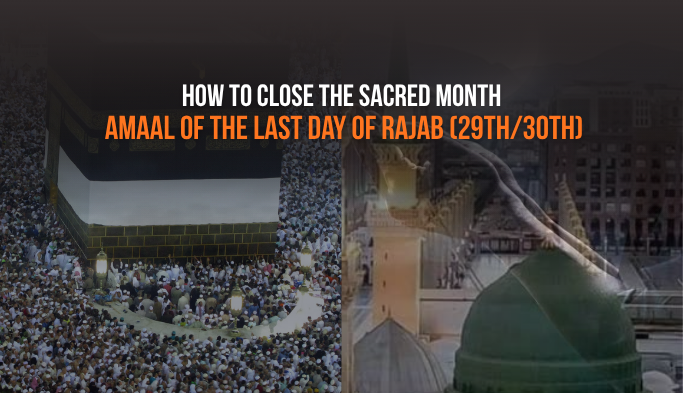
The last day of Rajab — whether it falls on the 29th or 30th depending on the moon sighting — is a threshold. Behind you is the Month of Allah, with everything it offered: its sacred days, its mourning and celebration, its concentrated window for repentance and worship. Ahead of you is Sha’ban — the Month of the Prophet (s), the month of salawat and preparation, the second step on the stairway that leads to Ramadan.
How you close Rajab shapes what you carry into Sha’ban. The classical devotional tradition, preserved in Mafatih al-Jinan and Iqbal al-A’mal, offers specific acts for this final day — acts that function as a seal on the month’s record of worship. This is how to use them.
The 28th of Rajab — just before these final days — is the anniversary of Imam Hussain’s (as) departure from Madinah. That context is not incidental. The worship of these final days of the month is performed in the shadow of the journey that began two days earlier. Let it not be entirely forgotten as you mark the month’s close.
The Amaal of the Final Day
Ghusl
Begin the last day of Rajab with Ghusl — the same ritual purification that opens many of the month’s significant days. The intention is specific: this Ghusl is for the last day of Rajab, for the sake of Allah alone (Qurbatan ilAllah). It is a physical marking of the transition: washing away the spiritual weight that has accumulated and presenting yourself, as clean as you can be, for the final hours of this sacred month.
Fasting: Three Protections
Fasting on the final day of Rajab carries a narrated reward that is among the most specific in the month’s devotional literature. Imam Ja’far al-Sadiq (as) is reported to have said that this fast protects the believer from three particular hardships: it eases the agony of the departure of the soul at death; it protects against the constriction of the grave; and it provides security from the terror of the Day of Judgment. (Mafatih al-Jinan, Shaykh Abbas Qumi)
Fasting also on the 28th and 29th — the three final days — adds the narrated reward of safety from all hardships of the Day of Judgment.
For Those Unable to Fast: The Glorification
If fasting is not possible on this day, a specific glorification has been transmitted as an alternative, to be recited 100 times:
سُبْحَانَ الْإِلَهِ الْجَلِيلِ سُبْحَانَ مَنْ لَا يَنْبَغِي التَّسْبِيحُ إِلَّا لَهُ سُبْحَانَ الْأَعَزِّ الْأَكْرَمِ سُبْحَانَ مَنْ لَبِسَ الْعِزَّ وَهُوَ لَهُ أَهْلٌ
Translation: “Glory be to the Majestic God. Glory be to the One whom alone deserves glorification. Glory be to the Most Mighty, the Most Generous. Glory be to the One who has clothed Himself in honour — for He alone is worthy of it.”
(Mafatih al-Jinan, Shaykh Abbas Qumi)
The Prayer of Salman al-Farsi: The Final 10 Units
One of the most notable prayers of the entire month of Rajab is a 30-unit prayer transmitted from the Prophet (s) to Salman al-Farsi (ra), designed to be distributed across the month. The final 10 units are performed on the last day, in five sets of two rak’aat.
In each rakaat, recite Surah al-Fatiha once, Surah al-Ikhlas three times, and Surah al-Kafirun three times. After completing all 10 units, raise your hands and make sincere dua — for your lawful needs, for forgiveness, for those you love. The full post-prayer supplication is in Mafatih al-Jinan under the Rajab Amaal. This prayer carries the narrated reward of forgiveness for sins committed throughout the month. (Mafatih al-Jinan, Shaykh Abbas Qumi)
The Seal of Istighfar
Closing the month with istighfar is both practically and symbolically fitting. Everything the month offered in terms of forgiveness, mercy, and divine generosity is accessed through the act of turning toward Allah honestly — naming what you carry, releasing it, and resolving to return. Recite the following 100 times:
أَسْتَغْفِرُ اللهَ وَأَتُوبُ إِلَيْهِ
Transliteration: “Astaghfirullaha wa atubu ilayh” — “I seek Allah’s forgiveness and I turn repentantly to Him.”
Surah al-Ikhlas: 100 Times
Reciting Surah al-Ikhlas 100 times on the last day of Rajab carries the narrated reward of being considered as one who has fasted 100 years in the way of Allah. One narration adds that Allah will designate 100 palaces in Paradise in the company of one of the Prophets. (Mafatih al-Jinan) It is a remarkably compact act for a remarkably large promised reward — which is itself a description of the kind of generosity the sacred month embodies.
What Fridays in Rajab Add
If the last day of Rajab falls on a Friday, an additional narration applies: reciting Surah al-Ikhlas 100 times on any Friday in Rajab is reported to bring a guiding light on the Day of Judgment that illuminates the path to Paradise. (Mafatih al-Jinan) The combination of Friday and the month’s final day, if they coincide, makes the day doubly weighted.
From the Month of Allah into the Month of His Prophet
At Maghrib on this final day, Rajab formally ends. The river in Paradise that is whiter than milk and sweeter than honey — the river Imam al-Kazim (as) described as the reward of even a single day’s fast — has flowed through this month and is now receding. Sha’ban begins: the month dedicated to the Prophet (s) and his household, the month in which salawat are multiplied and preparation for Ramadan deepens.
The believer who closes Rajab with fasting, prayer, istighfar, and conscious worship does not enter Sha’ban from a standstill. They carry the momentum of thirty days of sacred-month devotion into a month that asks them to deepen it further. That continuity is what the three-month stairway — Rajab, Sha’ban, Ramadan — is designed to produce.
For those who wish to spend the final days of Rajab, or the beginning of Sha’ban, at the shrines of the Ahlul Bayt (as) in Iraq — completing the month’s worship at the thresholds of the Imams who taught us how to use it — our 2026–2027 Iraq Ziyarat Packages are open. Karbala, Najaf, Kadhimiya, and Samarra are waiting.
Visit: www.ziaratplanner.com





 04-Jun-2026