The First Step of Three
There is a narration attributed to the Prophet Muhammad (s) that frames three consecutive months as a single spiritual journey: “Rajab is the month of Allah, Sha’ban is my month, and Ramadan is the month of my community.” Whether or not this specific phrasing is authenticated to the level of the highest hadith standards, the tradition of the Ahlul Bayt (as) consistently treats these three months as a progression — a preparation, a deepening, and an arrival. Rajab is where it begins.
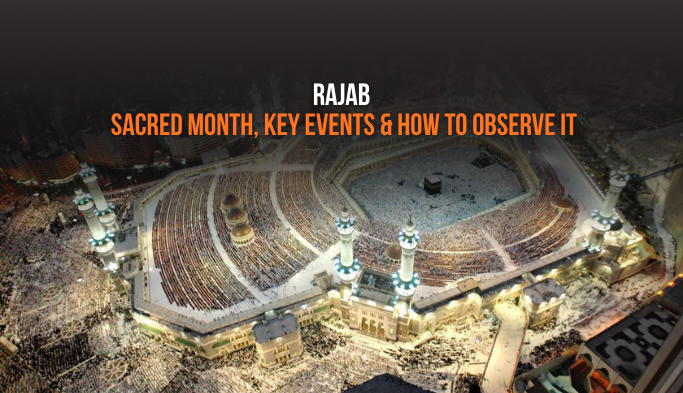
Rajab is the seventh month of the Islamic lunar calendar and one of the four sacred months that Allah distinguished in the Quran. It falls between Jumada al-Thani and Sha’ban. For the lovers of the Ahlul Bayt (as), it is not merely a season of general worship — it is a month filled with specific history, specific grief, specific celebration, and specific acts that the Imams taught and practiced. Entering it with knowledge of what it contains is itself a form of devotion.
In the Islamic year 1448 AH, Rajab is expected to fall approximately in late January to late February 2027, pending moon sighting confirmation.
The Character of Rajab
Classical Shia scholarship consistently describes Rajab as the month of istighfar — of seeking forgiveness. Before Sha’ban’s deeper devotion and Ramadan’s fasting, Rajab asks the believer to first address what stands between them and Allah: the accumulated weight of sins, the distance that neglect creates, the habits that need to change before they can be transformed. A heart that arrives at Ramadan already cleaned of its heaviest burdens receives Ramadan differently than one that begins that cleansing only in the last ten nights.
This is the purpose of Rajab. It is not a month of obligation — its fasts are voluntary, its prayers are recommended rather than required. Its invitation is precisely in that voluntariness: no one is forcing you to use it. The one who chooses to is already choosing something.
The acts emphasized throughout Rajab reflect this character: abundant istighfar, voluntary fasting, salawat upon the Prophet (s) and his household, recitation of the Quran, and charity. All of these are acts that soften the heart rather than merely discipline the body — which is exactly what the months ahead will require.
Key Events and Dates in Rajab
Rajab contains more commemorated dates from the lives of the Ahlul Bayt (as) than almost any other month. Each one is an invitation to learn, to grieve, to celebrate, and to deepen one’s connection to the Imams whose guidance the month itself is preparing us to receive more fully.
1st Rajab — Wiladat of Imam Muhammad al-Baqir (as)
The fifth Imam, Muhammad ibn Ali al-Baqir (as), was born on the 1st of Rajab, 57 AH, in Madinah. His title al-Baqir — meaning “the one who splits knowledge open” — reflects his extraordinary contribution to Islamic scholarship. He systematized the transmission of religious knowledge from the Ahlul Bayt (as) and trained the scholars who would carry it forward, including his son Imam Ja’far al-Sadiq (as). His birth anniversary opens the month with remembrance of one of its greatest scholars.
2nd Rajab — Wiladat of Imam Ali al-Hadi (as)
The tenth Imam, Ali ibn Muhammad al-Hadi (as), was born on the 2nd of Rajab, 212 AH, in Madinah. He spent decades under effective house arrest in Samarra, where the Abbasid caliph kept him under constant surveillance. Yet from that confinement he guided the Shia community through letters and trusted intermediaries, and he laid the foundation for the Ghaybah (occultation) that would follow his son’s Imamate. His shrine in Samarra, shared with his son Imam Hasan al-Askari (as), is among the most sacred sites in Iraq.
3rd Rajab — Shahadat of Imam Ali al-Hadi (as)
Imam Ali al-Hadi (as) was martyred on the 3rd of Rajab, 254 AH, in Samarra — poisoned, as was the pattern for so many of the Imams, by the Abbasid authorities who feared his influence. He was forty-one years old. Within the opening three days of Rajab, the month contains both the birth and the martyrdom of the tenth Imam — a grief and a celebration held almost within sight of each other.
10th Rajab — Wiladat of Imam Muhammad al-Jawad (as)
The ninth Imam, Muhammad ibn Ali al-Jawad (as), was born on the 10th of Rajab, 195 AH, in Madinah. As discussed in our Dhul Qa’dah series, he assumed the Imamate at approximately eight years of age and was martyred at twenty-five — yet in those years he defended the authentic teachings of Islam against intellectual and political corruption with a wisdom that astonished all who encountered him. His shrine in Kadhimiya, Baghdad, shared with his grandfather Imam Musa al-Kazim (as), draws pilgrims from across the world throughout Rajab.
13th Rajab — Wiladat of Imam Ali ibn Abi Talib (as)
The first Imam, Ali ibn Abi Talib (as), was born on the 13th of Rajab inside the Ka’bah itself — an honour unique in Islamic history and a mark, according to Shia narrations, of the singular station he held. His life is the standard against which Islamic justice, courage, knowledge, and devotion are measured. His shrine in Najaf, Iraq, is one of the most visited sacred sites on earth. His Wiladat on the 13th transforms the middle of Rajab into one of the greatest days of the Shia calendar year.
25th Rajab — Shahadat of Imam Musa al-Kazim (as)
The seventh Imam, Musa ibn Ja’far al-Kazim (as), was martyred on the 25th of Rajab, 183 AH, in a Baghdad prison after years of imprisonment under the Abbasid caliph Harun al-Rashid. He died in captivity, having endured what the tradition describes as extraordinary patience — his title al-Kazim meaning “the one who suppresses anger.” He is buried in Kadhimiya, where his shrine stands alongside that of his grandson Imam al-Jawad (as). The 25th of Rajab is among the most profound days of mourning in the Shia calendar.
27th Rajab — Eid al-Mab’ath
The 27th of Rajab commemorates Mab’ath — the day on which the Prophet Muhammad (s) received the first revelation in the Cave of Hira and was appointed as the Messenger of Allah. This is counted among the greatest days in Islamic history: the moment the final message to humanity began. In Shia tradition, this day is observed as an Eid — a celebration — and carries specific recommended acts of worship including Ghusl, a two-rakaat prayer, increased salawat, recitation of the Quran, and charity. It is a day of joy proportionate to the magnitude of what it commemorates.
How to Honour Rajab
The devotional tradition of the Ahlul Bayt (as) offers specific guidance for this month, accessible in Mafatih al-Jinan and Iqbal al-A’mal. The core acts recommended throughout the entire month are: voluntary fasting (especially on the white days — the 13th, 14th, and 15th — and on Mondays and Thursdays), abundant istighfar, daily salawat upon the Prophet (s) and his household, regular recitation of the Quran, and charity. On Thursdays, Dua Kumayl — the supplication transmitted from Imam Ali (as) — is especially fitting, given the month’s emphasis on repentance. On the 27th, the specific amaal of Eid al-Mab’ath carry their own additional reward.
What unites all of these acts is the intention behind them: Rajab is not a month for showing the world that you are devout. It is a month for being honest with Allah about where you actually are, and taking the first serious steps back toward where you want to be. The Imams taught that even a single day’s sincere fast in Rajab, or a single night of genuine istighfar, has weight that extends far beyond the act itself. The month rewards proportion to sincerity, not to scale.
Rajab in Iraq: Beginning the Journey at the Shrines
Rajab is one of the most spiritually complete times to perform Ziyarat in Iraq. The month contains the Shahadat of Imam Musa al-Kazim (as) on the 25th, the Wiladat of Imam al-Jawad (as) on the 10th — both of whom are buried in Kadhimiya, Baghdad. The Wiladat of Imam Ali (as) on the 13th draws pilgrims to Najaf. The Shahadat and Wiladat of Imam Ali al-Hadi (as) on the 3rd and 2nd bring mourners and celebrants alike to Samarra. And Eid al-Mab’ath on the 27th is observed throughout the holy cities with gatherings, lectures, and communal worship that no other setting provides in quite the same way.
To begin the three-month spiritual journey of Rajab, Sha’ban, and Ramadan by standing at the shrines of the Ahlul Bayt (as) is to begin it in the best possible place. Our 2026–2027 Iraq Ziyarat Packages cover Karbala, Najaf, Kadhimiya, and Samarra — the four cities that hold the household of the Prophet (s) in Iraq — with departures available throughout Rajab and into Sha’ban.
Visit: www.ziaratplanner.com





 04-Jun-2026