A Peace That Looked Like Defeat
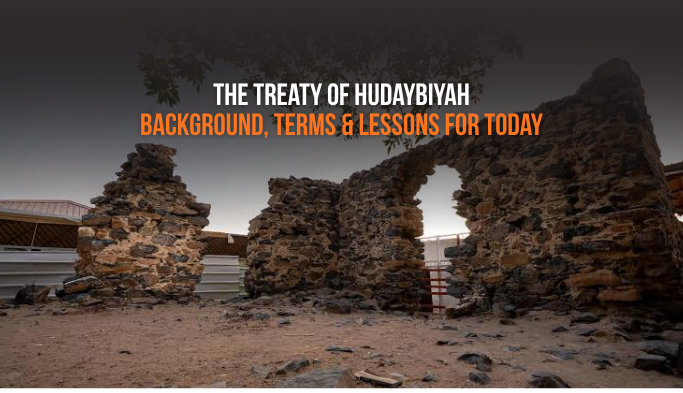
In Dhul Qa’dah of 6 AH — the very month we are in — one of the most consequential moments in early Islamic history unfolded not on a battlefield, but at a negotiating table in the dust outside Makkah. The Treaty of Hudaybiyah was an agreement that frustrated many of those who signed it, confused others who witnessed it, and has been studied ever since as one of the most instructive examples of strategic wisdom in the life of Prophet Muhammad (s).
It was a moment that asked the Muslims a difficult question: can you accept terms that look like a loss, trusting that the longer view belongs to Allah? The Prophet (s) answered yes. And within two years, Makkah was open.
The Journey That Led to Hudaybiyah
After the Hijrah of 622 CE, the Muslim community in Madinah had grown steadily in both size and strength. They had organized themselves into a functioning society, survived major battles — Badr, Uhud, the Trench — and endured the relentless hostility of the Quraysh. But one longing remained unfulfilled: access to the Ka’bah. The Quraysh controlled Makkah and denied the Muslims entry, cutting them off from the sacred house that stood at the heart of their faith.
In 628 CE (6 AH), the Prophet (s) received a dream in which he performed tawaf — the ritual circling of the Ka’bah. Interpreting this as a divine sign, he set out for Makkah with approximately 1,400 companions. They traveled as pilgrims: dressed in ihram, carrying only sheathed swords, their intention unmistakably peaceful. The Quraysh, however, were not persuaded. Fearing that the approaching Muslims — however they were dressed — might threaten their authority, they blocked the caravan at a place called Hudaybiyah, a short distance from the city. Conflict seemed close. Instead, negotiation began.
The Prophet (s) demonstrated, throughout these tense days, the qualities that Shia scholars consistently point to in his seerah: patience, calm, an ability to hold the long view without losing sight of immediate responsibilities. He sent envoys, received the Quraysh’s delegates, and engaged in the kind of respectful, firm dialogue that turns potential confrontation into agreement. Eventually, a Quraysh leader named Suhayl ibn Amr was designated to negotiate on behalf of Makkah, and after lengthy discussions, both sides put their names to a written pact.
The Terms — and Why They Stung
The conditions of the Treaty of Hudaybiyah were as follows. There would be a ceasefire between the Muslims and the Quraysh for ten years, with neither side attacking the other. The Muslims would not perform Umrah that year — they would turn back to Madinah and return the following year, staying in Makkah for no more than three days. During that return visit, they could carry weapons only if sheathed. Any tribe in Arabia was free to ally with either side. And most difficult of all: any Qurayshi who left Makkah to join the Muslims would be returned to the Quraysh, but the same obligation did not apply in reverse — a Muslim who went to Makkah would not be sent back.
The reaction among the companions was immediate and pained. The clause about returning Qurayshi converts was particularly hard to accept. Umar ibn al-Khattab voiced the frustration openly. Many felt they had given more than they had received. From the outside, the treaty looked like a concession — perhaps even a humiliation.
From a Shia perspective, this moment is deeply instructive. The Prophet (s) did not argue, did not yield to pressure from those around him, and did not allow short-term sentiment to override long-term wisdom. He had clarity about what the peace would make possible. Shia scholarship on this episode consistently emphasizes that sabr — patience — is not passivity. It is the strength to act with restraint when you understand that Allah’s plan extends beyond the horizon you can currently see. The Quran later described this treaty as a fath mubeen — a clear victory (Surah al-Fath, 48:1) — and the Muslims who had chafed at its terms came to understand why.
Two Years of Peace — and What They Built
The Muslims returned to Madinah. The following year, as agreed, they came back to Makkah, performed their Umrah, and spent three days in the city. They worshipped at the Ka’bah, met people, and demonstrated the spirit of Islam without the shadow of war. Beyond the pilgrimage itself, the period of ceasefire opened space that conflict had always closed.
With the threat of Quraysh attack removed, the Muslim community could focus inward and outward simultaneously. Administration, education, and social organization strengthened. Ambassadors were sent to the leaders of Persia, Byzantium, Egypt, and Ethiopia — the message of Islam now traveling beyond Arabia. Tribes that had been hesitant began to enter into alliances, and many converted not through military pressure but through exposure to the community’s way of life. The political recognition embedded in the treaty — the fact that the Quraysh had negotiated with the Muslims as equals — granted the young Muslim state a standing among Arabian tribes that no victory in battle had yet fully achieved.
For Shia thought, this period carries a lesson about the nature of growth: that a community rooted in knowledge, moral character, and patient leadership will expand in times of peace in ways that conflict alone can never produce.
The Breaking of the Treaty and the Opening of Makkah
The ten-year ceasefire did not reach its full term. After approximately two years, the Quraysh violated the agreement by supporting an attack on the Banu Khuza’ah, a tribe allied with the Muslims. The Prophet (s) gave the Quraysh the opportunity to honour the treaty or offer redress. They did neither.
In 630 CE, the Prophet (s) marched toward Makkah at the head of a large force. The city — which had denied him entry just two years earlier — was taken almost without bloodshed. He entered with dignity and declared a general amnesty. Those who had persecuted the early Muslims for over two decades were, for the most part, forgiven. This was the fulfilment of what the treaty had made possible: not a conquest driven by vengeance, but an opening driven by mercy.
The dream the Prophet (s) had received in 6 AH — of performing tawaf at the Ka’bah — was realized not in the year he set out, but in the year that followed his patience.
What Hudaybiyah Still Teaches
The Treaty of Hudaybiyah endures as a study in the relationship between wisdom and faith. It asks every believer: can you trust the plan when you cannot yet see the outcome? Can you accept a position that looks weak from the outside because you understand the strength it quietly builds? Can you negotiate without abandoning your principles, and hold your ground without resorting to force when force is not yet the answer?
These are not only historical questions. They are questions for families navigating conflict, for communities facing pressure, and for individuals whose goals require more patience than they expected. The Prophet’s (s) conduct at Hudaybiyah — calm, deliberate, confident in a wisdom that others could not yet fully share — remains a model for anyone who must act well in circumstances that feel unfair.
The month of Dhul Qa’dah, in which this treaty was signed, is one of the four sacred months of the Islamic calendar — a month in which Arabia itself once observed peace. Standing in this month, reflecting on Hudaybiyah, is an invitation to ask where in our own lives we are being called to patience rather than reaction, and to wisdom rather than immediate satisfaction.
For those who feel that call pulling them toward a deeper connection with the Prophet (s) and his household, our 2026 Iraq Ziyarat Packages offer a journey to the cities where that household is buried — Karbala, Najaf, Kadhimiya, and Samarra — the same family whose lives embodied, generation after generation, the lesson that Hudaybiyah first taught.
Visit: www.ziaratplanner.com





 04-Jun-2026