Two Reasons to Mark This Day
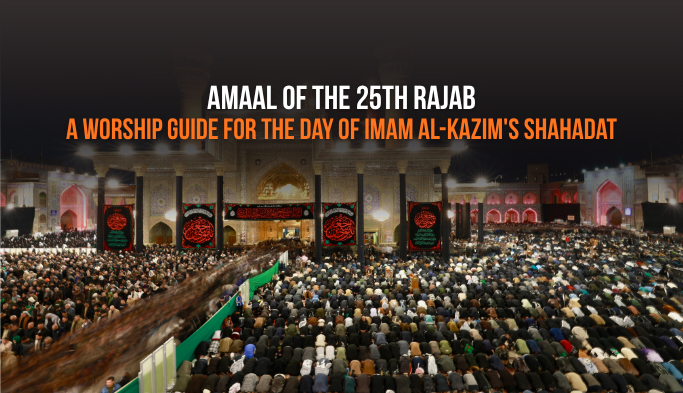
The 25th of Rajab carries a dual significance that makes it one of the most spiritually charged days of the month. It is the day of the Shahadat of Imam Musa al-Kazim (as) — the seventh Imam, martyred in Harun al-Rashid’s Baghdad prison — and it falls within Rajab itself, one of the four sacred months in which every act of worship carries heightened weight. The grief of the Shahadat and the blessing of the sacred month converge on this single day.
For a full account of the Imam’s life, his prison years, and his legacy, see our dedicated post on his Shahadat. What this guide addresses is the practical question: how do you spend this day in worship, in a way that honours both its mourning and its sacred-month blessings?
Acts Specific to This Day
Fasting
Fasting on the 25th of Rajab is among the most strongly recommended acts of this day. It serves simultaneously as an act of gratitude for being alive in a sacred month and as a form of solidarity with an Imam who spent years in prison, deprived of ordinary freedoms. The narration from Imam al-Kazim (as) himself — that fasting even one day in Rajab distances a person from Hell at the length of a year’s journey — applies here with added resonance on the day of his own martyrdom. Intend the fast before Fajr, and let the hunger be a form of mindfulness throughout the day. (Iqbal al-A’mal, Sayyid Ibn Tawus)
Ziyarat of Imam Musa al-Kazim (as)
Reciting the Ziyarat of Imam al-Kazim (as) is specifically recommended on this day. His son Imam Ali al-Ridha (as) said that visiting the grave of his father carries a reward like the reward of visiting the graves of the Prophet (s) and Imam Ali (as). (Al-Kafi, Shaykh al-Kulayni, vol. 4, p. 583) For those who cannot be at his shrine in Kadhimiya, reciting his Ziyarat text while facing his direction, with the full sincerity of presence, is the devotional equivalent. The Ziyarat text is available in Mafatih al-Jinan.
Dua for the Imam
After reciting Ziyarat, make personal supplication — asking Allah through the intercession of Imam al-Kazim (as), the one who bore years of unjust imprisonment with the prayer of gratitude still on his lips. He was known as Bab al-Hawa’ij — the Gateway of Fulfilled Needs — and today is the day to knock at that gate with whatever you carry.
The Great Supplication of Rajab
One of the most important acts of worship for the month of Rajab — recommended morning, evening, and after every prayer throughout the month — is a supplication transmitted by Imam Ja’far al-Sadiq (as) to Muhammad ibn Dhakwan, a devoted worshipper who wept in prostration so frequently that he lost his sight. The Imam (as) said: “Write and recite this every day of Rajab, morning and evening, as well as after your daily prayers.” (Iqbal al-A’mal, Sayyid Ibn Tawus)
The supplication begins:
يَا مَنْ أَرْجُوهُ لِكُلِّ خَيْرٍ وَآمَنُ سَخَطَهُ عِنْدَ كُلِّ شَرٍّ
يَا مَنْ يُعْطِي الْكَثِيرَ بِالْقَلِيلِ يَا مَنْ يُعْطِي مَنْ سَأَلَهُ
يَا مَنْ يُعْطِي مَنْ لَمْ يَسْأَلْهُ وَمَنْ لَمْ يَعْرِفْهُ تَحَنُّنًا مِنْهُ وَرَحْمَةً
أَعْطِنِي بِمَسْأَلَتِي إِيَّاكَ جَمِيعَ خَيْرِ الدُّنْيَا وَجَمِيعَ خَيْرِ الْآخِرَةِ
وَاصْرِفْ عَنِّي بِمَسْأَلَتِي إِيَّاكَ جَمِيعَ شَرِّ الدُّنْيَا وَشَرِّ الْآخِرَةِ
فَإِنَّهُ غَيْرُ مَنْقُوصٍ مَا أَعْطَيْتَ وَزِدْنِي مِنْ فَضْلِكَ يَا كَرِيمُ
Translation: “O You in whom I place all my hope for every good, and from whose displeasure I seek safety at every moment of evil. O You who gives abundantly for little offered. O You who gives to the one who asks You, and O You who — out of compassion and mercy — gives even to the one who does not ask and does not know You. Grant me, by my asking You alone, all the good of this world and all the good of the Hereafter, and turn away from me, by my asking You alone, all the evil of this world and the evil of the Hereafter. For there is no diminishment in what You grant — and increase me in Your grace, O Generous One.”
The full text of this supplication — which continues with the beautiful passage beginning “Ya dhal jalali wal ikram” — is in Mafatih al-Jinan in the Amaal of Rajab. It is one of the most treasured duas of the entire sacred month.
Istighfar Formulas for Rajab
The Prophet (s) described Rajab as the month of seeking forgiveness for his community. Classical sources transmit a number of specific istighfar prescriptions for the month, several of which are particularly recommended on its major days.
The 70-Times Morning and Evening Formula
Recite the following 70 times each morning and 70 times each evening throughout Rajab — a person who does this and dies in Rajab, according to the narration, will not be touched by Hellfire:
أَسْتَغْفِرُ اللهَ وَأَتُوبُ إِلَيْهِ
Transliteration: “Astaghfirullaha wa atubu ilayh” — “I seek Allah’s forgiveness and I turn repentantly to Him.”
After the 70 repetitions, raise your hands toward the sky and say:
اللَّهُمَّ اغْفِرْ لِي وَتُبْ عَلَيَّ
Transliteration: “Allahumma ighfir li wa tub ‘alayya” — “O Allah, forgive me and accept my repentance.”
The 100-Times Formula (For Martyrs’ Reward)
Reciting the following 100 times with charity given immediately after each set carries, according to the narration, the blessing of Allah’s mercy and forgiveness at death; reciting it 400 times is described as the reward of one hundred martyrs:
أَسْتَغْفِرُ اللهَ الَّذِي لَا إِلَٰهَ إِلَّا هُوَ وَحْدَهُ لَا شَرِيكَ لَهُ وَأَتُوبُ إِلَيْهِ
Transliteration: “Astaghfirullaha alladhi la ilaha illa Huwa wahdahu la sharika lahu wa atubu ilayh” — “I seek the forgiveness of Allah, besides whom there is no god, the One, without partner, and I turn to Him in repentance.”
(Mafatih al-Jinan, Shaykh Abbas Qumi)
The 1,000-Times Formula
Reciting the following one thousand times in Rajab carries the promise of forgiveness:
أَسْتَغْفِرُ اللهَ ذَا الْجَلَالِ وَالْإِكْرَامِ مِنْ جَمِيعِ الذُّنُوبِ وَالْآثَامِ
Transliteration: “Astaghfirullaha dhal jalali wal ikrami min jami’ al-dhunubi wal-atham” — “I seek the forgiveness of Allah, the Possessor of Majesty and Honour, from all my sins and offences.”
(Mafatih al-Jinan, Shaykh Abbas Qumi)
For Those Who Cannot Fast
If fasting is not possible — due to illness, travel, or other valid reasons — the classical sources transmit a glorification specifically for those in this situation, recited 100 times as a participation in the blessings of fasting in the sacred month:
سُبْحَانَ اللهِ وَالْحَمْدُ لِلَّهِ وَلَا إِلَٰهَ إِلَّا اللهُ وَاللهُ أَكْبَرُ وَلَا حَوْلَ وَلَا قُوَّةَ إِلَّا بِاللهِ الْعَلِيِّ الْعَظِيمِ
Transliteration: “Subhanallahi walhamdulillahi wa la ilaha illallahu wallahu akbar wa la hawla wa la quwwata illa billahi al-‘Aliyyi al-‘Azim” — “Glory be to Allah; all praise is for Allah; there is no god save Allah; Allah is the Greatest; and there is no might and no power except with Allah, the Most High, the Most Great.”
Follow this with salawat upon the Prophet (s) and his household:
اللَّهُمَّ صَلِّ عَلَى مُحَمَّدٍ وَآلِ مُحَمَّدٍ
“O Allah, send blessings upon Muhammad and the family of Muhammad.”
And seek forgiveness for oneself and the believers:
اللَّهُمَّ اغْفِرْ لِلْمُؤْمِنِينَ وَالْمُؤْمِنَاتِ
“O Allah, forgive the believing men and the believing women.”
Closing the Day at the Gateway
At Maghrib, if you are fasting, break it with gratitude and the awareness of what day it was. The Imam whose martyrdom this day marks spent his final years thanking Allah for the opportunity to worship from a prison cell. To have spent his Shahadat anniversary in voluntary fasting, reciting his Ziyarat, and turning to Allah in istighfar, is to have answered his example in the most fitting way available.
His title is Bab al-Hawa’ij — the Gateway of Fulfilled Needs. For those who wish to stand at that gateway in person, his shrine in Kadhimiya, Baghdad, is open. Our 2026–2027 Iraq Ziyarat Packages include Kadhimiya as a central destination, alongside Karbala, Najaf, and Samarra. Come and stand where the seventh Imam is buried — the one who taught us what it means to find freedom inside a prison.
Visit: www.ziaratplanner.com





 04-Jun-2026